

Does Insurance Cover Mold Remediation in Virginia? A Complete Homeowner's Guide
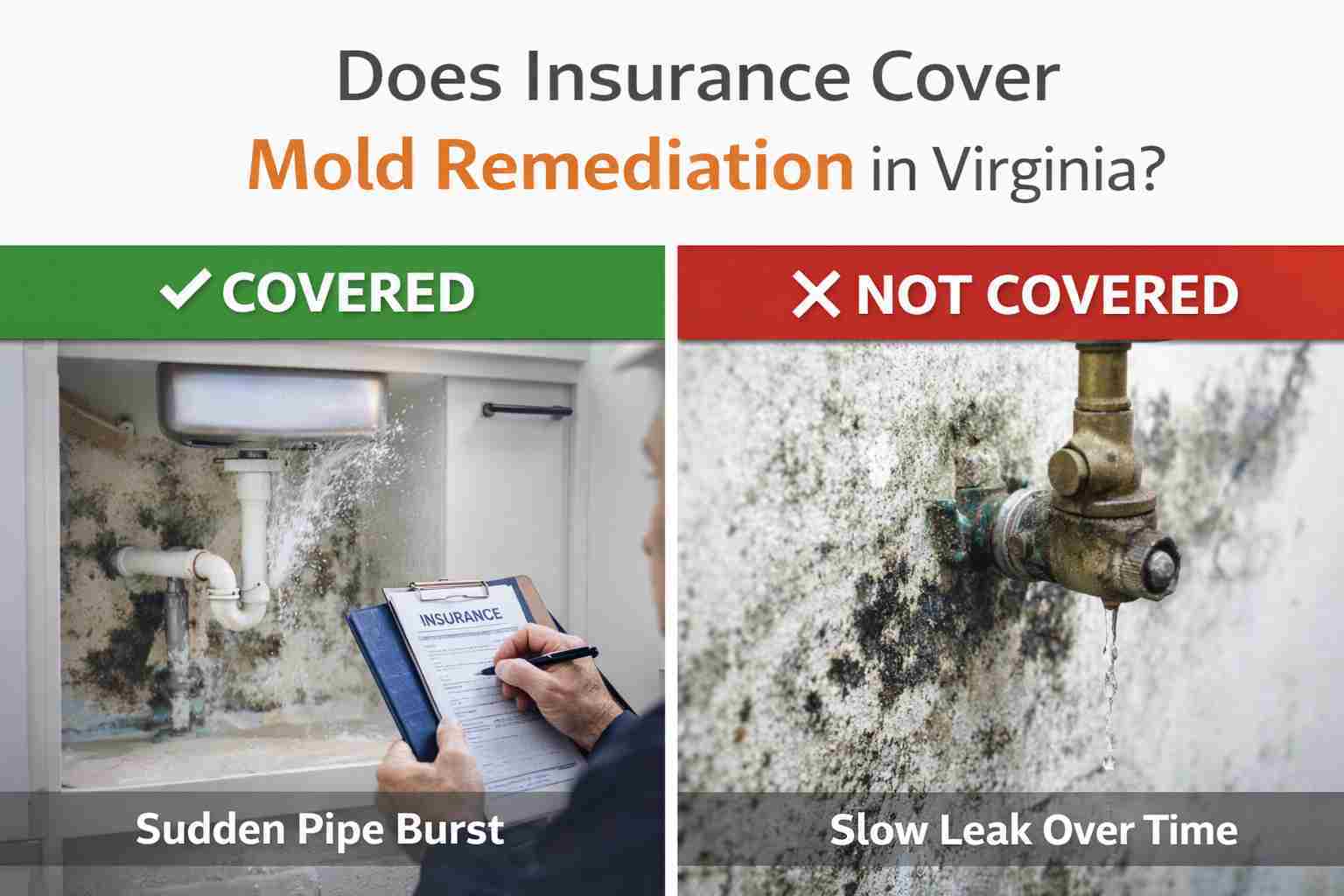
Mold is one of the most frustrating and expensive problems a Virginia homeowner can face — and one of the most confusing when it comes to insurance coverage. The short answer: homeowners insurance may cover mold remediation in Virginia, but only if the mold resulted from a covered peril, such as a burst pipe or sudden water damage. Slow leaks, flooding, and general neglect are almost always excluded.
This guide breaks down exactly when insurance pays, when it doesn't, how to file a mold insurance claim in VA, and what to do if your claim gets denied.
What Does Homeowners Insurance Actually Cover for Mold in Virginia?
Homeowners insurance in Virginia covers mold remediation when the mold is a direct result of a covered water damage event. The key word is sudden — insurers draw a hard line between accidental damage and ongoing neglect.
Virginia follows standard HO-3 policy structures, which most homeowners carry. Under these policies, mold remediation is covered when it stems from:
- Burst or frozen pipes — a sudden pipe failure during a winter cold snap that causes water intrusion and subsequent mold growth
- Accidental appliance overflow — a washing machine or dishwasher that malfunctions and leaks onto the floor
- Storm-related water intrusion — rain entering through a roof damaged by a covered windstorm or hail event
- Firefighting water damage — water used to extinguish a fire that later causes mold
In each of these scenarios, the mold is considered a secondary consequence of the covered peril, and your insurer should cover the remediation as part of the claim.
"In Virginia, homeowners insurance covers mold remediation only when the mold is a direct result of a sudden, covered water damage event — such as a burst pipe or accidental appliance leak. Slow leaks and flooding are not covered under standard policies."
When Is Mold NOT Covered by Insurance in Virginia?
Most mold claims in Virginia are denied because the mold resulted from a non-covered cause — typically long-term moisture problems, inadequate maintenance, or flooding. Understanding these exclusions before you file can save you significant time and frustration.
Common Exclusions That Void Mold Coverage
- Gradual leaks and seepage — A slow drip under a sink that you didn't notice for six months is considered a maintenance failure, not an accident. Insurers routinely deny these claims.
- Flood damage — Standard homeowners policies exclude flooding entirely. Mold from flood water requires separate flood insurance through the National Flood Insurance Program (NFIP) or a private flood policy.
- High indoor humidity and condensation — Mold caused by poor ventilation, HVAC issues, or chronic humidity is classified as a maintenance issue.
- Pre-existing mold — If an adjuster determines the mold predates your policy or the reported incident, coverage will be denied.
- Lack of timely reporting — Virginia homeowners who delay reporting water damage give mold time to spread and give insurers grounds to argue the damage was preventable.
⚠️ Virginia-Specific Consideration
Virginia's climate — with humid summers and cold winters — makes mold a year-round risk. Northern Virginia areas like Fairfax, McLean, and Arlington frequently see mold develop in crawl spaces and basements after seasonal freeze-thaw cycles. Insurers in this region are experienced at identifying whether damage is sudden or gradual.
Covered vs. Not Covered: Mold Scenarios at a Glance
Covered vs. Not Covered Mold Damage
How to File a Mold Insurance Claim in Virginia: Step-by-Step
Filing a mold insurance claim in VA successfully requires documentation, speed, and the right sequence of actions. Insurers look for reasons to limit payouts — your job is to eliminate every ambiguity before the adjuster arrives.
Step 1: Stop the Source of Water Immediately
Before anything else, stop the water. Whether it's a burst pipe, leaking roof, or appliance overflow — mitigate the damage. Virginia insurers can reduce or deny claims if they believe you failed to take reasonable steps to prevent further damage.
Step 2: Document Everything Before Cleanup
Take dated photos and videos of all visible mold, water damage, and the point of origin. Include wide shots and close-ups. Do not clean or paint over mold before the adjuster visits — this can void your claim.
Step 3: Call Your Insurance Company Promptly
Report the damage as soon as possible. Most policies require "prompt notification." Waiting weeks while mold spreads is one of the most common reasons VA mold claims are denied or reduced.
Step 4: Request a Mold Testing Report
Hire a certified industrial hygienist (CIH) to conduct a mold inspection and air quality test. This report establishes the extent of mold growth and is a powerful document when negotiating with your insurer.
Step 5: Get a Professional Remediation Estimate
Contact a licensed mold remediation company in Virginia to assess the damage and provide a written estimate. For homeowners in Northern Virginia, our teams serving Alexandria, Arlington, and Falls Church can provide same-day assessments.
Step 6: Work with the Insurance Adjuster
Be present during the adjuster's inspection. Share your photos, mold test report, and remediation estimate. Ask questions and take notes. If the adjuster's scope of work seems too limited, request a detailed explanation in writing.
Step 7: Consider a Public Adjuster or Attorney if Denied
If your mold insurance claim in VA is denied or underpaid, you have options. A licensed public adjuster can re-negotiate on your behalf. If the denial is in bad faith, a Virginia insurance attorney can advise on next steps.
Does Water Damage Mold Insurance Differ From Standard Mold Coverage?
Water damage mold insurance is not a separate policy — it refers to the mold coverage that activates when water damage from a covered peril is the root cause. Some insurers offer mold endorsements that expand standard coverage.
Virginia homeowners should review their policy for:
- Fungi/mold sublimits — Many HO-3 policies cap mold-related payouts at $5,000–$10,000 even when the water damage itself is fully covered. This is a critical limitation most homeowners don't discover until they file a claim.
- Mold endorsements — Some Virginia insurers offer optional mold coverage riders for an additional premium, which raise or remove the sublimit.
- Mold exclusion riders — Some policies add explicit mold exclusions. If your policy has one, standard water damage claims may not trigger any mold coverage.
"Many Virginia homeowners are surprised to find that even when water damage is covered, their policy's mold sublimit caps remediation reimbursement at just $5,000 to $10,000 — far less than the actual cost of professional mold removal in the Northern Virginia region."
What Does Mold Remediation Cost in Virginia — and What Will Insurance Pay?
Understanding the gap between actual remediation costs and insurance payouts helps you prepare financially. For a detailed breakdown, see our mold remediation cost guide for Virginia 2026.
Average Mold Remediation Costs vs. Insurance Payouts in Virginia
Mold Remediation Insurance Coverage by Area: Northern Virginia
Northern Virginia's dense housing stock, older homes, and seasonal weather patterns make mold a particularly common issue. Here's how coverage and risk vary by area:
Alexandria, VA
Alexandria's older row homes and colonial-era buildings often have aging plumbing and limited vapor barriers. Sudden pipe failures in winter are a leading cause of covered mold claims. Our Alexandria mold remediation team responds rapidly to emergency water events.
Arlington, VA
High-rise condos and mid-century homes in Arlington frequently see mold in HVAC systems and behind drywall after appliance leaks. Condo policies (HO-6) have different mold coverage rules than standard homeowner policies — always verify what your master policy covers. See our Arlington mold remediation services.
Fairfax, VA
Fairfax County's suburban homes with finished basements are highly susceptible to crawl space and basement mold after heavy rain — but remember, groundwater intrusion is not covered by standard policies. Our Fairfax mold remediation experts can help identify covered vs. uncovered sources.
McLean and Tysons, VA
High-value homes in McLean and Tysons often carry higher-limit policies with better mold endorsements. However, luxury finishes mean remediation costs can be significantly higher — always verify your sublimits match your home's actual risk.
Falls Church, VA
Falls Church homes built in the 1950s–1970s frequently have original plumbing that is prone to failure. A burst supply line in these homes can cause rapid mold growth within 24–48 hours. Our Falls Church mold remediation specialists are familiar with the local building stock and insurance documentation requirements.
"In Northern Virginia's older housing stock — particularly in Alexandria, Falls Church, and Arlington — mold from burst pipes and appliance leaks is one of the most common covered insurance claims. Acting within 24 hours of water damage is critical to preserving your coverage."
📚 Explore More: Related Mold Resources
- Complete Mold Remediation Services in Virginia — What professional remediation includes and how we work with your insurer
- Mold Remediation Cost Guide: Virginia 2026 — Detailed cost breakdowns, regional pricing, and what affects your final bill
- Mold Remediation in Alexandria VA
- Mold Remediation in Arlington VA
- Mold Remediation in Fairfax VA
Frequently Asked Questions: Mold Insurance Claims in Virginia
1. Does homeowners insurance cover mold remediation in Virginia?
Homeowners insurance covers mold remediation in Virginia only when the mold results from a covered peril — typically sudden water damage like a burst pipe or storm damage. Mold from flooding, slow leaks, or poor maintenance is generally excluded. Always check your policy for mold sublimits, which often cap payouts at $5,000–$10,000.
2. How do I prove mold damage is covered by my insurance?
To prove your mold claim, document the water damage event with dated photos, obtain a mold testing report from a certified industrial hygienist, and get a written remediation estimate from a licensed contractor. Establish a clear, documented link between the covered water event and the mold growth. Prompt reporting to your insurer strengthens your case significantly.
3. Will my insurance premium go up if I file a mold claim in Virginia?
Filing a mold insurance claim in VA may increase your premium at renewal, depending on your insurer and claims history. Some insurers also place mold exclusion riders on policies after a claim. Weigh the cost of remediation against potential premium increases before filing, especially for smaller claims near your deductible.
4. What if my mold claim is denied by my Virginia insurer?
If your mold insurance claim in VA is denied, request the denial in writing with the specific policy language cited. You can file a complaint with the Virginia Bureau of Insurance (BOI), hire a public adjuster to re-evaluate the claim, or consult a property insurance attorney. Many denials are reversed when supported by independent mold testing and documentation.
5. Does flood insurance cover mold remediation in Virginia?
NFIP flood insurance policies in Virginia do cover mold remediation when the mold results directly from flood water — but coverage is limited and subject to the policy's overall limits. Private flood insurance may offer broader mold coverage. Standard homeowners insurance does not cover flood-related mold under any circumstances.

