

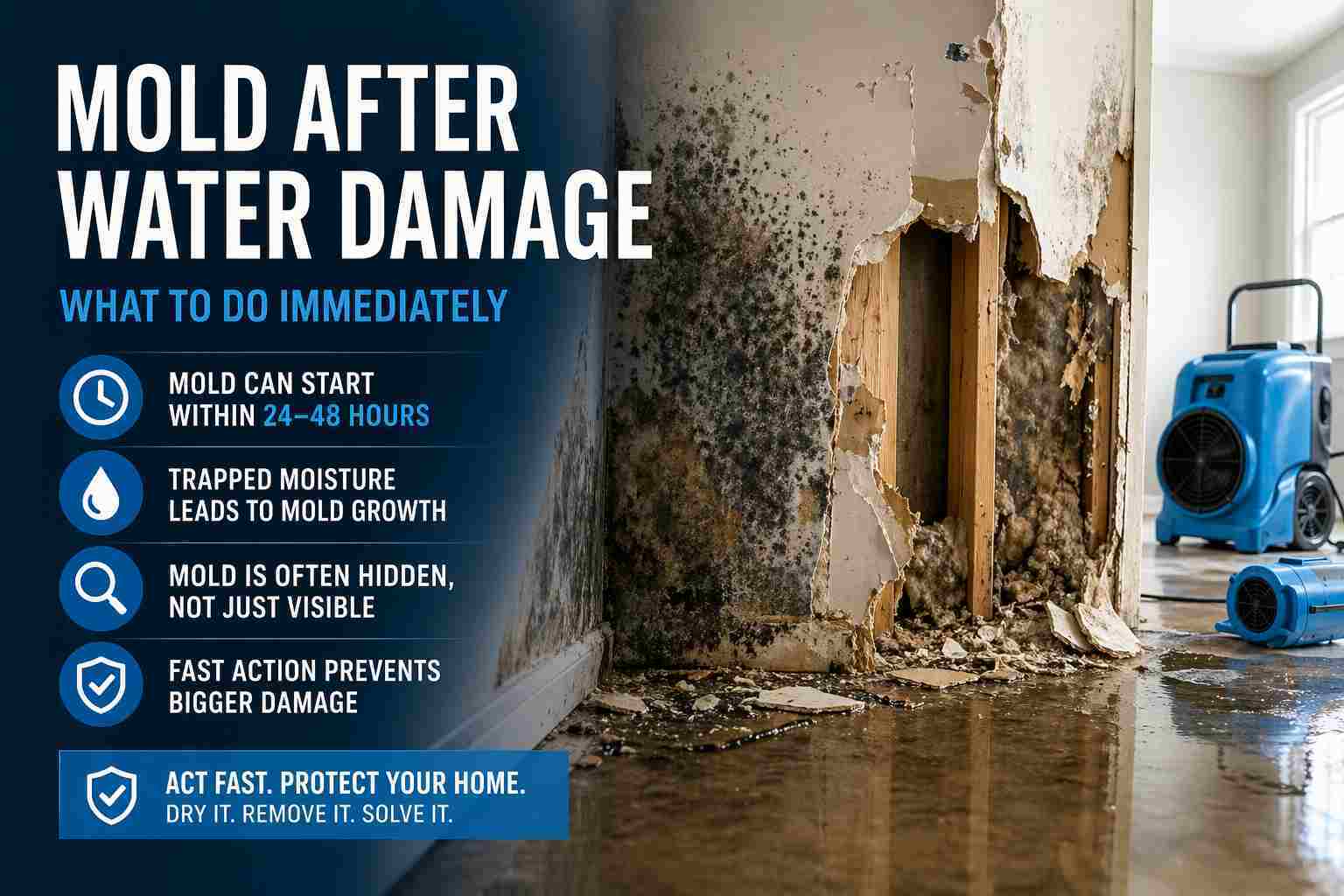
Mold After Water Damage: What to Do Immediately (VA Guide)
Quick Answer (TL;DR)
If you’re searching mold after water damage what to do, here’s the reality most contractors won’t explain clearly:
- You have 24–48 hours max before mold begins
- Surface drying is not enough if materials got wet
- If you smell anything musty — mold has already started
- Basement flooding almost always leads to hidden contamination
If water damage just happened, your first move is not cleaning — it’s proper structural drying like what’s done during water damage restoration.
What Actually Happens After Water Damage (And Why Mold Starts Anyway)
Most homeowners focus on what they can see: wet floors, soaked carpet, visible damage.
The real problem is what you don’t see:
- moisture inside drywall
- water trapped under flooring
- humidity inside wall cavities
- insulation holding moisture for days
Mold doesn’t need standing water — it needs trapped moisture and time.
That’s why even a small leak can turn into a full remediation job if it’s not handled correctly from the beginning.
Mold Growth Timeline (How Fast You Actually Lose Control)
Wet Drywall Mold Risk (The Most Common Hidden Failure)
Drywall is where most mold problems start.
Why drywall is a risk:
- absorbs water instantly
- paper backing feeds mold
- traps moisture internally
- dries unevenly (outside vs inside)
This leads to a dangerous assumption:
“it looks dry, so it’s fine.”
In reality, mold is often already growing inside the wall.
Signs of wet drywall mold risk:
- bubbling or peeling paint
- soft or uneven wall surface
- persistent musty smell
- discoloration
- cold or damp areas
If drywall stayed wet longer than 24–48 hours, it often becomes part of a mold remediation scope — not a drying job.
Basement Flooding Mold VA: Why Basements Are the Worst Case
Basements are the most common place where mold problems escalate in Virginia.
Why:
- poor airflow
- higher humidity
- concrete retains moisture
- water settles and stays longer
Finished basements (common in Fairfax, McLean, Falls Church) include drywall, insulation, and framing — all materials that support mold growth.
That’s why after flooding, proper drying is critical. Situations like this are typically handled through targeted services such as water damage restoration in Fairfax, where moisture inside structures — not just surfaces — is addressed.
Mold After Water Damage: What to Do Immediately (Step-by-Step)
1. Stop the Water Source
- shut off supply
- fix leaks or pipe issues
- prevent additional intrusion
2. Remove Standing Water
- pumps or wet vacuums
- remove soaked materials
- extract as much as possible
3. Start Structural Drying (Most Critical Step)
This is where most mistakes happen.
Drying is NOT:
- opening windows
- placing one fan
- waiting
Proper drying means:
- high airflow
- dehumidification
- opening wet cavities if needed
This is exactly what’s done during water damage restoration in Arlington.
4. Remove Materials That Cannot Be Saved
Trying to save everything leads to mold.
Common removals:
- drywall
- insulation
- carpet padding
- baseboards
5. Apply Antimicrobial Treatment
- treat exposed surfaces
- prevent further growth
Important: bleach does not penetrate porous materials.
6. Monitor for Mold
Even if everything looks fine, watch for:
- odor
- spots
- air quality changes
If these appear, you’re no longer preventing mold — you’re dealing with it, often requiring services like mold remediation in Arlington.
What NOT to Do After Water Damage
These mistakes lead directly to mold:
- waiting 24–48 hours
- assuming surfaces are dry
- not opening walls
- masking odor
- relying on bleach
Most remediation projects start with one of these decisions.
Signs Mold Is Growing Behind Walls
Hidden mold is more common than visible mold.
Watch for:
- persistent musty smell
- bubbling or peeling paint
- slight wall warping
- cold or damp spots
- recent leak history
If you notice multiple signs, assume internal contamination.
DIY vs Professional: Where the Line Is
If structure is involved, it’s not DIY anymore.
Cost of Mold Remediation in Virginia
For a full breakdown, see the Virginia mold remediation cost guide, or review a real project example in this Fairfax estimate guide.
Does Insurance Cover Mold After Water Damage?
It depends on the cause.
Covered:
- sudden incidents (pipe burst, appliance failure)
Not covered:
- long-term leaks
- maintenance issues
This is explained in detail in this Virginia insurance guide.
Mold Risk in Virginia Homes (Local Reality)
Virginia homes are more vulnerable due to:
- humidity
- older construction (Alexandria, Arlington)
- finished basements
- seasonal storms
That’s why local services like water damage restoration in McLean or mold remediation in Falls Church focus heavily on early intervention and prevention.
FAQ
How fast does mold grow after water damage?
Mold can begin growing within 24–48 hours after water damage. In humid regions like Virginia, the timeline is often even faster, especially when moisture gets trapped inside porous materials such as drywall, insulation, and wood.
But that short answer doesn’t capture the full picture. The speed of mold growth depends on where the water went, how quickly drying starts, and what materials are affected.
But that short answer doesn’t capture the full picture. The speed of mold growth depends on where the water went, how quickly drying starts, and what materials are affected.
What to do if mold already started?
If mold has already started after water damage, the priority is to stop the moisture immediately and prevent it from spreading. Fix the source of water (leak, flood, humidity), avoid disturbing the mold (no scrubbing or dry wiping), and isolate the affected area as much as possible. Surface cleaning alone is not enough — if materials like drywall or insulation are affected, they usually need to be removed because mold grows inside them, not just on top. Proper drying is critical at this stage, similar to what’s done during water damage restoration.
If the affected area is more than a small patch or you notice a musty smell, hidden spread is very likely. In that case, you’re already in a remediation scenario, not a cleanup — which typically requires controlled removal, antimicrobial treatment, and full structural drying, like in mold remediation. The key is speed: the longer mold sits, the more it spreads and the more expensive it becomes to fix.
If the affected area is more than a small patch or you notice a musty smell, hidden spread is very likely. In that case, you’re already in a remediation scenario, not a cleanup — which typically requires controlled removal, antimicrobial treatment, and full structural drying, like in mold remediation. The key is speed: the longer mold sits, the more it spreads and the more expensive it becomes to fix.
Can drywall be saved?
Sometimes — but in many cases, no. If drywall was exposed to water for more than 24–48 hours, it likely absorbed moisture internally, and that creates a high mold risk. Even if the surface looks dry, the inside may still be damp. In small, quickly dried areas it can be saved, but once moisture sits inside, removal is usually part of proper mold remediation.
Is mold always visible?
No — and that’s the problem. Most mold starts behind walls, under floors, or inside insulation, where you can’t see it. By the time it becomes visible, it’s usually already spread. Early signs are often indirect: musty smell, bubbling paint, or slight wall deformation.
Is mold dangerous?
It can be, especially with prolonged exposure. Mold may cause allergic reactions, respiratory issues, headaches, and irritation, particularly for children, elderly people, or those with asthma. Beyond health, it can also damage materials and structure over time. The risk depends on the type of mold, amount, and exposure duration — but ignoring it is never a good idea.
Final Thought
If water damage happened today — you’re already in the decision window. Wait, and it becomes mold. Act fast, and it stays manageable. Start with proper drying through water damage restoration, and if needed, move into mold remediation. Because in this situation, time decides everything.

