

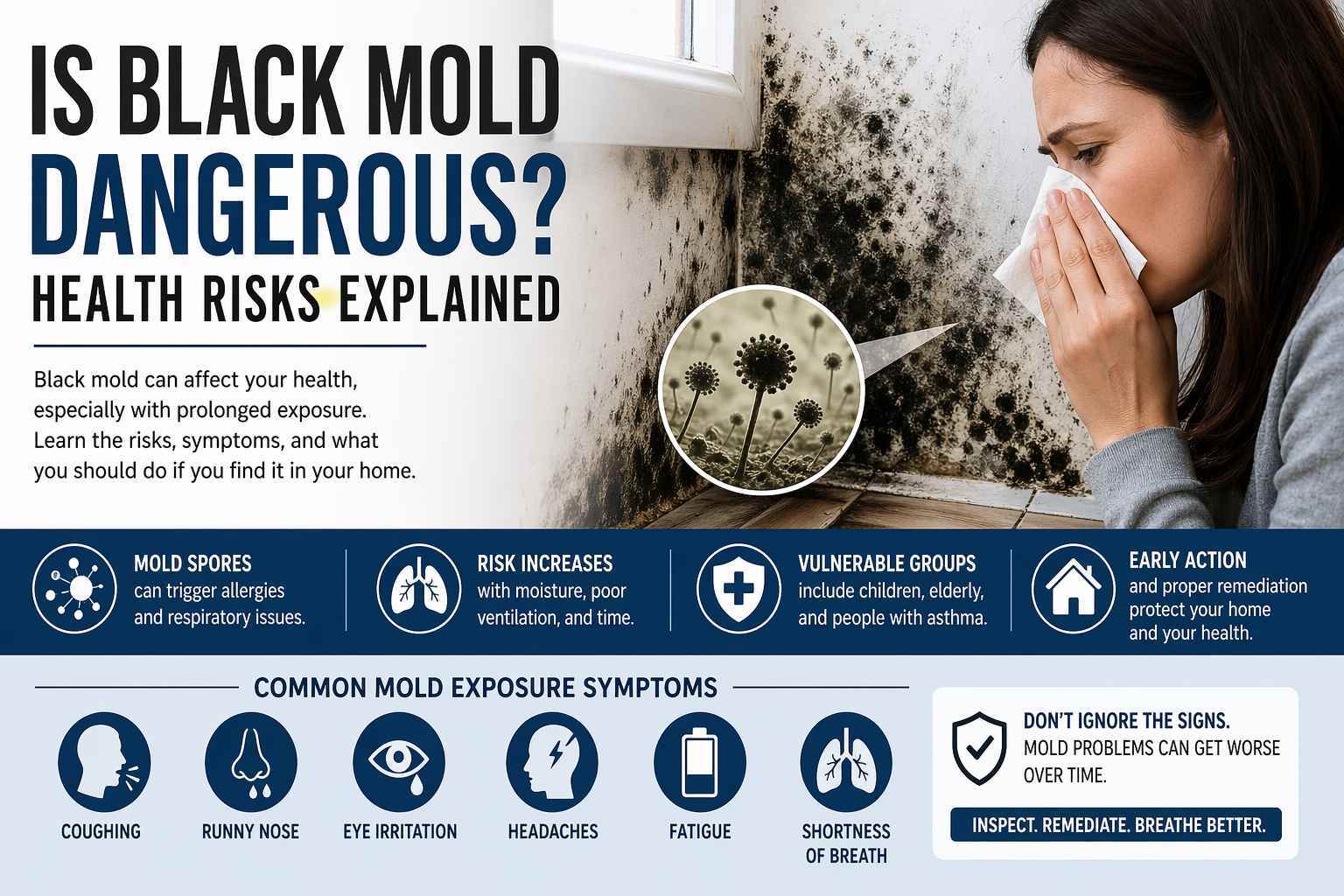
Is Black Mold Dangerous? Health Risks Explained
Yes, black mold can be dangerous—especially with prolonged exposure. It may cause respiratory issues, allergic reactions, and worsen existing conditions like asthma. The risk depends on exposure level, location of mold, and individual health.
Key Takeaways
- Black mold can produce toxins that affect indoor air quality
- Most healthy adults experience mild symptoms—but long exposure increases risk
- Children, elderly, and people with asthma are most vulnerable
- Mold after water damage is the most common cause in homes
- Removing visible mold is not enough if moisture is not fixed
What Is Black Mold?
Black mold usually refers to Stachybotrys chartarum, a moisture-loving mold that grows on:
- Drywall
- Wood
- Ceiling materials
- Insulation
It typically appears as dark green or black patches and is often found after water damage.
If your home had a leak or flooding, mold growth can start quickly. Here’s how that process works in real homes:
Is Black Mold Dangerous to Humans?
Short Answer
Yes—but the severity varies.
What Actually Makes It Dangerous
Black mold becomes a problem when:
Black mold is not dangerous simply because of its color or name. Its risk comes from a combination of biological, environmental, and exposure factors. Understanding these factors is key to evaluating real danger in your home.
1. Mycotoxin Production (Toxic Compounds)
Certain molds, including Stachybotrys chartarum, can produce mycotoxins—microscopic toxic substances released into the air or attached to spores.
These compounds can:
- Irritate the respiratory system
- Trigger inflammatory responses
- Affect immune function over time
Important:
Not every black mold colony produces high levels of mycotoxins—but when it does, prolonged exposure increases the risk of toxic mold exposure effects.
2. Airborne Spore Contamination
Mold reproduces by releasing spores into the air. These spores are:
- Invisible to the naked eye
- Easily inhaled
- Capable of spreading throughout the entire home
Once airborne, spores can circulate through:
- HVAC systems
- Air vents
- Open doorways
This is what turns a small localized issue into a whole-house air quality problem.
3. Hidden Growth (The Real Risk Factor)
The most dangerous mold is often not the one you see.
Black mold commonly grows in hidden areas such as:
- Behind drywall
- Inside ceilings
- Under flooring
- Around ductwork
This creates two problems:
- Continuous exposure without awareness
- Delayed response, allowing the colony to expand
That’s why surface cleaning alone rarely solves the issue.
4. Duration of Exposure
Exposure time is one of the biggest risk multipliers.
- Short-term exposure: usually mild symptoms (if any)
- Repeated exposure: increasing irritation and fatigue
- Long-term exposure: higher chance of respiratory issues and chronic symptoms
Many homeowners underestimate this because symptoms build gradually and are often mistaken for allergies.
5. Moisture Source (Root Cause)
Black mold cannot exist without moisture.
The real danger is not just the mold itself—but the ongoing moisture problem behind it, such as:
- Slow pipe leaks
- Roof leaks
- Condensation in walls
- Poor ventilation
If the moisture source is not fixed, mold will:
- Return after cleaning
- Spread deeper into materials
- Increase contamination over time
6. Individual Sensitivity
Not everyone reacts the same way to mold exposure.
High Sensitivity Groups
- Children
- Elderly
- People with asthma
- Individuals with weakened immune systems
Why This Matters
Two people can live in the same house:
- One may feel nothing
- The other may experience strong mold health symptoms
This variability makes mold especially tricky—it’s often underestimated until symptoms become noticeable.
7. Confined Indoor Environment
Outdoor mold exists everywhere—but indoor mold is different.
Inside a home:
- Air is recirculated
- Ventilation is limited
- Exposure is constant
This creates a concentrated environment, where mold spores and particles accumulate—especially in tightly sealed homes common in Northern Virginia.
Mold Health Symptoms You Should Not Ignore
Early Symptoms
- Sneezing
- Runny nose
- Itchy eyes
- Mild cough
Moderate Symptoms
- Headaches
- Fatigue
- Persistent coughing
- Skin irritation
Severe Symptoms
- Difficulty breathing
- Chest tightness
- Chronic sinus infections
- Worsening asthma
Symptom Severity by Exposure
Who Is Most at Risk?
High-Risk Groups
- Children
- Elderly
- People with asthma
- Individuals with weakened immune systems
Why It Matters
These groups are more sensitive because their bodies either react more aggressively to mold spores or struggle to clear them efficiently. For example, children have developing respiratory and immune systems, which makes them more reactive to airborne irritants. Elderly individuals often have reduced immune response and underlying conditions that make recovery slower. People with asthma or allergies already have inflamed airways, so even low levels of mold exposure can trigger symptoms like wheezing, coughing, or shortness of breath much faster than in healthy individuals.
In addition, individuals with weakened immune systems may not respond to mold in a typical way—they can experience more severe or prolonged symptoms because their bodies cannot effectively fight off the inflammatory effects. This means that what might be a minor irritation for one person can become a chronic health issue for another, even at relatively low exposure levels. That’s why mold risks at home in Virginia should never be evaluated based on visibility alone—who lives in the home is just as important as how much mold is present.
In addition, individuals with weakened immune systems may not respond to mold in a typical way—they can experience more severe or prolonged symptoms because their bodies cannot effectively fight off the inflammatory effects. This means that what might be a minor irritation for one person can become a chronic health issue for another, even at relatively low exposure levels. That’s why mold risks at home in Virginia should never be evaluated based on visibility alone—who lives in the home is just as important as how much mold is present.
Mold Risks in Homes (Virginia Focus)
Homes in Northern Virginia have higher mold risk due to:
- Humid summers
- Basement moisture
- Storm-related water damage
- Older housing structures
If you're in the DMV area, localized mold issues are common in:
Can Black Mold Kill You?
Clear Answer
In most cases—no.
But Here’s the Reality
- It can cause serious complications in vulnerable individuals
- Long-term exposure can worsen health significantly
- The biggest danger is ignoring it
How Black Mold Spreads Indoors
Common Causes
- Water leaks
- Flooding
- High humidity
- Poor ventilation
Hidden Mold Risk
Most dangerous mold is often:
- Behind drywall
- Inside ceilings
- Under flooring
This is why visible cleaning alone is not enough.
DIY vs Professional Mold Removal
When DIY Is OK
- Small area under 10 sq ft
- Surface-level mold
- No health symptoms
When You Need Professionals
- Strong odor
- Mold keeps coming back
- Health symptoms present
- Mold after water damage
Comparison Table
How Much Does Mold Remediation Cost?
Costs depend on:
- Size of affected area
- Location (walls, ceiling, HVAC)
- Severity
Full breakdown here:
Real estimate example:
Does Insurance Cover Mold?
Sometimes—but only if caused by a covered event (like a burst pipe).
Full explanation:
When Should You Take Action Immediately?
You should act fast if:
- Mold is spreading
- You smell strong musty odor
- You feel health symptoms
- Mold is near HVAC
Professional Mold Remediation Process
Typical steps:
- Inspection
- Containment
- Air filtration
- Removal of affected materials
- Antimicrobial treatment
- Drying and prevention
Final Answer — Is Black Mold Dangerous?
Yes, black mold is dangerous in certain conditions.
- It’s not always immediately harmful
- It becomes risky with prolonged exposure
- The real issue is untreated moisture
FAQ
Is black mold dangerous to breathe?
Yes. Breathing black mold spores can irritate the respiratory system and trigger allergy-like symptoms such as coughing, sneezing, and throat irritation. In some cases, especially with prolonged exposure, it can worsen asthma or lead to chronic respiratory issues. The risk increases in enclosed indoor environments where spores continuously circulate through the air.
How fast can black mold affect your health?
For sensitive individuals, symptoms can appear within 24–48 hours of exposure. For others, effects may develop gradually over days or weeks. The timeline depends on factors like spore concentration, ventilation, and personal health. Long-term exposure is more likely to cause persistent symptoms such as fatigue, headaches, and breathing difficulties.
Why are some people more affected by black mold than others?
Some groups are more sensitive because their immune or respiratory systems react more strongly—or recover more slowly—from exposure. Children have developing lungs, people with asthma already have inflamed airways, and those with weakened immune systems may struggle to clear mold particles from the body. As a result, even low levels of exposure can trigger stronger or longer-lasting symptoms.
Can you stay in a house with black mold?
It is possible, but not recommended—especially for long periods. Even if symptoms are mild at first, continuous exposure can lead to worsening health effects over time. If mold is present in living areas or near HVAC systems, it can spread throughout the home and affect overall indoor air quality.
Does bleach permanently remove black mold?
No. Bleach may remove the visible surface staining, but it does not penetrate porous materials like drywall or wood where mold roots grow. This means the mold often returns if the underlying moisture problem is not fixed. Effective removal requires addressing both the mold and the source of moisture.
What is the safest way to remove black mold?
The safest approach depends on the size and location of the problem. Small, surface-level areas may be handled carefully with proper protection. However, larger or hidden mold growth should be addressed through professional remediation, which includes containment, air filtration, removal of affected materials, and moisture control to prevent recurrence.

