

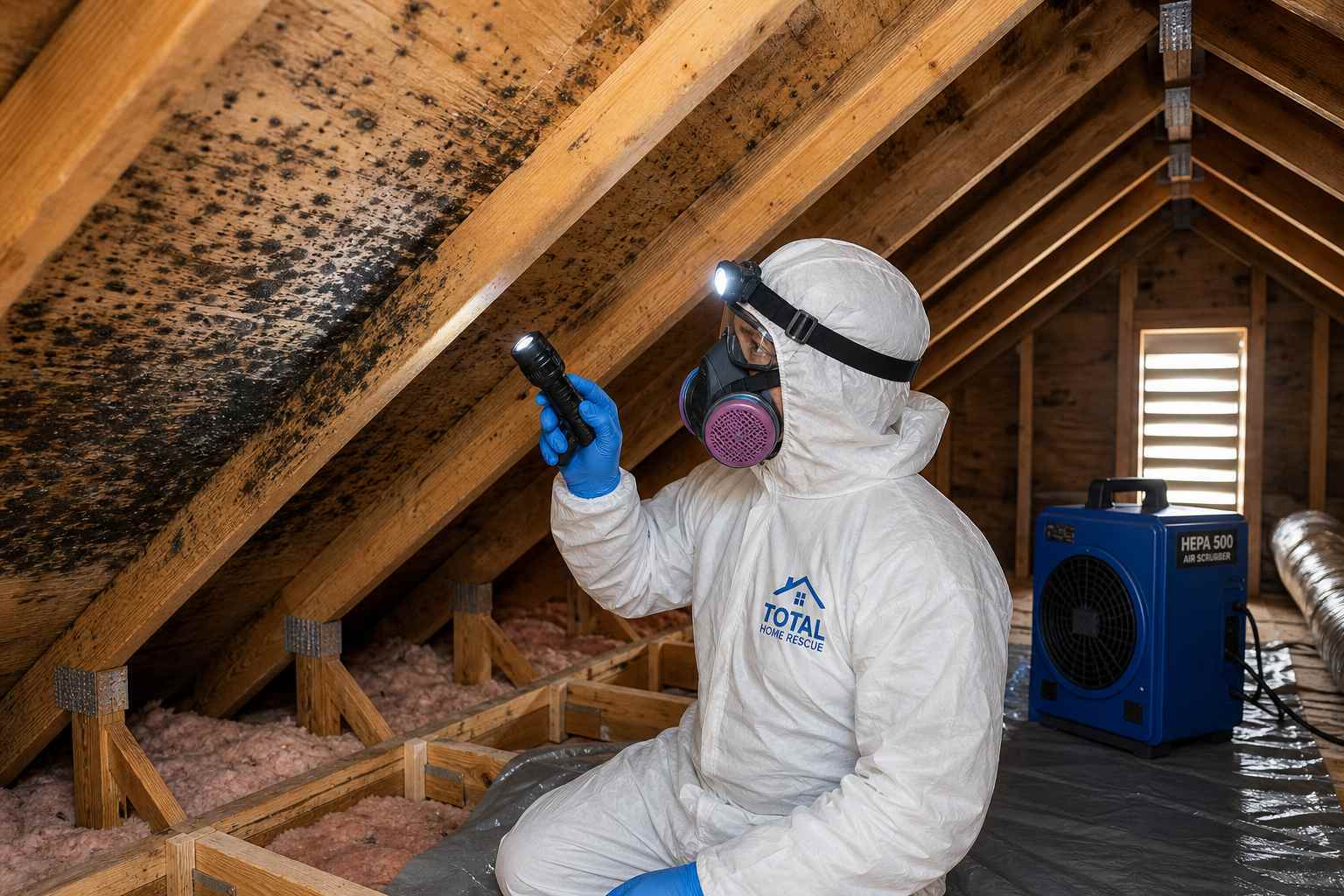
Attic Mold Removal in Northern Virginia: Causes, Cost & Remediation Steps
Attic mold removal in Northern Virginia is a common need for homeowners when moisture, condensation, roof leaks, or poor ventilation affect the attic space. In homes across Alexandria, Arlington, Fairfax, McLean, Tysons, Falls Church, and nearby DMV communities, attic mold is often discovered during a home inspection, roof inspection, insulation project, or after a homeowner notices a musty smell near the attic access.
The most common attic mold problems include mold on attic sheathing, mold on roof sheathing, mold on rafters, mold near bathroom fan exhaust lines, and attic condensation mold caused by poor airflow. Because attics are hidden spaces, mold can grow for months before anyone sees it.
Attic mold remediation VA services should not be treated as simple surface cleaning. If the moisture source remains active, mold can return after the visible growth is removed. A proper attic mold removal plan should include both remediation and prevention.
For a broader explanation of the full mold remediation process, read What Is Mold Remediation? Step-by-Step Process Explained.
What Is Attic Mold Removal in Northern Virginia?
Attic mold removal Northern Virginia refers to the process of identifying, containing, cleaning, removing, and preventing mold growth inside attic spaces. This may involve mold on attic sheathing, mold on roof sheathing, mold on rafters, mold on framing, mold near vents, or mold caused by attic condensation.
A proper attic mold remediation VA process usually includes:
- Visual assessment of affected attic areas
- Moisture source review
- Protection of access areas
- Containment when needed
- HEPA air filtration during disturbance
- Removal of affected porous materials if necessary
- Cleaning of attic sheathing, roof decking, rafters, or framing
- Antimicrobial treatment
- Final HEPA vacuuming or wipe-down
- Recommendations to prevent recurrence
Attic mold is different from a simple dirty attic problem. Mold needs moisture to grow. If the attic has condensation, poor airflow, wet insulation, or a roof leak, cleaning the visible surface without correcting the source may not solve the issue.
For homeowners who need direct service information, visit Mold Remediation and Attic Mold Removal.
Why Attic Mold Is Common in Northern Virginia Homes
Northern Virginia homes are exposed to humid summers, cold winters, heavy rain, and frequent temperature swings. These conditions can make attic mold more likely, especially when the attic has poor ventilation, blocked soffits, roof leaks, or warm indoor air leaking into the attic.
Many homes in Alexandria, Arlington, Fairfax, McLean, Tysons, and Falls Church have older attic systems, limited attic access, bathroom fans that were not properly vented outdoors, or insulation that blocks airflow. When moisture collects on wood surfaces, mold on attic sheathing or mold on roof sheathing can develop.
Common Northern Virginia attic mold conditions include:
- Bathroom exhaust venting into the attic
- Poor soffit intake ventilation
- Blocked ventilation baffles
- Ridge vents that do not move air properly
- Roof leaks around pipe boots, flashing, chimneys, or valleys
- Wet or compressed insulation
- Condensation on cold roof decking
- Air leaks around recessed lights, attic hatches, wiring, or duct chases
- HVAC duct condensation inside the attic
If your attic mold is connected to previous water damage, read Mold After Water Damage: What to Do Immediately
What Causes Mold on Attic Sheathing?
Mold on attic sheathing means mold has grown on the wood panels underneath the roof covering. This sheathing is often plywood or OSB. Wood is an organic material, so when it stays damp long enough, mold can grow on the surface.
Mold on attic sheathing is not always a sign that the roof structure has failed. However, it does mean the attic has had enough moisture to support microbial growth. The next step is to identify why that moisture is there.
Common causes of mold on attic sheathing include:
- Attic condensation mold from warm indoor air meeting cold roof decking
- Bathroom fans releasing humid air into the attic
- Poor attic ventilation
- Roof leaks
- Blocked soffit vents
- Missing or damaged ventilation baffles
- Wet insulation touching wood surfaces
- Air leakage from the living space below
Mold on roof sheathing often appears as black, gray, greenish, or patchy staining. It may be concentrated near the roof ridge, bathroom fan duct, north-facing roof plane, or roof leak area. If staining is widespread, the issue is often connected to attic ventilation mold or condensation rather than one small leak.
For more information about mold-related health concerns, read Is Black Mold Dangerous? Health Risks Explained.
Common Causes of Attic Mold
Attic Condensation Mold: Why It Happens
Attic condensation mold happens when warm, moist indoor air rises into the attic and touches cold roof sheathing. This is especially common in winter. When the roof deck is cold, moisture can condense on the underside of the sheathing. Over time, the wood may stay damp long enough for mold to grow.
This type of attic mold is often related to poor air sealing between the living space and attic. Gaps around ceiling fixtures, attic stairs, wiring penetrations, bathroom fans, recessed lights, and duct chases can allow warm indoor air to rise into the attic. Once that warm air meets cold roof sheathing, condensation can form.
Attic condensation mold can be confusing because there may be no obvious roof leak. The roof may look intact from the outside, but the attic can still have a moisture problem from indoor air movement and poor ventilation.
Common signs of attic condensation mold include:
- Dark staining on the underside of roof sheathing
- Mold growth across multiple roof deck areas
- Rusted roofing nails visible from inside the attic
- Frost or moisture during cold weather
- Musty odor near attic access
- Damp or compressed insulation
- Poor airflow near soffits
Attic condensation mold should be addressed carefully because cleaning alone may not prevent recurrence. The attic may also need ventilation improvements, air sealing, insulation correction, or bath fan exhaust correction.
Attic Ventilation Mold: Why Airflow Matters
Attic ventilation mold develops when air cannot move correctly through the attic. A balanced attic usually needs intake and exhaust. Intake commonly comes from soffit vents. Exhaust may come from ridge vents, roof vents, or gable vents.
When soffit vents are blocked by insulation or when roof ventilation is poorly designed, humid air can remain trapped. This creates conditions for mold on roof sheathing and rafters.
Signs of attic ventilation mold include:
- Mold spread across multiple roof sheathing areas
- Rusted roofing nails visible from inside the attic
- Condensation or frost during cold weather
- Musty smell near attic access
- Dark staining on the underside of the roof deck
- Warm, humid attic air
- Insulation pushed tightly against soffits
Preventing mold from returning often requires correcting ventilation and moisture movement, not just cleaning the wood.
For prevention strategies, read How to Prevent Mold Growth in Northern Virginia Homes.
Signs You May Need Attic Mold Removal
Homeowners often discover attic mold by accident. It may be found during a home inspection, roof replacement estimate, insulation upgrade, HVAC visit, or after a ceiling stain appears below the attic.
Common warning signs include:
- Visible mold on attic sheathing
- Dark staining on roof decking
- Mold on rafters or framing
- White, gray, black, or green surface growth
- Musty odor near attic access
- Wet or damaged insulation
- Bathroom fan duct ending in the attic
- Ceiling stains below attic areas
- Rusted nails under the roof deck
- Condensation or frost in the attic
- Mold found during a real estate inspection
If you are trying to understand whether mold may be hidden behind walls, ceilings, or attic materials, read 10 Signs of Hidden Mold in Your Home.
When Attic Mold Is More Than a Cleaning Problem
Attic mold removal in Northern Virginia should not be treated as a simple wipe-down service when the mold is connected to condensation, ventilation failure, roof leaks, or bathroom exhaust problems. If the moisture source remains active, mold on attic sheathing or mold on roof sheathing can return after cleaning.
A professional attic mold remediation VA plan should answer three questions.
1. Where is the mold?
The location matters. Mold near a bathroom exhaust duct may point to fan discharge problems. Mold spread across roof sheathing may point to condensation or ventilation issues. Mold near a roof penetration may suggest a leak.
2. Why did it grow?
The cause may be poor ventilation, roof leakage, condensation, wet insulation, or indoor air leakage. Without finding the cause, attic mold removal is incomplete.
3. How can it be prevented?
Prevention may require better ventilation, air sealing, insulation correction, roof repair, bath fan venting, or moisture control.
What Not to Do If You Find Mold in Your Attic
If you find mold on attic sheathing, roof decking, rafters, or insulation, avoid quick fixes that only hide the problem. Attic mold is usually connected to moisture, so the wrong approach can make the issue worse or allow it to return.
Do not:
- Paint over mold without proper cleaning
- Spray bleach on attic sheathing and assume the problem is solved
- Ignore bathroom fans that vent into the attic
- Cover wet insulation with new insulation
- Close off ventilation pathways
- Assume all attic mold comes from a roof leak
- Disturb large mold areas without containment or filtration
- Replace insulation before correcting the moisture source
The safest next step is to identify why the attic became damp, then create a remediation plan based on the actual source and affected materials.
Attic Mold Found During a Home Inspection
Attic mold is commonly discovered during a home inspection in Northern Virginia. Buyers may become concerned when an inspector reports visible mold-like growth, staining on roof sheathing, poor ventilation, wet insulation, or a bathroom fan terminating inside the attic.
If attic mold is found during a real estate transaction, homeowners should avoid delaying the issue. A clear remediation scope can help explain:
- Where the mold is located
- Whether insulation is affected
- What moisture source may be contributing to the problem
- What cleaning or removal steps are recommended
- Whether ventilation, exhaust, or roof repairs should be addressed
- What can be done before closing
For sellers, attic mold removal can reduce inspection objections and help prevent repair negotiations from becoming more expensive. For buyers, attic mold should be evaluated carefully so they understand whether the issue is minor, moderate, or connected to a larger moisture problem.
Attic Mold Removal Cost in Northern Virginia
Attic mold removal cost in Northern Virginia depends on the size of the affected area, the severity of growth, the materials involved, access conditions, insulation removal, containment needs, equipment use, and whether moisture source repairs are needed.
A small localized area of mold on attic sheathing may cost less than a large attic with widespread mold on roof sheathing and contaminated insulation. If the attic is difficult to access or has very low clearance, labor time can increase.
For a detailed pricing overview, read Mold Remediation Cost in Virginia.
These ranges are general estimates only. Actual pricing depends on the affected area, attic access, materials involved, moisture source, containment requirements, and whether insulation or repair work is needed.
If you need a written estimate, read How to Get a Mold Remediation Estimate in Fairfax VA.
Professional Attic Mold Remediation Steps
A proper attic mold removal Northern Virginia project should follow a structured process. The exact scope depends on the attic condition, but most professional projects include the following steps.
Step 1: Attic assessment
The contractor evaluates affected areas, checks visible mold patterns, reviews moisture indicators, and looks for likely sources such as roof leaks, bathroom fan discharge, blocked vents, or condensation.
Step 2: Source identification
The source must be identified before remediation is complete. If the cause is attic condensation mold, the solution may involve ventilation and air sealing. If the cause is a leak, roof repair may be needed.
Step 3: Work area protection
The access path should be protected before work begins. This may include covering floors, protecting walls near the attic entrance, and controlling debris.
Step 4: Containment
Containment helps reduce the spread of dust and mold particles. Depending on the attic layout, this may include plastic barriers, sealed access points, or negative pressure equipment.
Step 5: HEPA filtration
HEPA air scrubbers may be used during attic mold remediation, especially when cleaning mold on roof sheathing or removing affected insulation.
Step 6: Removal of affected porous materials
Wet, damaged, or contaminated insulation may need removal. Other porous materials may also require disposal if they cannot be cleaned properly.
Step 7: Cleaning mold from sheathing and framing
Mold on attic sheathing, rafters, and roof decking may be cleaned using methods appropriate for the material and severity. This can include HEPA vacuuming, wiping, controlled abrasive cleaning, or other professional remediation methods.
Step 8: Antimicrobial treatment
After physical cleaning, antimicrobial treatment may be applied to affected surfaces. This step should support the remediation process, not replace actual mold removal.
Step 9: Drying and moisture control
If materials are damp, drying may be needed. This may involve air movement, dehumidification, or waiting until the attic environment is dry enough for final treatment or insulation replacement.
Step 10: Prevention recommendations
A professional attic mold remediation plan should include recommendations for ventilation, roof repairs, insulation correction, bath fan venting, or air sealing as needed.
For guidance on selecting the right contractor, read How to Hire a Mold Remediation Company in Northern Virginia.
Can You Remove Attic Mold Yourself?
DIY attic mold removal is risky when mold covers a large area, insulation is affected, or mold is growing on roof sheathing. Attics are tight, dusty, and difficult to work in safely. Disturbing mold without containment and proper filtration can spread particles into other areas of the home.
A homeowner may also clean the surface but miss the cause. If attic condensation mold is caused by poor ventilation or air leaks, the problem can return. If a bathroom fan vents into the attic, the mold may return after every shower. If mold on roof sheathing is caused by a leak, the roof issue must be corrected.
DIY cleaning is not recommended when:
- Mold covers a large attic area
- Mold is on roof sheathing or rafters
- Insulation is wet or contaminated
- There is an active roof leak
- The attic has poor access
- The mold was found during a home sale inspection
- There are sensitive occupants in the home
- The source is unknown
Does Insurance Cover Attic Mold Removal?
Insurance coverage for attic mold removal depends on the cause and the policy. Mold caused by long-term humidity, poor ventilation, or maintenance issues may not be covered. Mold caused by a sudden and accidental covered water event may have a better chance of coverage, depending on policy terms and limits.
Examples that may affect coverage include:
- Sudden storm-related roof damage
- Plumbing leak affecting attic or ceiling areas
- Long-term condensation from poor ventilation
- Bathroom fan venting into the attic for months or years
- Delayed discovery after repeated moisture exposure
Every situation is different. Homeowners should review their policy and speak with their insurance carrier when mold is connected to water damage.
For more details, read Does Insurance Cover Mold Remediation in Virginia?
Attic Mold Removal by Northern Virginia Area
Attic Mold Removal in Alexandria VA
Attic mold removal in Alexandria VA is common in older homes, townhomes, and properties with limited attic access. Mold may appear on attic sheathing because of bathroom exhaust issues, older roof ventilation systems, or condensation during colder months.
Local page: Mold Remediation Alexandria VA.
Attic Mold Removal in Arlington VA
In Arlington VA, attic mold is often found during home inspections or roof evaluations. Older homes may have limited soffit ventilation, mixed roof designs, or older bathroom fan systems.
Local page: Mold Remediation Arlington VA.
Attic Mold Removal in Fairfax VA
Fairfax VA homes may experience attic condensation mold because of larger attic spaces, blocked soffits, uneven insulation, or roof leak issues.
Local page: Mold Remediation Fairfax VA.
Attic Mold Removal in McLean VA
In McLean VA, attic mold may be discovered in larger homes with complex rooflines, multiple attic sections, or ventilation limitations.
Local page: Mold Remediation McLean VA.
Attic Mold Removal in Tysons VA
Tysons VA properties may have attic mold related to ventilation, condensation, roof penetrations, or HVAC-related moisture.
Local page: Mold Remediation Tysons VA.
Attic Mold Removal in Falls Church VA
Falls Church VA homes often include older attic structures where poor airflow, insulation placement, or bath fan exhaust can contribute to attic ventilation mold.
Local page: Mold Remediation Falls Church VA.
How to Prevent Attic Mold from Returning
The best attic mold removal Northern Virginia solution is not just cleaning. It is preventing moisture from returning. Mold needs moisture to grow, so prevention should focus on ventilation, air sealing, leak control, and insulation performance.
Prevention steps include:
- Make sure bathroom fans vent outdoors
- Keep soffit vents open and unblocked
- Use baffles where insulation may block airflow
- Repair roof leaks quickly
- Seal air leaks around attic access, lights, wiring, and duct chases
- Replace wet or damaged insulation
- Check attic humidity and ventilation balance
- Inspect the attic after major storms
- Avoid storing damp items in the attic
- Schedule remediation if mold is visible or spreading
The goal is to make the attic drier, better ventilated, and less likely to support future mold growth.
FAQ: Attic Mold Removal in Northern Virginia
1. Is attic mold common in Northern Virginia?
Yes. Attic mold is common in Northern Virginia because the region has humid summers, cold winters, frequent rain, and many homes with older or imperfect attic ventilation systems. Mold may grow when warm indoor air enters the attic and condenses on cold roof sheathing. It may also develop from roof leaks, bathroom fans venting into the attic, blocked soffit vents, or wet insulation.
2. Should mold on attic sheathing be removed before selling a house?
Yes, in most cases, mold on attic sheathing should be addressed before selling a house. Attic mold can become a major issue during buyer inspections. Even if the mold is not affecting the living space, visible mold on roof sheathing can raise concerns about moisture, ventilation, roof leaks, and indoor air quality.
3. Can attic mold fail a home inspection?
Attic mold can create problems during a home inspection. Inspectors often report visible mold-like growth, staining on roof sheathing, wet insulation, poor ventilation, bathroom fans terminating in the attic, or signs of roof leakage. Visible attic mold can delay a sale, trigger repair requests, or require further evaluation.
4. Does painting or sealing attic mold work?
Painting or sealing over attic mold is not a proper substitute for remediation. Mold should be physically removed or cleaned using appropriate remediation methods before any coating is considered. If mold is simply covered, the underlying contamination and moisture issue may remain.
5. How much does attic mold removal cost in Northern Virginia?
Attic mold removal in Northern Virginia may range from a smaller localized project to a larger remediation job. Small areas may start around $750–$1,500+, moderate projects may fall around $1,500–$4,000+, and larger attic mold projects with widespread sheathing contamination, insulation removal, and difficult access may cost $4,000–$8,000+.
These are general ranges only. The actual cost depends on the affected area, access, contamination level, materials involved, containment, HEPA filtration, insulation removal, and whether roof or ventilation repairs are needed.
Final Takeaway
Attic mold removal Northern Virginia is not only about cleaning visible mold. It is about understanding why the mold appeared, removing contamination safely, and correcting the attic moisture conditions that allowed it to grow.
Mold on attic sheathing, mold on roof sheathing, attic condensation mold, and attic ventilation mold are all signs that the attic environment needs attention. A strong remediation plan should include assessment, containment, HEPA filtration, material removal when needed, surface cleaning, antimicrobial treatment, drying, and prevention recommendations.
For local attic mold remediation VA help, visit Total Home Rescue: http://totalhomerescue.pro/attic-mold-removal.

