

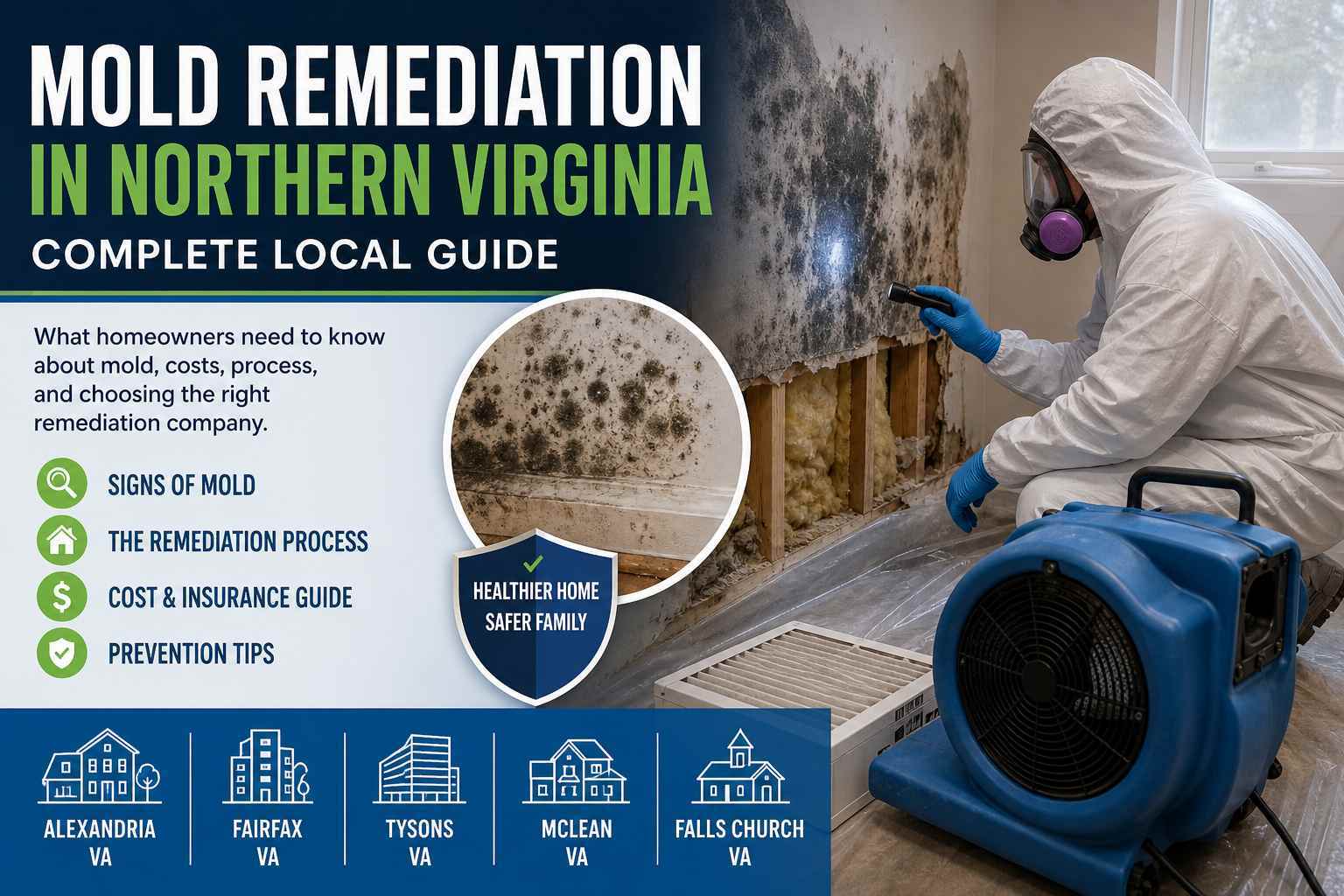
Mold Remediation in Northern Virginia: Complete Local Guide
Mold remediation Northern Virginia homeowners need is different from a simple cleaning job. In Alexandria, Fairfax, Tysons, McLean, Falls Church, Arlington, and nearby DMV communities, mold is often connected to hidden moisture, older building materials, finished basements, attic ventilation issues, HVAC condensation, plumbing leaks, storm damage, and humidity changes throughout the year.
The goal of professional mold remediation is not just to make a stain disappear. The real goal is to identify the affected area, control the moisture source, contain the work zone, remove contaminated materials when needed, clean the remaining surfaces properly, filter the air, and help prevent the problem from returning.
For homeowners, landlords, real estate agents, and property managers, this guide explains how mold remediation in Northern Virginia usually works, what signs to watch for, what affects the scope, and why local conditions matter.
For service information, you can also visit mold remediation Northern Virginia
What Mold Remediation Means
Mold remediation is the process of correcting a mold problem in a controlled and professional way. It may include containment, removal of affected porous materials, HEPA vacuuming, antimicrobial cleaning, air filtration, drying, and post-remediation cleanup.
Mold remediation Northern Virginia projects often involve more than one step because many homes in the area have mixed construction types: older brick homes in Alexandria, townhomes in Fairfax, condos in Tysons, luxury homes in McLean, and older properties in Falls Church. Each property can have different wall cavities, insulation, attic conditions, HVAC layouts, and moisture risks.
A helpful breakdown of the full process is available here: what is mold remediation step-by-step process.
Mold Remediation vs. Mold Cleaning
Mold cleaning usually means wiping or treating a visible surface. Mold remediation goes further. It addresses the condition that allowed mold to grow, removes contaminated materials when required, reduces airborne particles during the work, and helps bring the affected area back to a cleaner condition.
For example, wiping mold from drywall in a bathroom may make the wall look better for a short time. But if moisture is trapped behind the wall, the problem may return. Professional mold remediation is focused on the full affected area, not only the visible surface.
Why Mold Is Common in Northern Virginia Homes
Northern Virginia has a climate and housing mix that can create mold-friendly conditions. Humid summers, heavy rain events, aging plumbing, finished basements, crawl spaces, and attic temperature differences can all create hidden moisture.
Mold remediation Northern Virginia requests are often linked to:
- Slow plumbing leaks behind cabinets or walls
- Water damage that was dried too late
- Basement humidity and poor ventilation
- Roof or attic moisture issues
- HVAC condensation problems
- Bathroom exhaust fans that do not vent properly
- Window condensation and exterior wall cold spots
- Flooding or storm-related water intrusion
If mold appeared after a leak, review this related guide: mold after water damage Virginia.
Local Building Conditions Matter
Mold remediation Alexandria VA projects often involve older homes, tight wall cavities, basement moisture, and historic construction details. Mold remediation Fairfax VA projects may involve townhomes, single-family homes, and finished basements. Mold remediation Tysons VA work often includes condos, apartments, and high-rise building systems. Mold remediation McLean VA projects may involve larger homes with complex HVAC systems, attic areas, and finished lower levels. Mold remediation Falls Church VA projects often include older properties where leaks may stay hidden longer.
That is why a local remediation plan should not be copied from another property. The right scope depends on the source of moisture, the materials affected, the size of the impacted area, and whether mold is only visible on the surface or also present behind building materials.
Common Signs You May Need Mold Remediation
Not every dark stain is mold, but certain warning signs should be taken seriously. Mold can grow on drywall, wood framing, insulation, baseboards, cabinets, ceiling materials, and other surfaces when moisture is present.
Common signs include:
- Musty or damp odor
- Dark spotting on drywall, ceilings, trim, or framing
- Peeling paint or bubbling drywall
- Soft, swollen, or stained baseboards
- Water stains near ceilings or exterior walls
- Mold around HVAC vents or closets
- Condensation near windows
- Recurring stains after cleaning
- Allergy-like irritation that seems worse indoors
- Visible growth inside cabinets, closets, attics, or basements
For a deeper visual checklist, see signs of hidden mold in your home.
When Hidden Mold Is More Likely
Hidden mold is more likely when there was a past water event, even if the area now looks dry. Drywall can appear normal on the finished side while moisture remains inside the wall cavity, behind baseboards, under flooring, or around insulation.
In Northern Virginia homes, hidden mold is especially common after:
- A pipe leak inside a wall
- Water intrusion from a roof or window
- Basement seepage
- Toilet, tub, dishwasher, or refrigerator supply-line leaks
- Delayed drying after water damage
- Poor attic ventilation
- HVAC drain or condensation issues
If you are not sure whether a project requires cleaning, removal, or full remediation, the safest next step is a professional visual assessment and moisture evaluation.
Complete Mold Remediation Process in Northern Virginia
Professional mold remediation Northern Virginia work usually follows a structured process. The exact scope may change based on the property, but the workflow is generally consistent.
Step 1: Identify the Source of Moisture
Mold needs moisture. Before remediation begins, the moisture source should be understood as much as possible. This may involve checking plumbing, HVAC areas, bathrooms, attics, exterior walls, ceilings, windows, basements, or flooring.
If the moisture source is not corrected, mold can return even after professional remediation.
Step 2: Define the Affected Area
The affected area may be limited to one wall, one closet, a basement section, an attic area, or a larger space. A professional contractor may check visible materials, surrounding surfaces, moisture readings, odor, and damage patterns.
In some cases, exploratory removal may be needed to see what is behind drywall, baseboards, cabinets, or flooring.
Step 3: Set Up Containment
Containment helps prevent dust, mold particles, and demolition debris from spreading into clean areas. Depending on the scope, containment may include plastic sheeting, sealed work areas, negative air pressure, and controlled access.
This is especially important in occupied homes, apartments, townhomes, condos, and properties with shared HVAC systems.
Step 4: Use HEPA Air Filtration
A HEPA air scrubber can help filter airborne particles during remediation. In mold remediation Northern Virginia projects, air filtration is often used when materials are disturbed, drywall is removed, or an affected area is being cleaned.
For more detail about containment and filtration, see professional mold remediation process
Step 5: Remove Affected Porous Materials
Porous materials such as drywall, insulation, carpet padding, some ceiling materials, and certain wood products may need removal if they are contaminated or water-damaged. The decision depends on condition, location, visible growth, moisture level, and whether cleaning is realistic.
This step is not about unnecessary demolition. It is about removing materials that cannot be properly cleaned or saved.
Step 6: Clean Remaining Surfaces
After removal, remaining surfaces such as framing, subfloor, sheathing, or other structural materials may be HEPA vacuumed, cleaned, and treated as appropriate. The method depends on the material and the severity of growth.
Bleach is not a complete remediation strategy. It may discolor surface staining, but it does not solve contamination inside porous materials or correct the moisture condition.
Step 7: Dry the Area
Drying is critical. If the area is still damp, the mold risk remains. Depending on the project, drying equipment, dehumidifiers, or air movement may be needed.
Step 8: Final Cleanup and Rebuild Planning
After remediation, the area should be cleaned before rebuild. Rebuild may include insulation replacement, drywall installation, trim, flooring, painting, or other repairs. In some cases, remediation and rebuild are handled as separate phases.
HTML Table 1: Mold Remediation Process
Mold Remediation by Northern Virginia Location
Mold Remediation Alexandria VA
Mold remediation Alexandria VA projects often involve older homes, townhomes, basements, crawl spaces, and properties with prior leak history. In Old Town, Del Ray, Rosemont, Landmark, and surrounding areas, water intrusion may come from aging plumbing, exterior walls, window areas, roof issues, or basement moisture.
For local service details, visit mold remediation Alexandria VA.
Mold Remediation Arlington VA
Arlington properties include condos, apartments, older homes, and remodeled townhomes. Mold may appear after HVAC condensation, bathroom ventilation issues, pipe leaks, or water damage in shared building systems.
For Arlington service details, visit mold remediation Arlington VA.
Mold Remediation Fairfax VA
Mold remediation Fairfax VA projects often involve finished basements, laundry rooms, bathroom leaks, attic moisture, and water damage from supply lines or appliances. Fairfax homes may have larger finished spaces where moisture can travel behind baseboards and flooring.
For Fairfax service information, visit mold remediation Fairfax VA.
If you are planning a project and need to understand estimate structure, see mold remediation estimate Fairfax VA.
Mold Remediation Tysons VA
Mold remediation Tysons VA often involves condos, apartments, high-rise buildings, and commercial-style residential systems. Moisture can be connected to HVAC closets, shared walls, plumbing stacks, condensation, and unit-to-unit water events.
For local service details, visit mold remediation Tysons VA.
Mold Remediation McLean VA
Mold remediation McLean VA projects may include larger homes, finished basements, attic spaces, luxury interiors, and complex HVAC systems. When mold affects high-value finishes, the remediation plan should be precise, documented, and carefully contained.
For local service details, visit mold remediation McLean VA.
Mold Remediation Falls Church VA
Mold remediation Falls Church VA projects often involve older homes, additions, basements, bathrooms, and exterior wall moisture. Older materials and previous repairs can sometimes hide moisture problems until visible staining or odor appears.
For local service details, visit mold remediation Falls Church VA.
How Much Does Mold Remediation Cost in Northern Virginia?
The cost of mold remediation Northern Virginia homeowners should expect depends on the size of the affected area, the materials involved, containment needs, equipment, demolition, cleaning, disposal, drying, and whether rebuild is included.
A small, contained area may cost much less than a project involving multiple rooms, wall cavities, flooring removal, or attic contamination. The most accurate pricing requires a site-specific evaluation.
For a deeper pricing guide, see mold remediation cost Virginia 2026.
Factors That Affect Cost
Does Insurance Cover Mold Remediation in Virginia?
Insurance coverage depends on the cause of the mold and the policy language. Mold related to a sudden and covered water damage event may be handled differently than mold caused by long-term humidity, deferred maintenance, or an unresolved leak.
Many policies limit mold coverage, exclude certain causes, or require documentation showing the source and timeline of damage. Homeowners should review their policy and communicate with their adjuster.
For a more detailed explanation, read does insurance cover mold remediation Virginia.
Documentation Matters
Good documentation may include photos, moisture readings, affected areas, work scope, equipment use, material removal details, and completion notes. This is especially important when mold remediation Northern Virginia projects are connected to water damage claims.
Is Black Mold Dangerous?
The phrase “black mold” is commonly used by homeowners, but color alone does not identify the species or level of risk. Mold can appear black, green, gray, brown, white, or orange depending on the material and conditions.
Any visible mold growth inside a home should be handled seriously, especially when it affects drywall, insulation, HVAC areas, or occupied living spaces. People with asthma, allergies, immune concerns, or respiratory sensitivity may react more strongly to indoor mold conditions.
For a practical health-risk overview, read is black mold dangerous health risks.
How to Choose a Mold Remediation Company in Northern Virginia
Choosing the right contractor matters because poor remediation can spread contamination, miss hidden moisture, or lead to repeat growth. A good mold remediation company should explain the scope clearly, use containment when appropriate, discuss material removal, and document the work.
Before hiring a company, ask:
- Will the affected area be contained?
- Will HEPA air filtration be used when materials are disturbed?
- What materials are being removed and why?
- Is drying included if moisture is present?
- Is rebuild included or separate?
- How will the work area be cleaned before completion?
- Will photos or documentation be provided?
For a full contractor checklist, visit how to hire mold remediation company Northern Virginia.
How to Prevent Mold After Remediation
After mold remediation, prevention is about moisture control. The cleanest remediation job can fail if the source of moisture continues.
Homeowners in Northern Virginia should focus on:
- Fixing plumbing leaks quickly
- Keeping indoor humidity under control
- Using bathroom exhaust fans properly
- Checking attic ventilation
- Cleaning HVAC drain lines when needed
- Drying water damage quickly
- Watching for condensation around windows
- Inspecting basements after heavy rain
- Avoiding closed-up damp spaces
- Addressing roof and exterior leaks early
For a more complete prevention checklist, see how to prevent mold growth Northern Virginia.
HTML Table 3: Local Mold Risk Areas
When to Call a Professional
You should consider professional mold remediation when mold covers more than a small surface area, returns after cleaning, appears after water damage, affects porous materials, is inside walls or ceilings, or is located near HVAC systems.
Mold remediation Northern Virginia homeowners request is especially important when the affected area is in a bedroom, living room, basement, attic, nursery, apartment, rental property, or any area with repeated moisture.
Total Home Rescue helps homeowners and property managers with mold remediation, water damage restoration, and property restoration across Northern Virginia. To learn more, visit mold remediation services.
FAQ: Mold Remediation in Northern Virginia
1. What is mold remediation, and how is it different from mold removal?
Mold remediation is the professional process of correcting a mold problem by controlling the affected area, removing contaminated materials when needed, cleaning remaining surfaces, filtering the air, drying the space, and helping prevent mold from returning. Mold removal is often used as a general term, but in reality, mold spores are naturally present in the environment. The goal is not to promise that every microscopic spore is gone forever. The goal is to bring the affected indoor area back to a cleaner, safer, properly corrected condition.
In Northern Virginia homes, mold remediation may involve drywall removal, insulation removal, HEPA vacuuming, antimicrobial cleaning, containment, and drying. The scope depends on the source of moisture and the materials affected.
2. How do I know if I need mold remediation in Northern Virginia?
You may need mold remediation if you see visible growth, smell a musty odor, notice staining after a leak, have damp drywall or baseboards, or see mold returning after cleaning. Mold remediation Northern Virginia projects are often needed after roof leaks, plumbing leaks, basement seepage, HVAC condensation, or water damage that was not dried quickly.
If the mold is on porous materials like drywall, insulation, carpet padding, or unfinished wood, simple wiping may not be enough. A professional evaluation can help determine whether the affected materials can be cleaned or need removal.
3. How much does mold remediation cost in Alexandria, Fairfax, Tysons, McLean, or Falls Church?
Pricing depends on the size of the affected area, the type of materials, containment needs, equipment, labor, disposal, and whether rebuild is included. Mold remediation Alexandria VA may be different from mold remediation Fairfax VA or mold remediation Tysons VA because property types, access, building age, and moisture sources vary.
A small contained area may be relatively straightforward. A larger project involving multiple rooms, attic sheathing, flooring removal, wall cavities, or insulation may cost more. For a detailed cost breakdown, visit mold remediation cost Virginia 2026.
4. Does homeowners insurance pay for mold remediation in Virginia?
Sometimes, but not always. Coverage depends on the cause of the mold and the specific insurance policy. Mold connected to a sudden covered water damage event may have a better chance of coverage than mold caused by long-term humidity, neglected leaks, or maintenance issues.
Documentation is important. Photos, moisture readings, source information, affected materials, and written scopes can help clarify the claim. For more information, read does insurance cover mold remediation Virginia.
5. Can I clean mold myself, or should I hire a mold remediation company?
Small surface spots on non-porous materials may sometimes be cleaned by a homeowner. However, you should be careful if mold is widespread, inside walls, on drywall, on insulation, near HVAC systems, after water damage, or returning after cleaning.
Hiring a professional mold remediation company is usually safer when containment, demolition, HEPA filtration, moisture control, and documentation are needed. In Northern Virginia homes, mold problems often involve hidden moisture, so the visible stain may only be part of the issue.
For hiring guidance, visit how to hire mold remediation company Northern Virginia.
If you see visible mold, smell a musty odor, or recently had water damage, do not wait for the problem to spread. Total Home Rescue provides mold remediation Northern Virginia homeowners and property managers can rely on in Alexandria, Arlington, Fairfax, Tysons, McLean, Falls Church, and nearby areas.
Request help here: mold remediation Northern Virginia.

