

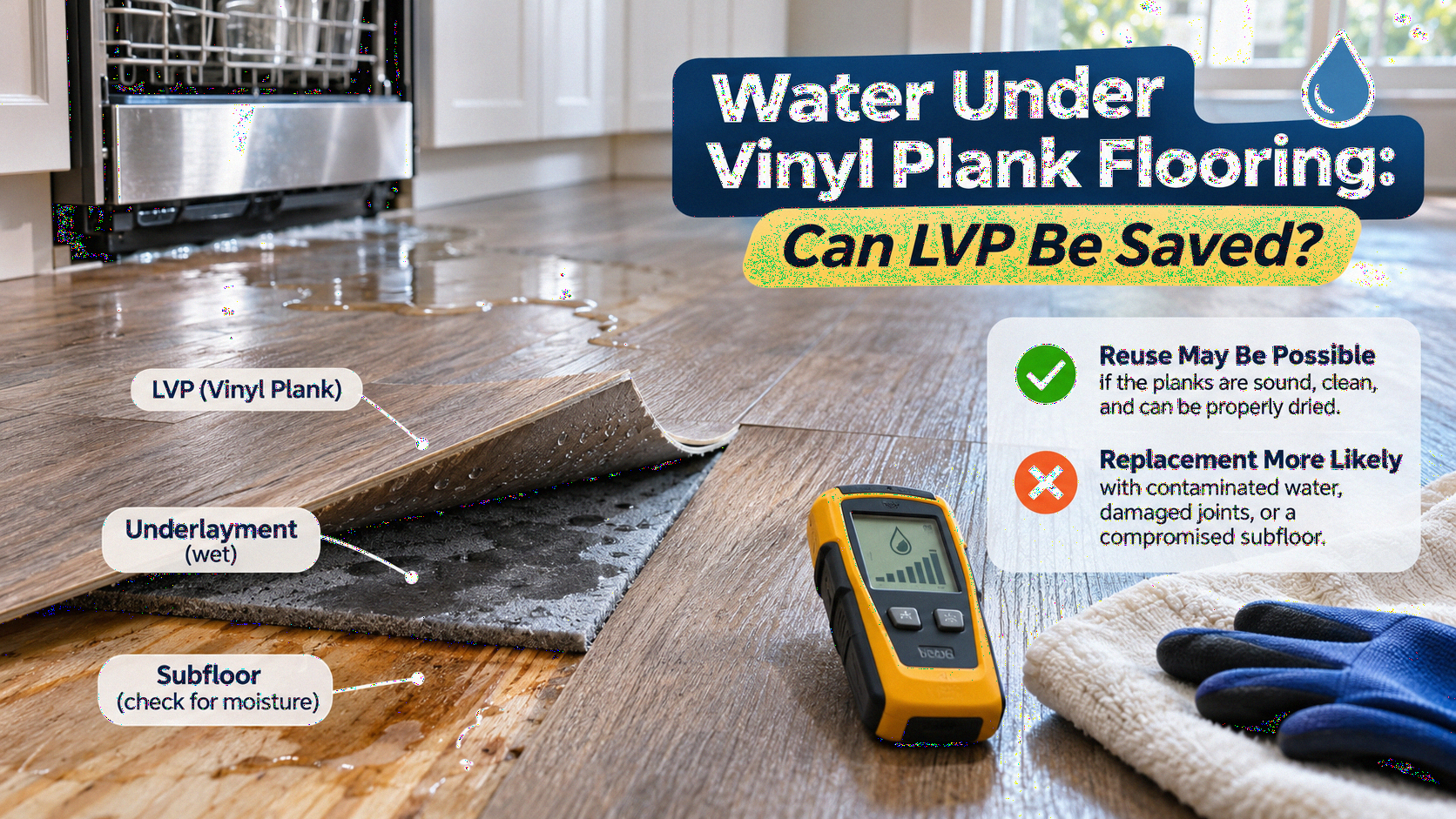
The dishwasher is fixed, the puddle is gone, and your luxury vinyl plank floor still looks perfect. Then you step near the kitchen island and water squeezes up through a seam. Where has it been hiding?
Water under vinyl plank flooring can damage the layers beneath an otherwise intact surface. Waterproof planks are not the same as a waterproof floor assembly. Moisture can travel beneath the boards, soak an underlayment, affect plywood or OSB, or stay trapped against concrete.
Quick Answer: Can Wet LVP Flooring Be Saved?
Sometimes. LVP may be reusable if the water source is controlled, the planks are undamaged and cleanable, the locking or adhesive system remains serviceable, and the subfloor can be dried to the manufacturer's requirements. Replacement becomes more likely with contaminated water, damaged joints, failed adhesive, deteriorated underlayment, or permanently damaged subflooring.
If you discover a leak:
- Stop the water source if it is safe; avoid wet electrical equipment and suspected sewage or floodwater.
- Photograph the leak, floor seams, transitions, baseboards, and adjoining rooms.
- Remove accessible standing water using suitable equipment and precautions. Never use an ordinary dry vacuum for water.
- Avoid repeatedly walking on areas that pump water through the seams.
- Have concealed moisture assessed if water reached the flooring edges or is suspected beneath the planks.
- Confirm that every retained layer is clean, sound, and adequately dry before reinstalling flooring.
Do not seal the perimeter or reinstall planks over a wet substrate.
Why Does Water Get Under “Waterproof” Vinyl Plank?
Manufacturers may describe LVP planks as waterproof because the product itself resists swelling or breakdown during typical water exposure. That description does not mean every seam, edge, and installation detail is watertight. Armstrong Flooring, for example, distinguishes waterproof flooring material from the subfloor beneath it, which can still be damaged by flooding.
Water can enter beneath LVP through an open perimeter, a doorway, appliance opening, plumbing penetration, damaged transition, or exposed edge. A refrigerator supply line or dishwasher can release water behind cabinetry before it becomes visible in the room. Water may then move laterally under a floating floor and emerge somewhere else.
If an appliance started the problem, see appliance leak water damage
Signs of Water Trapped Under Luxury Vinyl Plank
Water trapped under luxury vinyl plank may not produce immediate swelling or discoloration. Watch for:
- Water rising between joints when someone steps nearby.
- New squishing or sloshing sounds under a floating section.
- Damp shoe molding, baseboards, cabinet toe kicks, or transitions.
- Lifting corners, shifting boards, or gaps that appeared after the leak.
- Damp spots spreading into an adjoining room.
- A recurring musty odor, particularly after a known water event.
- Staining on a ceiling below an upstairs installation.
These clues are not diagnoses. Conversely, a floor can look normal while the underlayment is wet. The leak history and material measurements matter more than appearance alone.
The Installation Type Changes What Can Be Saved
Floating Click-Lock LVP
Click-lock planks form a connected floating surface. Some can be disassembled from an accessible edge, allowing examination of the backing and subfloor. Others are difficult to lift without damage, especially around cabinets, door jambs, and transitions.
Can You Reinstall the Same Planks?
Possibly. Check for permanent distortion, damage to attached pads, contamination, and manufacturer restrictions on reinstallation. Reusing a plank that cannot lock securely may leave an unstable or gapped floor, even when its top surface looks flawless.
Inspect the Locking Edges
Broken tabs can prevent a secure fit even when the surface looks intact.
Before the Floor Goes Back Down
The substrate must be suitable for that exact product's moisture, flatness, and underlayment specifications. Dry-looking plywood or concrete is not enough.
Glue-Down LVP
These planks depend on adhesive. Moisture can interfere with that bond, and pulling up planks may damage them or leave unusable adhesive residue. Replacement may be necessary even where the vinyl itself appears sound.
Attached Pad and Separate Underlayment
Wet underlayment may be the reason a floor cannot simply be put back together. Foam, cork, fiber, and other pads have different cleaning and drying properties. Whether a component can stay depends on its condition, contamination, and manufacturer requirements—not just whether it feels dry to the touch.
What Happens to Plywood, OSB, and Concrete Under LVP?
Plywood Subfloor
Plywood can absorb water at seams and exposed edges. A sound panel may dry and remain usable, but significant delamination, softness, or loss of strength requires further repair.
OSB Subfloor
OSB is particularly worth checking at panel edges, where swelling can leave permanent ridges. The relevant questions are whether it stays structurally sound, becomes sufficiently dry, and provides the flat surface the flooring needs.
Concrete Slab
Concrete can hold moisture and allow vapor movement even after surface water disappears. A concrete slab typically does not need replacement merely because it got wet, but ongoing slab moisture, floor coatings, adhesive compatibility, and the flooring manufacturer's testing requirements need attention.
There is no universal subfloor moisture number that applies to every LVP system. Confirm the correct test and allowable limits for the selected flooring and installation method.
For signs that wood or concrete layers need more work, see subfloor water damage
Can Water Beneath LVP Dry Without Removing Any Planks?
If a spill stayed on top, normal surface cleanup can be enough. But if water is known to be trapped below a relatively low-permeability covering, airflow across the top may accomplish little for the concealed layer.
Fans and dehumidifiers alone do not prove that a wet pad, plywood panel, or concrete interface underneath an intact floating floor has reached suitable conditions. Depending on the assembly, targeted access or removal of affected rows may be necessary for water extraction, cleaning, and drying.
Avoid drilling random holes through the planks, forcing hot air below them, or prying up boards without understanding how they lock together.
How Professionals Locate and Dry Hidden Floor Moisture
Professional water mitigation begins with the source and the material conditions, not an automatic decision to remove every plank.
- Identify the water source and timing. A recent supply-line discharge differs from wastewater, groundwater, or a leak that remained unnoticed.
- Map likely travel paths. Evaluate seams, doorways, cabinet bases, wall edges, neighboring rooms, and a ceiling below when relevant.
- Measure and inspect materials. Appropriate meters and comparative readings help identify affected areas.
- Establish access where needed. Carefully lift restorable floating planks, remove damaged underlayment, or open a portion of the assembly if concealed layers cannot otherwise be assessed or dried.
- Remove bulk water and address contamination. Use extraction and cleaning methods appropriate to the water source and the materials present.
- Dry restorable layers. Control airflow and humidity and monitor plywood, OSB, concrete, and nearby walls as appropriate.
- Verify and rebuild. Confirm material integrity, acceptable substrate conditions, and manufacturer requirements before installing retained or replacement planks.
Moisture distribution, contamination, floor layout, and the ability to preserve locking joints determine which approach makes sense.
For more detail on equipment and monitoring, read structural drying after water damage
When Is LVP Replacement Actually Necessary?
LVP replacement is more likely when the planks are distorted, their locking edges are broken, the adhesive fails, attached backing cannot be restored, or contamination prevents appropriate cleaning. Severe substrate damage may also require repairs before any flooring is installed.
A flooring contractor should review whether saved pieces can be reassembled to the product's requirements.
For the wider water damage restoration process, see water mitigation process
Does Water Under LVP Mean Mold Is Growing?
Not necessarily. Moisture can support mold on susceptible materials, including wood, dust, and some backing or wall materials, but a musty odor or stained seam does not prove mold is present or identify its species.
EPA advises drying water-damaged items and areas within 24–48 hours when possible to help prevent mold. That is a recommendation to act promptly, not an exact countdown to mold growth and not a guarantee that every floor can be dried in two days. An older or recurring leak deserves particular attention because the duration of concealed moisture may be unknown.
If visible growth or significant contamination is present, remediation may be needed before reconstruction. Learn about signs of hidden mold in your home
What Will It Cost, and Is Water Under LVP Covered by Insurance?
Costs depend on how much flooring was affected, the water source, installation type, access, underlayment condition, whether the subfloor remains sound, and the availability of matching planks. A limited clean-water leak with reusable boards can have a very different scope from wastewater beneath multiple rooms.
Homeowners insurance depends on policy terms and the cause of loss. Sudden accidental discharge may be considered differently from repeated seepage, excluded flooding, or maintenance-related moisture. A manufacturer's waterproof product warranty is not homeowners insurance, and it may not cover damaged subflooring.
Keep photos, source-repair findings, product details, moisture records, removal documentation, and itemized mitigation and reconstruction estimates. For practical documentation steps, see water damage insurance claim help
Water Under LVP: Help for Northern Virginia Homeowners
Homes in Alexandria, Arlington, Fairfax, McLean, Falls Church, Vienna, and nearby DMV communities have different floor systems, from floating LVP over plywood to glued-down products over concrete. The appropriate drying and reconstruction plan should follow the assembly and the extent of moisture.
Total Home Rescue provides water mitigation, structural drying, and reconstruction of water-damaged materials. A qualified plumber or appliance specialist should correct the original leak. For help with affected flooring, contact Total Home Rescue at 571-343-3444.
Frequently Asked Questions
1. Can waterproof LVP be saved after a dishwasher leak or a flooded room?
Sometimes. The fact that the plank is described as waterproof does not establish that its backing, underlayment, or substrate escaped damage. Armstrong Flooring specifically notes that its waterproof luxury vinyl products may be removable and reinstallable while the subfloor beneath them can still be harmed by flooding. That guidance does not mean every brand or installation can be reused.
A short, clean-water event with intact click-lock planks offers a different set of options from a prolonged leak, contaminated water, broken locking tabs, or glue-down adhesive failure. Planks should be evaluated for deformation, integrity, cleanliness, and compatibility with the original installation. Wet pads and underlying materials also need attention.
Before reuse, confirm that the water source is fixed, affected layers are appropriately dry and clean, and the flooring manufacturer allows reinstallation. Even perfect-looking planks should not be laid over an unverified wet substrate.
2. How do I know whether water is trapped under luxury vinyl plank flooring?
Watch for water appearing from seams when someone walks across the floor, newly damp baseboards, wet thresholds, squishing sounds, or unexplained moisture in an adjoining room. A persistent musty smell can justify inspection, but it is not proof of mold or of a specific water pathway.
The absence of obvious symptoms does not rule out trapped water. A low-permeability covering can hide damp underlayment or subflooring while the top looks clean and dry. A professional assessment can combine the leak history, likely travel paths, and moisture measurements appropriate for the materials. Sometimes selective access is required to evaluate the actual substrate rather than the surface.
If water visibly emerges through a joint after a known leak, stop treating it as a routine surface spill. Have the concealed layers checked before sealing transitions or installing new trim.
3. Can fans or a dehumidifier dry water under LVP without lifting the planks?
For water that remained entirely on top of an intact floor and was promptly removed, additional intervention may not be needed. Once water has moved beneath LVP, however, fans blowing across the surface cannot reliably reach the trapped moisture. Dehumidifiers reduce room humidity, but they do not prove that water beneath an underlayment or vapor barrier has been removed.
Professional drying may require lifting selected rows of floating LVP, removing wet underlayment, extracting accessible water, and drying exposed plywood or other restorable materials. Glue-down installations require a different assessment because adhesive may be compromised. Contaminated sources may require different cleaning and removal precautions.
Do not try improvised heating, drill holes into the floor, or pry up boards without understanding the locking system. Final moisture verification and manufacturer installation requirements matter more than a predetermined drying time.
4. Does a wet plywood, OSB, or concrete subfloor need to be replaced?
Not automatically. Sound plywood and OSB may be dried and retained if they remain structurally stable, can be appropriately cleaned, and reach conditions suitable for the planned flooring. Severe swelling, delamination, soft spots, crumbling edges, or loss of strength may require replacing damaged sections. Drying cannot reverse permanent physical deterioration.
Concrete usually does not require replacement merely because it absorbed water. The concern is whether a leak or ongoing vapor source leaves moisture conditions incompatible with the LVP or adhesive. Manufacturer-specified substrate testing must guide reinstallation rather than an invented universal moisture limit.
Underlayment is a separate question. A contaminated or deteriorated pad may need replacement even when the wood or concrete beneath can remain. The correct scope should preserve sound materials while preventing moisture from being trapped under the restored floor.
5. How much does LVP water damage restoration cost, and will insurance pay?
There is no responsible fixed price without a material assessment. Cost depends on the water source, rooms affected, how the planks were installed, whether joints survive removal, the state of the subfloor, and any cleaning, drying, or reconstruction required. Matching materials can also affect the work if a plank design has been discontinued.
A useful estimate separates source repair, emergency water removal, material inspection, selective removal, drying, and floor reinstallation or replacement. Ask what evidence supports the decision to discard or retain materials. Photographs, moisture records, and product information help explain the scope.
Insurance coverage depends on the actual policy and the cause of loss. Sudden plumbing discharge may be handled differently from long-term seepage, floodwater, or maintenance issues. Product warranties are separate. The insurance carrier makes the coverage decision; no contractor can promise payment.
Final Takeaway
Water under vinyl plank flooring is primarily a question about the entire floor assembly, not just the visible planks. The LVP may be reusable when it remains sound and the concealed layers can be cleaned and dried. Stop the source, check the underlayment and substrate, verify conditions, and only then decide what needs to be replaced.

