

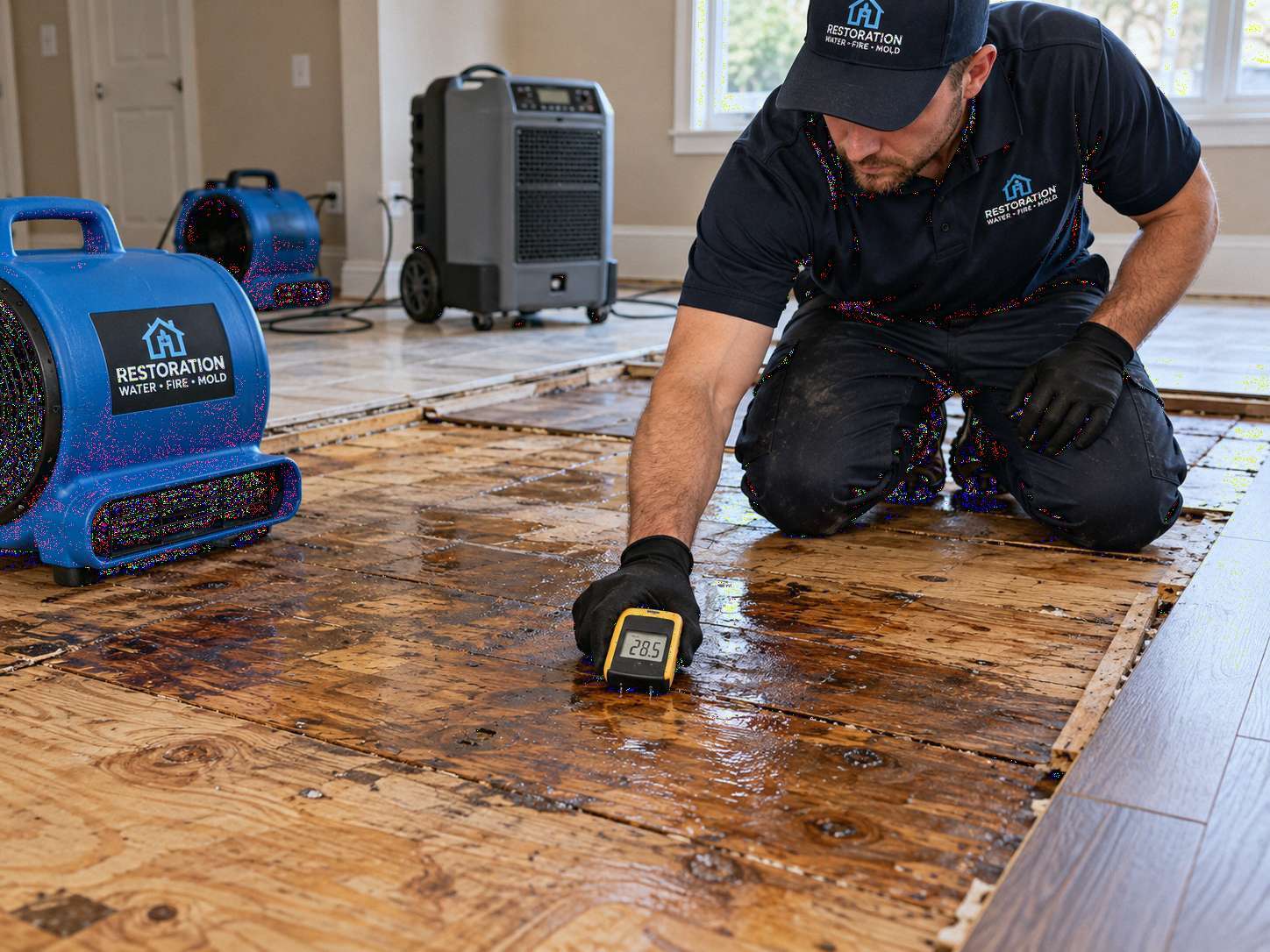
Subfloor water damage does not automatically mean the subfloor must be replaced.
A wet plywood or OSB subfloor can often be dried when the material remains structurally sound, the water source is stopped, and moisture can be properly exposed to airflow and dehumidification. Replacement becomes necessary when water has caused permanent physical damage such as severe swelling, delamination, soft spots, crumbling edges, or loss of structural strength.
The key distinction is simple:
Moisture can often be dried. Permanent material damage cannot.
A proper evaluation of a water damaged subfloor should consider:
- Whether the material is plywood or OSB
- Where the water came from
- How long the material remained wet
- How deeply the floor assembly became saturated
- Whether the panel is swollen or distorted
- Whether plywood layers are separating
- Whether the floor feels soft or unstable
- Whether moisture is trapped beneath finished flooring
- Whether the subfloor can be exposed from above or below
If the panel remains solid and moisture readings steadily improve, drying may be sufficient.
If the panel has permanently lost strength or shape, subfloor replacement after leak damage is usually the more appropriate repair.
Quick Answer: Can a Wet Subfloor Be Dried?
Yes. A wet subfloor can often be dried rather than replaced.
Drying is most realistic when:
- The water source was stopped quickly
- The subfloor remains firm
- Swelling is limited
- Plywood layers remain bonded
- OSB edges have not severely deteriorated
- The water source was not heavily contaminated
- Flooring above the subfloor can be removed or opened
- Moisture readings continue to decrease
Replacement becomes more likely when the subfloor is:
- Soft or spongy
- Delaminated
- Severely swollen
- Crumbling
- Permanently bowed
- Unable to hold fasteners
- Structurally unstable
- Significantly contaminated
For a broader explanation of trapped moisture below finished flooring see water damage under flooring
What Is a Subfloor?
A subfloor is the structural flooring layer installed over floor joists and underneath the finished floor.
Common finish materials installed over it include:
- Hardwood
- Laminate
- Carpet
- Luxury vinyl plank
- Tile
- Engineered flooring
Most modern residential subfloors are made from:
- Plywood
- OSB
- Older plank systems in some homes
The subfloor gives the finished floor structural support and distributes loads across the joists.
That is why subfloor water damage is more serious than a cosmetic stain on the finished floor.
How Does a Subfloor Get Wet?
A subfloor can become wet after many common household water losses, including:
- Dishwasher leaks
- Refrigerator supply-line leaks
- Washing machine leaks
- Toilet failures
- Shower or tub leaks
- Burst pipes
- Water heater failures
- Basement flooding
- Hidden plumbing leaks
For appliance-related losses see appliance leak water damage
For pipe failures see burst pipe water damage
Water Often Travels Beyond the Visible Leak
A leak does not stay neatly around its source.
Water may travel:
- Along panel seams
- Beneath floating floors
- Under cabinets
- Through underlayment
- Into adjacent rooms
Finished Flooring Can Hide the Problem
The floor surface may appear dry even while the subfloor underneath remains wet.
Panel Edges Can Absorb More Water
Seams and cut edges often show swelling before the middle of the panel.
Hidden Moisture Should Be Verified Before Repairs
Replacing flooring without checking the subfloor can trap unresolved moisture underneath the new installation.
Signs of Subfloor Water Damage
Some symptoms appear before the finished flooring is removed.
Common warning signs include:
- Soft spots
- Spongy movement
- New squeaking
- Uneven flooring
- Raised seams
- Buckling
- Swollen flooring edges
- Musty odor
- Loose flooring
- Persistent moisture readings
Why a Soft Floor Is a Major Warning Sign
A floor that feels soft or unstable after a leak may indicate that the subfloor has lost strength.
This is different from simply having elevated moisture.
Drying can remove water.
It cannot rebuild severely deteriorated wood fibers or re-bond separated layers.
How Is a Wet Subfloor Evaluated?
A professional inspection usually combines moisture testing with physical evaluation.
Methods may include:
- Moisture meters
- Infrared imaging as a screening tool
- Removing selected flooring
- Inspecting seams and edges
- Checking the underside from a basement or crawl space
- Comparing the affected area with dry reference materials
For more information see hidden water damage detection
Moisture Readings Are Only Part of the Decision
A high reading confirms that the subfloor is wet.
It does not automatically prove the material needs replacement.
The panel must also be evaluated for:
- Strength
- Flatness
- Swelling
- Delamination
- Surface deterioration
- Drying progress
Plywood Subfloor Water Damage: Can It Be Dried?
Plywood subfloor water damage can often be successfully dried when the exposure is limited and addressed quickly.
Plywood consists of multiple veneer layers bonded together.
After water exposure, plywood may:
- Absorb moisture
- Swell slightly
- Warp
- Develop veneer separation if severely saturated
When Wet Plywood May Be Saved
Drying may be reasonable when:
- The panel remains rigid
- Layers remain bonded
- Edges are intact
- Swelling is limited
- Fasteners remain secure
- Moisture decreases during drying
When Plywood Replacement Is More Likely
Replacement becomes more appropriate when:
- Veneer layers separate
- The panel becomes soft
- Surface layers peel
- Edges remain heavily distorted
- The sheet loses rigidity
- Fasteners no longer hold correctly
OSB Water Damage: Can OSB Be Dried?
OSB water damage is common because OSB is widely used as residential subflooring.
OSB is made from compressed wood strands bonded into structural panels.
After moisture exposure, common symptoms include:
- Edge swelling
- Raised seams
- Rough surfaces
- Flaking
- Soft spots
- Permanent distortion
Can Wet OSB Be Saved?
Yes, sometimes.
If OSB remains structurally firm and swelling is minor, drying may be sufficient.
The important question is whether the panel remains stable after moisture levels return to acceptable conditions.
Does Swollen OSB Return to Its Original Shape?
Not always.
OSB may dry while remaining permanently swollen.
This does not automatically mean replacement is necessary, but severe swelling can create an uneven substrate that causes problems with new flooring.
How Do You Dry a Wet Subfloor Properly?
To dry wet subfloor material effectively, moisture must have a way to leave the floor assembly.
A typical process may include:
- Stop the source of water
- Extract standing water
- Determine how far moisture spread
- Remove or lift finish flooring when necessary
- Remove wet padding or underlayment
- Expose the subfloor
- Increase controlled airflow
- Use dehumidification
- Monitor moisture throughout drying
For the broader restoration sequence see water mitigation process
Why Finished Flooring May Need Removal
A subfloor may dry very slowly if it remains covered.
Materials that can trap moisture include:
- Carpet padding
- Laminate
- LVP
- Underlayment
- Hardwood
The finish floor may need to be opened or removed so evaporation can occur.
Can a Wet Subfloor Be Dried From Below?
Sometimes.
If the underside of the floor is accessible from:
- A basement
- A crawl space
- An open ceiling below
additional airflow from below may support drying.
However, access from below does not necessarily solve moisture trapped between the top of the subfloor and the finished flooring.
Why Air Movers and Dehumidifiers Work Together
Professional drying usually combines airflow and humidity control.
Air Movers
Air movers increase evaporation from exposed wet materials.
Dehumidifiers
Dehumidifiers remove that evaporated moisture from the air.
Why Household Fans May Not Be Enough
Fans move air but do not necessarily control humidity.
If water evaporates from the subfloor but remains in the room air, drying can slow substantially.
When Does a Water-Damaged Subfloor Need Replacement?
A water damaged subfloor generally needs replacement when water has caused permanent structural or dimensional damage.
Important warning signs include:
- Soft or spongy sections
- Severe swelling
- Delamination
- Crumbling edges
- Permanent bowing
- Fastener failure
- Structural movement
- Significant contamination
Dry Does Not Mean Undamaged
This distinction is critical.
A panel can become completely dry and still be unsuitable for reuse.
Drying does not repair:
- Broken wood fibers
- Separated plywood veneers
- Severe OSB swelling
- Lost structural strength
Does a Swollen Subfloor Always Need Replacement?
No.
Minor swelling does not automatically require replacement.
The decision depends on:
- Amount of swelling
- Strength of the panel
- Surface flatness
- Flooring system being installed
- Condition after drying
Minor Swelling
If the panel remains stable and provides a suitable surface for the new flooring, replacement may not be necessary.
Severe Distortion
If swelling creates significant ridges or an unstable surface, replacing the damaged section may be the better repair.
Subfloor Water Damage Under Hardwood
Hardwood can hide substantial moisture underneath.
Signs of moisture in the floor system may include:
- Cupping
- Crowning
- Buckling
- Gaps
- Finish damage
Both the hardwood and the subfloor should be evaluated.
Subfloor Water Damage Under LVP
Luxury vinyl plank may resist surface water, but that does not mean the entire floor system is dry.
Water can remain trapped between:
- LVP
- Underlayment
- Subfloor
The flooring may need to be lifted so the wet subfloor can be inspected and dried.
Subfloor Water Damage Under Laminate
Laminate often develops swelling when water reaches its core.
At the same time, water may continue spreading across the subfloor underneath it.
Damaged laminate may need removal before effective subfloor drying can begin.
Kitchen Subfloor Water Damage
Kitchen leaks frequently begin underneath:
- Dishwashers
- Refrigerators
- Sinks
- Ice-maker supply lines
Because these areas are partially hidden, water may spread for some time before the problem becomes obvious.
Bathroom Subfloor Water Damage
Bathroom subfloors can be affected by:
- Toilet leaks
- Tub overflows
- Shower leaks
- Supply-line failures
Common affected areas include:
- Around the toilet flange
- Under vanities
- Along tub edges
- Below tile assemblies
Subfloor Damage After Basement Flooding
Finished basements may contain floor assemblies built over concrete, including:
- Raised panels
- Sleeper systems
- Wood platforms
- Floating flooring systems
Water can become trapped underneath these assemblies.
Can Mold Grow on a Wet Subfloor?
Yes.
Persistent moisture can create conditions favorable to mold growth.
Possible warning signs include:
- Musty odor
- Discoloration
- Visible spotting
- Growth underneath removed flooring
- Persistent moisture
Drying and Mold Remediation Solve Different Problems
Drying removes excess moisture.
Mold remediation addresses growth that has already developed.
If mold is present, drying the panel alone may not be enough.
DIY Subfloor Drying vs Professional Water Damage Restoration
A small clean-water spill on an exposed subfloor may sometimes be manageable without professional restoration.
Professional evaluation becomes more important when:
- Water traveled underneath finished flooring
- Multiple rooms are affected
- The subfloor is difficult to expose
- The floor feels soft
- Plywood or OSB is visibly swollen
- Moisture remained hidden
- Mold is suspected
- Sewage or other contaminated water is involved
How Long Does a Wet Subfloor Take to Dry?
There is no universal drying time.
Drying depends on:
- Plywood versus OSB
- Panel thickness
- Amount of water
- Length of exposure
- Flooring installed above
- Temperature
- Relative humidity
- Airflow
- Dehumidification
- Access from above and below
A fixed number of days should not be used as the only drying standard.
The drying endpoint should be based on actual moisture conditions, dry reference materials, and requirements for the flooring system that will be installed.
When Can New Flooring Be Installed?
New flooring should be installed only after the subfloor is both dry enough and physically suitable.
Before flooring installation, confirm:
- The original leak is repaired
- Moisture conditions are appropriate
- The panel is structurally stable
- Damaged sections have been replaced
- The surface is sufficiently flat
- Flooring manufacturer requirements can be met
Installing flooring over unresolved subfloor water damage can trap moisture and create another failure.
How Does Subfloor Replacement After a Leak Work?
When subfloor replacement after leak damage is necessary, the repair generally follows a sequence such as:
- Remove the finished flooring
- Expose damaged subfloor
- Determine the replacement boundary
- Inspect surrounding framing and joists
- Remove damaged panel sections
- Dry surrounding materials
- Install replacement subfloor
- Prepare the surface for finish flooring
Does the Entire Subfloor Need Replacement?
Usually not.
If only one section is structurally damaged, selective replacement may be possible.
The objective is to remove compromised material while preserving sound panels whenever practical.
What Happens After Subfloor Repair?
After the subfloor has been dried or replaced, reconstruction may include:
- Underlayment
- New flooring
- Baseboards
- Cabinet reinstallation
- Finish repairs
Does Insurance Cover Subfloor Water Damage?
Coverage depends on the cause of loss and the insurance policy.
A sudden plumbing failure may be evaluated differently from:
- Long-term seepage
- Repeated leakage
- Maintenance-related damage
Useful documentation may include:
- Photos
- Moisture readings
- Flooring removal records
- Mitigation documentation
- Repair estimates
For general information see does insurance cover water damage restoration
Common Subfloor Water Damage Mistakes
Avoid these common mistakes:
- Installing new flooring before moisture is verified
- Assuming the visible surface is the only wet area
- Ignoring swollen OSB seams
- Leaving wet padding or underlayment in place
- Using airflow without controlling humidity
- Ignoring soft or spongy subfloor sections
- Covering mold or contamination
- Rebuilding before fixing the water source
- Replacing finish flooring without checking underneath
Final Takeaway
Subfloor water damage does not automatically require replacement.
A wet plywood or OSB subfloor may often be dried when:
- It remains structurally firm
- Swelling is limited
- Layers remain bonded
- Moisture continues decreasing
- The panel can be adequately exposed to drying
Replacement becomes more likely when the subfloor is:
- Soft
- Spongy
- Severely swollen
- Delaminated
- Crumbling
- Permanently distorted
- Structurally unstable
- Significantly contaminated
The most important rule is:
Drying addresses moisture. Replacement addresses permanent damage.
A good restoration decision should consider both the final moisture condition and the physical integrity of the subfloor before new flooring is installed.
FAQ About Subfloor Water Damage
1. Can a wet subfloor be dried without removing it?
Sometimes.
If the subfloor remains structurally sound and sufficient drying access exists, it may be possible to dry the material in place.
However, finish flooring, padding, or underlayment may still need to be removed to expose the wet surface.
Drying from a basement or crawl space below can sometimes help, but it may not address moisture trapped on the upper surface.
The final decision should be based on moisture readings and the physical condition of the subfloor.
2. How do you know if a water-damaged subfloor needs replacement?
Look for permanent physical damage.
Replacement becomes more likely when the panel has:
- Soft or spongy sections
- Severe swelling
- Delamination
- Crumbling edges
- Permanent bowing
- Poor fastener holding
- Structural movement
Moisture alone does not automatically require replacement.
A panel may begin very wet and still be salvageable if it remains structurally sound after drying.
3. Is plywood or OSB better after water damage?
Both plywood and OSB may survive limited water exposure.
Plywood is more likely to show veneer separation when severe saturation damages the bond between layers.
OSB often develops swelling along exposed edges and seams.
Neither material should automatically be removed simply because it became wet.
What matters most is whether the panel remains strong, stable, and suitable for the flooring that will be installed above it.
4. How long should a wet subfloor dry before installing new flooring?
There is no universal number of days.
Drying time depends on:
- Material type
- Panel thickness
- Amount of water
- Indoor humidity
- Temperature
- Flooring system
- Airflow
- Dehumidification
Before new flooring is installed, the subfloor should meet appropriate moisture conditions and flooring installation requirements.
A dry-looking surface is not enough.
5. Can mold grow underneath flooring on a wet subfloor?
Yes.
Persistent moisture under flooring can create conditions favorable to mold growth.
Potential locations include beneath:
- Carpet
- Laminate
- LVP
- Hardwood
- Underlayment
Possible warning signs include musty odors, discoloration, visible growth after flooring removal, and moisture that remains elevated.
If microbial growth has already developed, simply drying the subfloor may not address the full problem and mold remediation may also be necessary.

