

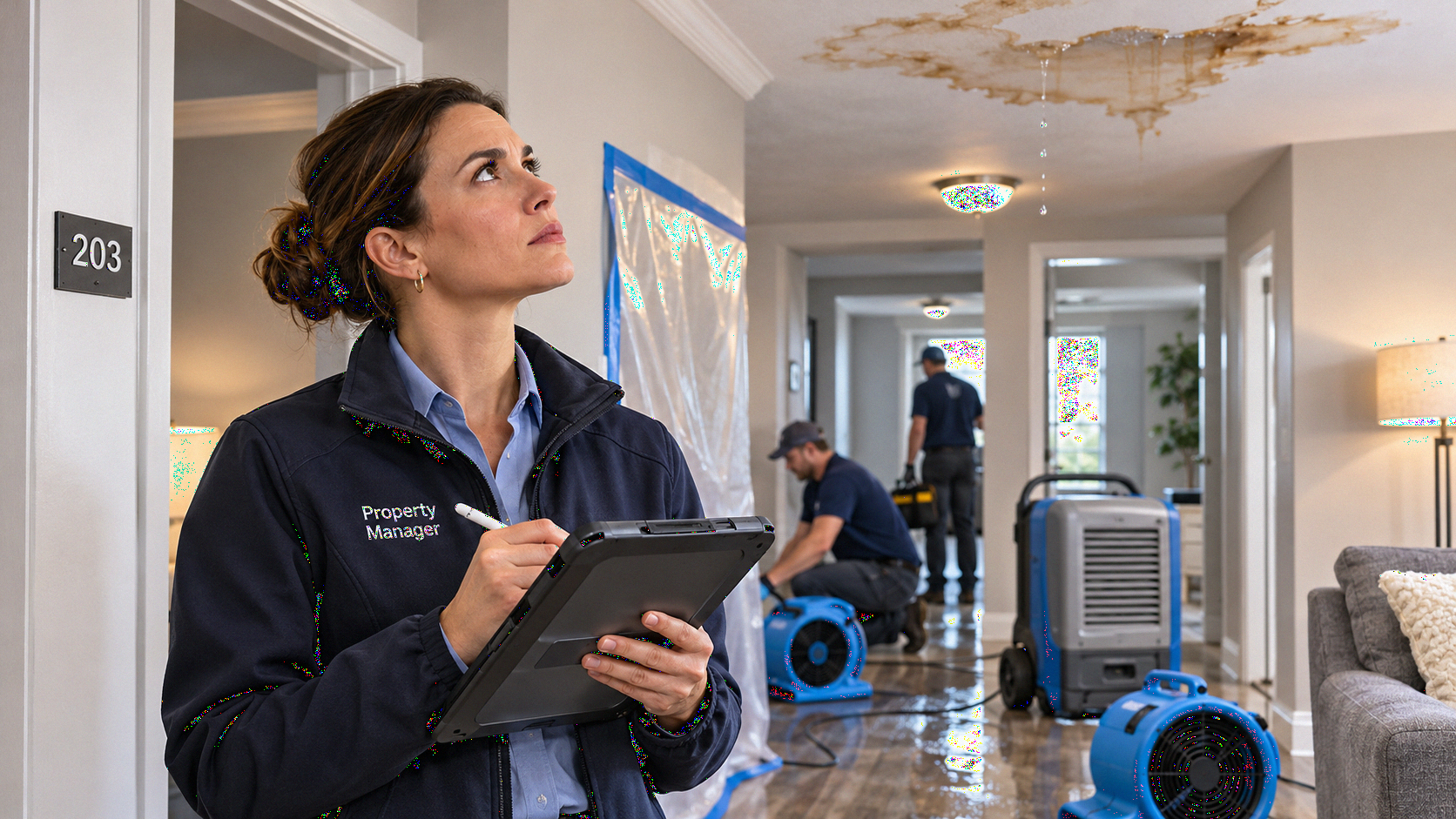
It begins with one work order: water is dripping through a tenant's ceiling. Upstairs, maintenance finds a leaking pipe. By the time the valve is closed, residents in two other apartments have noticed wet baseboards. The original work order is now a building incident.
Apartment building water damage cleanup succeeds when management coordinates safety, source repair, resident access, moisture assessment, and documentation as one response. One wet ceiling does not define the entire loss.
The first 24 hours establish a documented mitigation plan, not complete drying.
Quick Answer: What Should a Property Manager Do First?
Protect residents, isolate the water source through qualified personnel, inspect the likely path across units, communicate access needs, and begin appropriate water mitigation. Do not wait for every apartment to show a visible stain.
- Restrict access near sagging ceilings, wet electrical equipment, or suspected contaminated water.
- Send maintenance and the appropriate plumber or building-system specialist to identify and safely stop the source.
- Appoint one incident lead to record times, decisions, contractors, and resident updates.
- Inspect the source apartment, units below, adjoining rooms, common areas, and relevant service shafts.
- Arrange authorized resident access and provide a clear channel for reporting new symptoms.
- Photograph conditions, document moisture findings, and begin water removal and drying when safe.
The objective is a controlled incident, not an unsupported promise that all apartments will be dry tomorrow.
Minutes 0–15: Protect People and Stop Escalation
Keep residents and staff away from water near electrical panels, light fixtures, elevator equipment, and exposed wiring. Qualified personnel should assess electrical isolation and equipment before reuse. Keep people clear of cracked or bowed ceiling drywall. If there is an immediate threat to life, contact emergency services.
Maintain safe exits and accessible routes. If fire alarms, sprinklers, or other life-safety systems may be compromised, involve the responsible qualified provider; do not shut off building protection casually.
Maintenance should coordinate any shared-riser shutoff with authorized personnel. Record the shutoff, any service interruption, and who performed the work.
Minutes 15–60: Trace the Leak Beyond the Reported Unit
An apartment leak from upstairs can travel sideways before moving down. Water may follow joists, piping, insulation, ceiling grids, and wall penetrations. The stain in Unit 203 may have originated elsewhere and may not be the lowest point reached.
Establish the Source and Potentially Affected Stack
Have the appropriate trade document the suspected and, when established, confirmed source. Common causes include supply-pipe failures, toilet or appliance connections, HVAC condensate, roof intrusion, and drain backups. Record whether water is still entering the building.
Check the source unit and each plausible point along the route: apartments below, neighboring units sharing the plumbing wall, closets, hallways, and common utility areas.
Where Should Maintenance Look First?
Look at ceiling penetrations, floor transitions, cabinet bases, wall bottoms, and service chases. Restoration professionals can determine when targeted access is necessary.
Document Units With No Visible Damage
A unit that looks normal may still need moisture evaluation. List both confirmed affected spaces and spaces inspected without findings.
Uninspected Is Not Cleared
Mark a locked or inaccessible apartment pending access, never "dry" or "unaffected." That distinction prevents a missing inspection from becoming a false conclusion.
For a related multi-residence situation, see condo water damage restoration
Hours 1–4: Coordinate Residents Without Losing Control of the Incident
Tenant coordination after a leak should be consistent, factual, and documented. Residents need to know which areas to avoid, whether water service is interrupted, when crews may need entry, and how to report fresh water or a new stain. Use one contact point and set the next update time.
A Practical Resident Message Should Include
- What management knows, without guessing who is responsible.
- Immediate restrictions, such as avoiding a damaged ceiling or wet electrical area.
- Why inspection is needed and how entry will be arranged.
- Any confirmed water or utility interruption.
- A contact for additional leaks, access concerns, or essential needs.
Follow the law and lease that apply to the property. In Virginia, Code §55.1-1229 permits landlord entry without consent in an emergency, while other entry and notice conditions differ. Do not assume this provision automatically governs Maryland or Washington, DC properties, or that every follow-up visit qualifies as emergency entry.
Record attempts to notify residents and obtain authorized access. Consider mobility limitations and pets when coordinating work, while sharing only the personal details crews actually need.
Hours 4–8: Assess Water Conditions and Building Materials
Professional property manager water mitigation starts with identifying the nature of the water and the materials it reached. A recent potable-water pipe break may require different precautions from sewage, groundwater, or wastewater that crossed dirty surfaces.
A restoration assessment may include ceiling drywall, insulation, carpet, pad, tile or vinyl flooring, subflooring, framing, trim, and nearby wall cavities. The affected area should be established through observations and material-appropriate moisture instruments. Thermal cameras show temperature patterns, not water through walls; their findings require confirmation.
EPA guidance for clean-water damage says sound wallboard may sometimes dry in place when it has not swollen and its seams remain intact. It generally recommends replacing wet fiberglass insulation and checking the material beneath hard-surface flooring.
Do not authorize blanket demolition simply because several units are involved. Equally, do not preserve compromised material only because the paint looks intact. Document why each area is dried, opened, removed, or reassessed.
Read more about how restoration companies find hidden water damage
Hours 8–12: Start Mitigation That Works in Occupied Buildings
The source may already be repaired, but water can remain in floor assemblies, carpet backing, insulation, and shared walls. Appropriate extraction and drying should begin as safety and contamination conditions permit. A restoration team may use dehumidification, air movement, controlled access, and repeat material readings.
Drying occupied buildings requires a safe work plan. Protect cords and pathways, preserve exits, manage dust during selective demolition, and coordinate equipment noise and access to kitchens or bathrooms. Do not use fans indiscriminately where contamination is unknown. If mold or sewage contamination is present, the containment and cleaning plan must reflect those hazards.
Assign separate scopes for plumbing repair, emergency extraction, drying, removal, and later reconstruction. Installing equipment does not verify that a hidden cavity is dry, and a plumber's repair invoice does not establish restoration completion.
For a deeper explanation, see structural drying after water damage
Hours 12–24: Reinspect, Update Residents, and Plan the Next Shift
By the end of day one, management should be able to answer five questions: Is the source controlled? Which units have been checked? Which remain inaccessible? What hazards or restrictions remain? Who is responsible for the next action?
Review the incident log with maintenance and the restoration lead. Reinspect areas where moisture can migrate or where residents report new symptoms. Update the affected-unit map rather than treating the first inspection as final.
Send a concise resident update covering confirmed facts, service interruptions, restricted areas, work completed, the next planned visit, and the contact for new reports. Avoid promising an exact drying or reconstruction date.
Who Owns Each Decision and Record?
The property manager should lead coordination, not personally certify every technical condition. Maintenance supplies building-system information and helps arrange access. Qualified plumbers or relevant trades confirm and correct the source. Electricians address electrical safety. Restoration professionals assess, extract, dry, and document affected materials. Ownership and insurers handle authorizations and coverage decisions within their roles.
Maintain a single incident record with timestamps, unit status, photographs, professional findings, work orders, and resident messages.
Can Residents Stay in Their Apartments During Drying?
Sometimes, but the decision must be made for the actual conditions in each unit. A room with a sagging ceiling, exposed electrical components, sewage contamination, obstructed exits, or loss of essential services presents different concerns from a safely contained drying area.
Equipment noise, cords, dust containment, and access to bedrooms or bathrooms can affect daily living. Management should coordinate qualified safety assessments and review the lease and jurisdiction-specific housing requirements when relocation or restricted occupancy is considered. Do not label a home safe solely because a dehumidifier is running.
What Should Management Save for Insurance and Ownership?
Keep the first report, incident timeline, suspected and confirmed source, shutoff records, unit inspection logs, notices, photos, moisture documentation, authorizations, invoices, and reconstruction scopes. Separate building-owned materials from residents' personal belongings.
Responsibility does not automatically fall on the resident in the source apartment. Maintenance duties, ownership of the failed component, policy language, leases, and local law can matter. Insurance carriers determine coverage; restoration contractors document conditions and work performed, not claim outcomes.
For related claim documentation, see water damage insurance claim help
Why the First Day Matters for Mold Prevention
EPA recommends drying wet building materials within 24–48 hours when possible to help reduce mold risk. This is guidance to act promptly, not a promise that all materials can dry within two days or that mold begins at an exact hour. Repeated leaks, contaminated sources, and inaccessible cavities require particular attention.
Where growth or contaminated material is confirmed, remediation may be needed before reconstruction.
For more detail, read mold after water damage in Virginia
Apartment Water Damage Cleanup in Northern Virginia
Property managers in Alexandria, Arlington, Fairfax, McLean, Falls Church, Vienna, and other nearby DMV communities may need coordinated response across occupied apartments and shared spaces. Total Home Rescue provides water mitigation, structural drying, mold remediation when necessary, and reconstruction for affected materials. The appropriate qualified trade should repair the source.
For water-damage restoration assistance, call Total Home Rescue at 571-343-3444. Explore commercial water damage restoration in Virginia for broader building losses.
Frequently Asked Questions
1. What should a property manager do when several apartments have water damage at once?
Start by restricting unsafe areas and dispatching qualified personnel to isolate the leak. Water near energized equipment, bulging ceilings, or suspected sewage should not be handled as routine maintenance. Contact emergency services when there is immediate danger. Preserve exit routes and avoid casual shutdown of fire protection or other shared life-safety systems.
Assign one incident lead and open a time-stamped record. Inspect the source unit, likely vertical stack, neighboring spaces, and common service areas according to the water's path. Document which units have been inspected and which are awaiting entry.
Coordinate resident communication and authorized access, then bring in the appropriate restoration professionals for water removal, material evaluation, and drying.
2. Can management enter an apartment for an emergency water leak without tenant permission?
It depends on the jurisdiction, facts, lease, and applicable law. In Virginia, §55.1-1229 of the Virginia Residential Landlord and Tenant Act permits entry without tenant consent in an emergency. The same statute sets conditions for other entry, including notice provisions for certain routine maintenance. It does not mean every later inspection or reconstruction appointment automatically qualifies as an emergency.
Document why entry was needed, efforts to notify the resident when practical, who entered, when, and what was done. Coordinate reasonable follow-up access using the correct procedures. Buildings in DC and Maryland are governed by their own rules, which should be checked separately.
A resident's absence does not establish that a room is unaffected. If authorized access cannot be obtained, mark that unit as pending in the incident log and seek appropriate management or legal guidance rather than inventing a finding.
3. Does every apartment below an upstairs leak need drywall removed?
No. Multi-unit water damage should be evaluated along likely migration pathways, but there is no automatic requirement to demolish every ceiling below the source. Water can follow framing, plumbing penetrations, and wall cavities, making visual stains an incomplete guide. An apparently dry room may still merit assessment based on the building layout and source.
A restoration professional can use material-appropriate moisture measurements, observations, and targeted access when needed. Under suitable clean-water conditions, EPA notes that sound drywall with intact seams may sometimes be dried in place. Material that is unstable, contaminated, visibly deteriorated, or inaccessible for adequate cleaning and drying may need removal. Wet insulation may require separate treatment.
Ask for unit-specific findings explaining what was removed, retained, or scheduled for reassessment. The objective is justified restoration rather than automatic demolition or premature patching.
4. Can tenants stay during structural drying, and how long does apartment restoration take?
Some residents may remain in their units while others need restricted rooms or alternative arrangements. Occupancy depends on electrical and structural hazards, contamination, safe exits, essential services, and whether mitigation equipment or work zones interfere with normal access. Management should obtain appropriate safety input and apply the legal and lease requirements for the property.
There is no reliable universal drying period for a multi-unit loss. Duration depends on water source, volume, exposure time, building materials, hidden cavities, access, and contamination. The first 24 hours should prioritize prompt action and a documented plan, not a guarantee of completion. A running air mover or apparently dry surface does not prove that concealed materials are ready to rebuild.
5. Who pays for multi-unit apartment water damage, and what documentation is needed?
Payment and responsibility depend on what failed, who owns or maintains the component, relevant lease obligations, applicable law, and insurance terms. A leak originating in one apartment does not automatically make that resident liable for every affected unit. Building property, common systems, tenant belongings, and third-party claims may be handled differently.
Management should maintain a chronological incident file with the original report, service-shutoff records, confirmed source findings, unit inspection logs, photographs, moisture readings, tenant notices, contractor work authorizations, and itemized estimates. Keep tenant-owned property separate from building repair records and protect resident information.
Contact the relevant insurers under applicable notification requirements while taking safe steps to limit ongoing damage. The carrier determines coverage.
Final Takeaway
The first 24 hours of apartment building water damage cleanup should create a safer building, a controlled water source, a reliable list of affected units, coordinated tenant access, and a documented mitigation plan. Follow the water path, preserve clear handoffs between trades, and verify material conditions before rebuilding. Fast action matters; unsupported assurances do not.

