

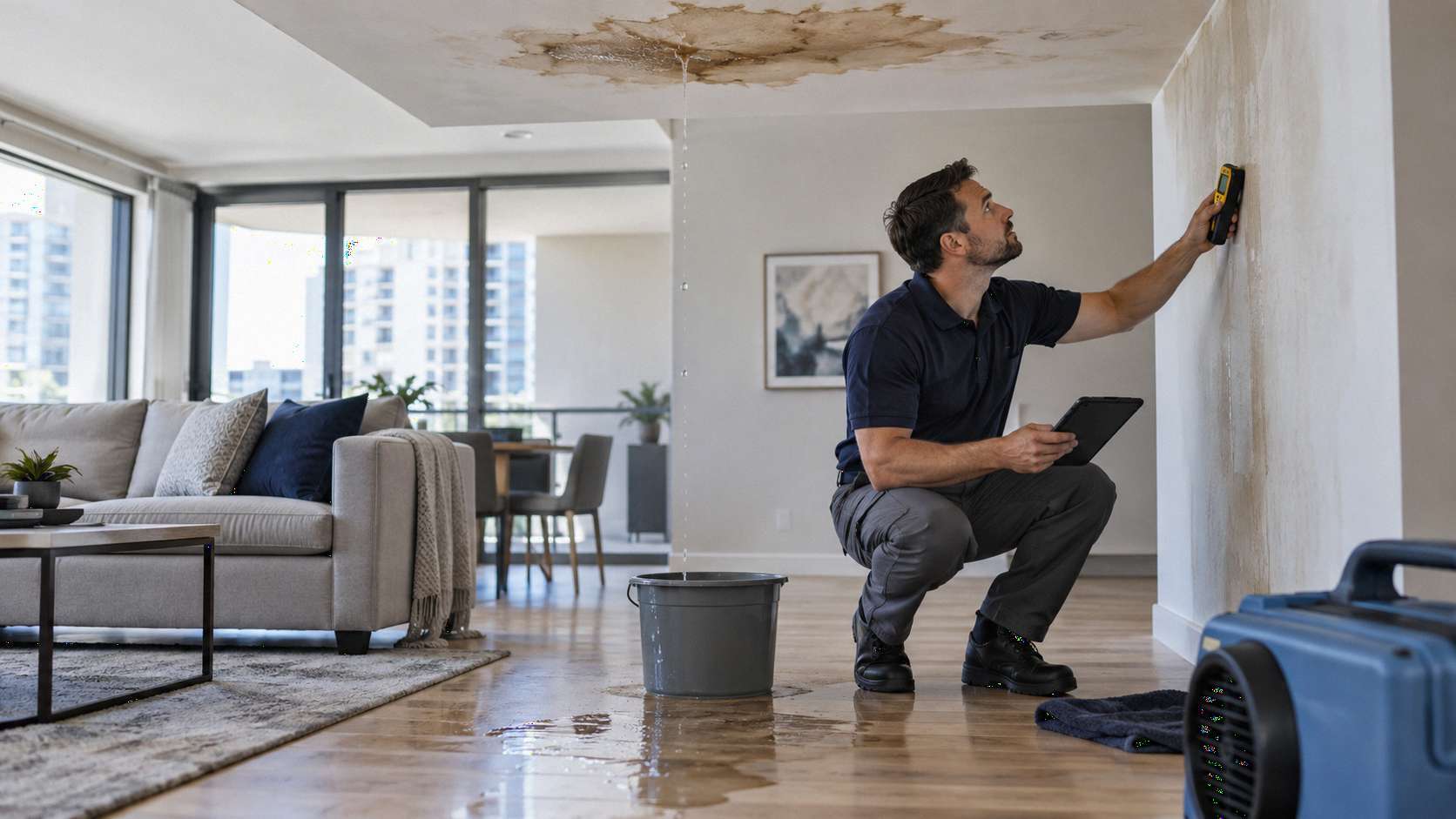
A water leak from the condo above can create far more damage than the visible stain on your ceiling suggests.
Water may travel through drywall, insulation, framing, pipe openings, electrical penetrations, walls, and flooring before it finally becomes visible in the unit below.
That is why condo water damage restoration should begin with three priorities:
- Stop the water source.
- Determine how far moisture has traveled.
- Dry or remove affected materials before repairs begin.
An upstairs neighbor leak may initially look like a cosmetic problem. You may notice a brown stain, bubbling paint, a wet ceiling, or water dripping near a light fixture.
But behind the surface there may already be:
- Wet ceiling drywall
- Saturated insulation
- Damp wood framing
- Moisture inside wall cavities
- Wet flooring or subfloor
- Water spreading into adjacent rooms
The most important rule is simple:
The visible stain is not necessarily the full extent of the water damage.
Quick Answer: What Should You Do After an Upstairs Condo Leak?
After a water leak from the unit above:
- Contact the upstairs resident or building management to stop the source
- Stay away from wet electrical fixtures
- Avoid standing under sagging ceiling drywall
- Move personal belongings out of the wet area
- Photograph and video the damage
- Notify the appropriate condo or association contact
- Check ceilings, walls, insulation, and flooring for hidden moisture
- Begin water mitigation if building materials are wet
- Do not repaint or rebuild until drying is verified
Prompt action can help reduce additional material damage.
Why an Upstairs Neighbor Leak Can Spread So Far
Water rarely travels in a perfectly straight line.
Inside multi-unit buildings, it may move along:
- Floor joists
- Ceiling framing
- Plumbing lines
- Metal tracks
- Electrical penetrations
- Drywall seams
- Insulation
- Wall cavities
before becoming visible.
For example, an upstairs bathroom leak may originate several feet away from the stain that appears on the ceiling below.
That is why a condo ceiling leak should not be evaluated only by looking directly above the stain.
For more information see ceiling water damage
What to Do Immediately After a Water Leak From a Unit Above
1. Stop the Source
The first priority is preventing additional water from entering the building.
Common sources include:
- Toilet leaks
- Shower or tub leaks
- Sink plumbing
- Dishwasher supply lines
- Washing machines
- Refrigerator lines
- Water heaters
- Burst pipes
- HVAC condensate
If the leak originates inside another unit, you may need help from:
- The upstairs resident
- Property management
- Building maintenance
- A plumber
For appliance-related losses see appliance leak water damage
For broken plumbing see burst pipe water damage
2. Watch for Electrical Hazards
A water leak from a unit above may reach:
- Recessed lights
- Ceiling fixtures
- Fans
- Electrical wiring
- Outlets
Do not touch wet electrical fixtures or stand in water while handling electrical devices.
3. Stay Away From a Sagging Ceiling
Saturated ceiling drywall may soften and lose strength.
If you see:
- Bulging
- Sagging
- Swelling
- Cracking
avoid standing directly below that area.
4. Protect Personal Property
When it can be done safely, move:
- Furniture
- Electronics
- Rugs
- Documents
- Artwork
- Clothing
- Other valuables
away from the wet area.
5. Notify the Building
Condo water damage restoration often involves coordination.
Notify the appropriate building contact when:
- The leak originates in another unit
- Shared plumbing may be involved
- Multiple units may be affected
- Access to another unit is needed
6. Document the Damage
Take clear photos and videos showing:
- Active leaking
- Ceiling stains
- Wet drywall
- Damaged flooring
- Personal property damage
- The suspected source
- The progression of staining or dripping
For insurance documentation guidance see water damage insurance claim help
How Hidden Moisture Is Found After a Condo Ceiling Leak
The visible stain is only one clue.
Professional condo water damage restoration may include moisture assessment of:
- Ceiling drywall
- Wall drywall
- Insulation
- Baseboards
- Cabinets
- Flooring
- Subfloor
- Framing
Moisture meters and other inspection techniques may help determine how far the water spread.
For more information see hidden water damage detection
Why Moisture Mapping Matters
Multi-unit water damage can spread in several directions at once.
An upstairs neighbor leak may affect:
- The ceiling below
- A nearby wall
- A closet
- Flooring
- A hallway
- An adjoining room
Without proper moisture mapping, part of the water damage may remain untreated.
How Condo Water Damage Restoration Works
The exact restoration process depends on the source and extent of damage.
Most projects follow a similar sequence.
Step 1: Stop the Water Source
The leak must be repaired or isolated before drying can begin effectively.
Step 2: Remove Standing Water
If water has reached flooring or created pooling, extraction may be necessary.
Removing liquid water mechanically is more efficient than trying to evaporate it.
Step 3: Identify the Moisture Boundary
The restoration team determines which materials are wet.
That may include:
- Drywall
- Insulation
- Flooring
- Cabinets
- Framing
- Subfloor
Step 4: Decide What Can Be Dried
Not all wet building materials need to be removed.
Some can be dried when:
- They remain structurally sound
- The water source is appropriate for restoration
- Airflow can reach them
- Moisture can be monitored
Step 5: Remove Materials That Cannot Be Restored
Selective removal may be needed when materials are:
- Heavily saturated
- Structurally damaged
- Contaminated
- Blocking access to hidden moisture
- Preventing structural drying
Step 6: Begin Structural Drying
Air movers and dehumidification may be used to dry remaining materials.
For more information see structural drying after water damage
Step 7: Monitor Drying
Materials should not be considered dry simply because they look normal.
Moisture levels may need to be checked throughout the drying process.
Step 8: Rebuild
Drywall, insulation, trim, paint, and other finishes should be restored after the underlying materials have dried.
For the full process see water mitigation process
Does a Condo Ceiling Leak Mean Drywall Must Be Removed?
Not always.
Wet drywall may sometimes be dried when:
- Exposure was limited
- Water was relatively clean
- The drywall remains firm
- There is no significant sagging
- Hidden insulation and framing can also dry
Removal becomes more likely when drywall is:
- Soft
- Sagging
- Heavily saturated
- Delaminating
- Contaminated
- Hiding saturated insulation
For a detailed explanation see wet drywall after water leak
Why Ceiling Drywall Needs Extra Attention
Water coming from the unit above may collect on top of ceiling drywall.
This can add weight while weakening the gypsum core.
A sagging condo ceiling should therefore be treated differently from a simple dry stain.
What Happens to Wet Insulation Between Condo Units?
Wet insulation is common after a water leak from a unit above.
Insulation may:
- Hold water above the ceiling
- Stay wet after dripping stops
- Reduce airflow
- Hide wet framing
- Slow structural drying
Lightly affected insulation may sometimes be dried depending on the material and water source.
Heavily saturated insulation may need to be removed.
For more information see wet insulation after water damage
Who Is Responsible for Water Damage From the Condo Above?
There is no single answer that applies to every building.
Responsibility may depend on:
- What caused the leak
- Which component failed
- Whether that component serves one unit or multiple units
- Condo governing documents
- Association maintenance obligations
- Insurance policies
- Other facts surrounding the loss
Potentially involved parties may include:
- The affected condo owner
- The upstairs unit owner
- The condominium association
- Property management
- Insurance carriers
- Contractors or maintenance providers
The fact that the water physically came from upstairs does not automatically determine who pays for every part of condo water damage restoration.
Review the Condo Documents
Useful documents may include:
- Declaration
- Bylaws
- Maintenance responsibilities
- Insurance requirements
- Association rules
Report the Loss
Depending on the circumstances, the affected owner may need to contact their own insurance carrier while responsibility is still being evaluated.
For general coverage guidance see does insurance cover water damage restoration
What Should You Document?
Good documentation is especially important in multi-unit water damage.
Keep records of:
- When the leak was discovered
- Photographs
- Videos
- Messages with the upstairs resident
- Communication with management
- Plumbing invoices
- Restoration reports
- Moisture documentation
- Damaged property
- Receipts
This creates a timeline showing what happened and what actions were taken.
Should You Wait for Insurance Before Starting Drying?
If building materials are actively wet, unnecessary delay can allow moisture to spread.
The restoration question and payment question are separate.
The immediate question is:
What needs to happen to prevent additional damage?
The financial question is:
Who is responsible for which costs?
Those issues may be resolved on different timelines.
For urgent situations see emergency water damage restoration
Mitigation and Reconstruction Are Different
Drying should usually happen before cosmetic repairs.
Do Not Patch the Ceiling Too Soon
Stopping the drip does not automatically mean the ceiling cavity is dry.
Avoid Closing Wet Materials
Installing new drywall over wet insulation or framing can conceal the original problem.
Apartment Water Damage vs Condo Water Damage
Apartment water damage and condo water damage often involve the same building materials.
Both may affect:
- Drywall
- Insulation
- Flooring
- Cabinets
- Framing
- Personal belongings
The main difference is usually ownership and responsibility.
In a rental apartment, the building owner or management company generally coordinates structural repairs.
In a condo, responsibilities may be divided between individual owners and the association.
From a restoration standpoint, the physical process remains similar:
- Stop the source
- Locate moisture
- Extract water
- Dry salvageable materials
- Remove materials that cannot be restored
- Verify drying
- Rebuild
Why Multi-Unit Water Damage Can Affect Several Areas
Water can move through connected building spaces such as:
- Pipe chases
- Floor assemblies
- Wall cavities
- Electrical openings
- Ceiling systems
A single upstairs leak can therefore affect more than one room.
Signs Water Has Spread
Watch for:
- New ceiling stains
- Damp baseboards
- Wet flooring
- Bubbling paint
- Musty odors
- Wet closet walls
- Water around vents
For hidden flooring moisture see water damage under flooring
Can Flooring Be Saved After a Leak From Upstairs?
Sometimes.
The answer depends on flooring type, water source, and moisture underneath.
Carpet
Carpet may sometimes be dried after a clean-water loss.
The pad and subfloor must also be checked.
Hardwood
Hardwood may develop:
- Cupping
- Swelling
- Crowning
- Elevated moisture
Some hardwood can be dried when addressed quickly.
For more information see water damaged hardwood floors repair or replace
Laminate
Laminate may swell at seams and edges after water exposure.
LVP
Luxury vinyl plank may appear unaffected on top while water remains underneath.
The subfloor should therefore be considered separately.
Can Mold Develop After an Upstairs Neighbor Leak?
Yes, if moisture remains long enough on susceptible building materials.
But an upstairs neighbor leak does not automatically mean mold remediation is necessary.
Potential affected surfaces include:
- Drywall paper
- Wood framing
- Insulation facings
- Baseboards
- Dust
- Debris
Possible warning signs include:
- Musty odor
- Visible spotting
- Growth behind drywall
- Repeated staining
- Mold around ceiling or wall edges
For more information see mold after water damage
For guidance on when remediation may be needed see when is mold remediation necessary
For professional services see mold remediation
DIY Cleanup vs Professional Condo Water Damage Restoration
Some very small clean-water events may be manageable without professional restoration.
DIY may be reasonable when:
- The affected area is small
- The water source is clean
- The leak was stopped immediately
- All moisture is visible
- No wall or ceiling cavity is wet
- No insulation is affected
- Flooring is dry underneath
Professional condo water damage restoration becomes more appropriate when:
- Water came through the ceiling
- Several rooms are affected
- Drywall is saturated
- Insulation is wet
- Flooring or subfloor is wet
- The leak duration is unknown
- Several units are involved
- Hidden moisture cannot be verified
For a broader comparison see DIY vs professional water damage cleanup
How Long Does Condo Water Damage Restoration Take?
There is no universal timeline.
The duration depends on:
- Water volume
- Water source
- Number of affected rooms
- Drywall saturation
- Insulation condition
- Flooring type
- Temperature
- Humidity
- Airflow
- Whether demolition is required
A small localized condo ceiling leak is very different from multi-unit water damage affecting several rooms or units.
Drying should be based on actual moisture conditions rather than a fixed number of days.
For additional guidance see water damage restoration timeline
What Should Happen Before Repairs Begin?
Before drywall is patched or the ceiling is repainted, confirm that:
- The water source has been repaired
- Standing water has been removed
- Saturated materials were removed where necessary
- Remaining drywall is dry
- Insulation is dry or replaced
- Framing is dry
- Hidden cavities were evaluated
- Mold concerns were addressed when appropriate
Painting over a ceiling stain may improve appearance.
It does not solve moisture behind the ceiling.
Final Takeaway
Condo water damage restoration after an upstairs neighbor leak should focus on the complete path of the water.
Moisture may travel through:
- Ceiling drywall
- Walls
- Insulation
- Framing
- Flooring
- Adjacent rooms
before becoming visible.
The most important steps are:
- Stop the source
- Protect people and property
- Document the loss
- Identify the full moisture boundary
- Dry or remove affected materials
- Verify drying before rebuilding
The key point is simple:
A ceiling that has stopped dripping may still contain wet insulation, drywall, or framing.
Proper condo water damage restoration should address the entire affected assembly rather than only the visible stain.
FAQ About Condo Water Damage Restoration
1. What should I do immediately after a leak from the condo above?
First, stay away from sagging ceilings and wet electrical fixtures.
Contact the upstairs resident or appropriate building management contact so the source can be identified and stopped.
Document the damage with photographs and video.
Move belongings away from the wet area when safe.
If water entered the ceiling, walls, insulation, or flooring, arrange for a moisture assessment rather than assuming the problem is over once dripping stops.
2. Who is responsible for condo water damage caused by an upstairs neighbor?
There is no universal answer.
Responsibility may depend on:
- The cause of the leak
- Which building component failed
- Whether that component serves one unit or several
- Condo governing documents
- Association responsibilities
- Insurance policies
- Other facts surrounding the incident
The fact that water came from the unit above does not automatically mean the upstairs owner is responsible for every repair.
Document the event and review the relevant condo and insurance documents.
3. Does ceiling drywall always need to be removed after an upstairs leak?
No.
Drywall may sometimes be dried when exposure is limited, the water source is appropriate for drying, and the drywall remains structurally sound.
Removal becomes more likely when the drywall is:
- Soft
- Sagging
- Heavily saturated
- Delaminated
- Contaminated
- Covering saturated insulation
The condition of the ceiling cavity is often more important than the appearance of the painted surface.
4. How can I tell whether water is still trapped inside my walls or ceiling?
You may not be able to determine that by appearance alone.
Possible warning signs include:
- Musty odor
- Bubbling paint
- Soft drywall
- Damp baseboards
- New staining
- Elevated moisture readings
Water can travel beyond the visible stain.
Moisture mapping can help determine whether drywall, insulation, framing, or flooring remains wet.
A dry-looking ceiling is not proof that the cavity above it is dry.
5. Can mold grow after a water leak from an upstairs condo?
Yes, if moisture remains on susceptible materials long enough.
Possible mold locations include:
- Drywall paper
- Wood framing
- Insulation facings
- Baseboards
- Dust
- Organic debris
A condo ceiling leak does not automatically mean professional mold remediation is required.
The most important step is to stop the source and dry the affected materials.
If visible growth or persistent musty odor develops, the affected cavity should be evaluated before reconstruction.
For prevention guidance see how to prevent mold growth Northern Virginia

