

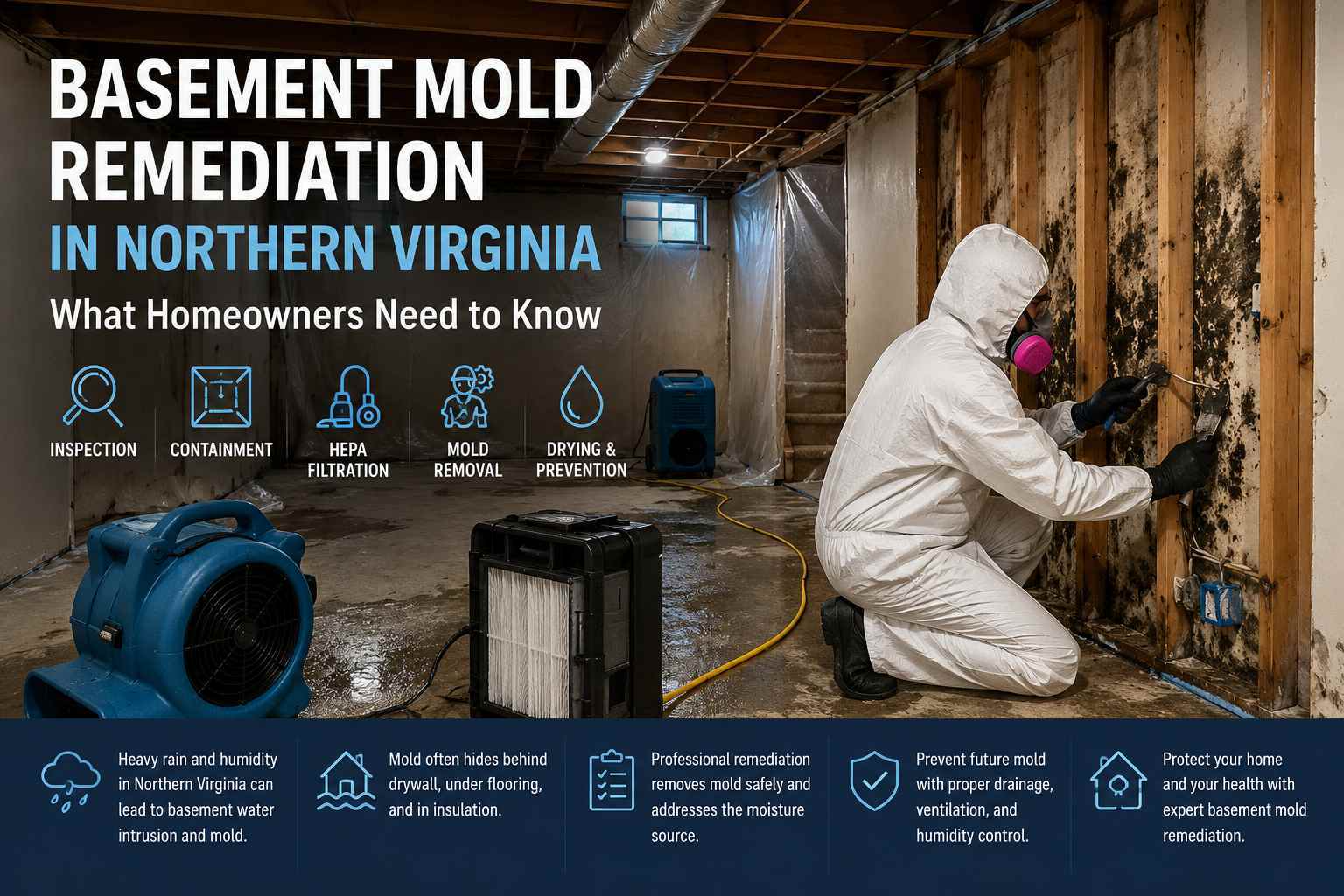
Basement Mold Remediation in Northern Virginia: What Homeowners Need to Know
Basement mold is one of the most common hidden problems in Northern Virginia homes. Homeowners in Alexandria, Arlington, Fairfax, McLean, Tysons, and Falls Church often deal with basement mold because many homes in this region have finished lower levels, older foundations, below-grade walls, humid utility areas, sump pump systems, and limited basement airflow.
The problem usually starts with moisture. Sometimes it comes from a sudden water event, such as a pipe leak, sump pump backup, appliance overflow, or basement flooding. Other times, mold develops slowly because of high humidity, foundation seepage, condensation, poor ventilation, or damp materials hidden behind finished walls.
That is why basement mold remediation in Northern Virginia is not just about wiping visible mold from a wall. A proper remediation project should identify the moisture source, determine whether mold is visible or hidden, remove contaminated materials when needed, clean remaining surfaces, control airborne particles, and prevent the mold from returning.
If you smell a persistent musty basement smell, see staining near baseboards, notice soft drywall, or suspect mold behind basement drywall, your basement may need a professional inspection before repairs or painting begin.
For a full breakdown of the remediation process, read: what is mold remediation
Why Basement Mold Is Common in Northern Virginia
Northern Virginia has several conditions that make basement mold more likely. The region experiences humid summers, heavy rain, seasonal storms, and temperature swings that can create condensation in below-grade spaces. Many homes also have older basement construction, finished drywall over foundation walls, utility closets, and storage areas with limited airflow.
Common causes of basement mold in Northern Virginia
Basement mold usually develops when moisture sits long enough for mold to grow on organic materials. Common causes include:
- Foundation seepage after heavy rain
- High indoor humidity
- Sump pump failure or backup
- Plumbing leaks behind walls or ceilings
- Water heater leaks
- HVAC condensation
- Damp carpet or carpet padding
- Poor airflow behind furniture or stored items
- Finished drywall installed against below-grade walls
- Previous water damage that was not fully dried
- Wet insulation behind basement walls
- Moisture trapped under flooring
A basement may look dry on the surface while moisture remains behind drywall, under carpet padding, or inside wall cavities. This is especially common in finished basements where painted walls hide framing, insulation, and foundation surfaces.
If the mold started after a leak or flood, this guide may help: mold after water damage in Virginia
Signs You May Need Basement Mold Remediation
Basement mold is not always obvious. Sometimes the first sign is odor. Other times, homeowners notice stains, peeling paint, or damp flooring before they see visible growth.
You may need basement mold remediation Northern Virginia services if you notice:
- A musty basement smell that does not go away
- Dark staining near baseboards or exterior walls
- Damp carpet, carpet padding, or flooring
- Soft, swollen, or bubbling drywall
- Peeling paint near the lower part of the wall
- Mold behind furniture, boxes, or stored items
- White, gray, green, brown, or black spotting on surfaces
- Recent basement water damage
- High humidity readings above 60%
- Condensation on pipes, windows, or ductwork
- Mold returning after cleaning
- Visible growth near HVAC closets, laundry areas, or utility rooms
A musty smell is especially important. Many homeowners ignore odor because they do not see visible mold, but smell can be an early warning sign of hidden moisture or microbial growth.
For more hidden warning signs, read: signs of hidden mold in your home
What a Musty Basement Smell Means
A musty basement smell usually means the space has too much moisture, poor airflow, or organic materials that have been damp for too long. It does not always prove there is visible mold, but it is a strong sign that the basement should be checked.
Common sources of musty basement odor
A musty odor may come from:
- Damp drywall
- Wet insulation
- Mold behind basement drywall
- Moldy carpet padding
- Moist wood framing
- Stored cardboard boxes
- Old water damage
- Utility closets with poor ventilation
- HVAC return areas pulling air from damp spaces
- Foundation seepage behind finished walls
The smell may become stronger after rain, during humid weather, or when the basement has been closed for several days. If the odor returns after cleaning, the source is probably not just surface dirt. It may be moisture trapped inside materials.
Why odor matters
Mold problems are easier to handle when they are found early. If a basement smells musty, but the walls look clean, the next step is not painting, deodorizing, or spraying air freshener. The next step is finding where moisture is coming from and whether hidden materials are affected.
Mold Behind Basement Drywall
One of the most common problems in finished basements is mold behind basement drywall. The painted side of the wall may look normal, while the back side of the drywall, insulation, or framing has mold growth.
Drywall is vulnerable because it has paper facing. When moisture gets trapped behind the wall, mold can grow on the paper backing and spread inside the wall cavity.
Why mold grows behind basement drywall
Mold behind basement drywall often happens after:
- Foundation seepage
- Basement flooding
- Plumbing leaks
- Toilet or bathroom leaks from above
- HVAC condensation
- Water heater leaks
- Poorly dried water damage
- High basement humidity
- Furniture or storage blocking airflow
Below-grade basement walls are especially sensitive because foundation walls can transfer moisture. If drywall is installed close to a damp foundation wall, the wall cavity may stay wet even when the room looks dry.
When drywall usually needs to be removed
Drywall may need to be removed when:
- It is wet or previously water-damaged
- It feels soft, swollen, or crumbly
- There is visible mold growth
- The back side of the drywall is contaminated
- Insulation behind the drywall is wet or moldy
- Moisture readings show elevated moisture
- The wall has a persistent musty smell
- Mold returns after surface cleaning
Cleaning the painted side of drywall is not enough if mold is growing behind it. In many cases, a controlled exploratory opening is needed to determine how far the damage extends before the full scope is finalized.
Basement Water Damage Mold
Basement water damage mold is common after flooding, sump pump failure, appliance leaks, foundation seepage, or plumbing issues. The main issue is that basement water spreads quickly into materials that are difficult to dry without professional equipment.
Water can move under flooring, behind baseboards, into drywall, and through carpet padding. Even if the surface looks dry after a few days, moisture may still be trapped inside the structure.
Materials commonly affected after basement water damage
After a basement water event, mold risk is higher in:
- Drywall
- Insulation
- Carpet padding
- Laminate flooring
- Baseboards
- Wood framing
- Built-in cabinets
- Stair components
- Utility closets
- Stored contents
- Subfloor materials
If these materials stay damp, mold can develop and spread. Basement mold removal in VA often requires more than cleaning visible spots. The affected materials must be evaluated to determine what can be dried, cleaned, removed, or restored.
For homeowners trying to choose a qualified provider, read: how to hire a mold remediation company in Northern Virginia
Basement Humidity Mold
Not every basement mold problem starts with a flood. Some cases come from long-term humidity. Basement humidity mold can develop slowly when relative humidity remains high for days or weeks.
Why humidity causes basement mold
Mold needs moisture to grow. In a humid basement, porous materials can absorb moisture from the air. Drywall paper, wood, cardboard, dust, carpet backing, and stored fabrics can all support mold growth when humidity remains elevated.
Basements are more vulnerable because they are below grade, cooler than upper floors, and often have less airflow.
Signs humidity may be the problem
Humidity may be contributing to mold if you notice:
- Musty odor during summer
- Condensation on pipes or windows
- Damp feeling in the basement air
- Dehumidifier filling quickly
- Mold on stored boxes or furniture
- White residue on foundation walls
- Recurring mold after cleaning
- No obvious leak, but continued dampness
A dehumidifier can help, but it may not solve every basement mold problem. If moisture is entering through the foundation, leaking from plumbing, or trapped behind drywall, the source still needs to be addressed.
For prevention guidance, read: how to prevent mold growth in Northern Virginia homes
What Homeowners Should Not Do When They Find Basement Mold
Many basement mold problems get worse because homeowners try to cover the issue before identifying the cause.
Do not paint over mold
Painting over mold does not remove contamination. It may hide stains temporarily, but mold can continue growing behind the paint if moisture remains.
Do not spray bleach on drywall
Bleach is not a proper solution for mold inside porous materials like drywall, insulation, carpet padding, or wood cavities. It may lighten surface staining, but it does not fix hidden contamination or moisture.
Do not install new flooring over damp materials
Installing new flooring over damp concrete, wet padding, or water-damaged subfloor can trap moisture and create recurring mold.
Do not close walls before drying
If drywall is removed after a leak, the wall cavity should be checked and dried before it is closed. Rebuilding too early can trap moisture behind new materials.
Do not assume odor means the basement is safe because no mold is visible
A persistent musty basement smell can come from hidden mold behind drywall, under carpet, or inside stored contents.
Professional Basement Mold Remediation Process
A professional basement mold remediation project should be structured and controlled. The goal is to remove contaminated materials safely, clean the affected area, reduce airborne particles, and correct the moisture conditions that allowed mold to grow.
Step 1: Inspection and moisture assessment
The first step is a visual and moisture assessment. The technician checks the basement for visible mold, water stains, odor, wet materials, humidity, and likely moisture sources.
Areas commonly checked include:
- Exterior basement walls
- Baseboards and lower drywall
- Carpet edges
- Utility closets
- HVAC areas
- Laundry areas
- Sump pump area
- Water heater area
- Bathroom or plumbing walls
- Storage areas
- Corners behind furniture
Moisture meters may be used to check whether materials are still wet. If mold is suspected behind drywall, an exploratory opening may be recommended.
Step 2: Containment setup
Containment separates the affected work area from clean areas of the home. This is important because mold remediation can disturb dust, spores, and contaminated debris.
Containment may include plastic sheeting, sealed access points, floor protection, and controlled work zones.
Step 3: HEPA air filtration
HEPA air scrubbers are commonly used during remediation to help filter airborne particles while work is being performed. This is especially important when removing drywall, insulation, carpet padding, or contaminated contents.
Step 4: Controlled removal of contaminated materials
Porous materials that are moldy, wet, or damaged may need to be removed. This can include drywall, insulation, carpet padding, baseboards, tack strips, cabinets, or other affected materials.
The removal should be controlled, not rushed. The purpose is to reduce cross-contamination and expose the affected cavity for cleaning and drying.
Step 5: Cleaning of remaining surfaces
After damaged materials are removed, remaining surfaces are cleaned. This may include HEPA vacuuming, detail cleaning, antimicrobial treatment, and wiping of structural surfaces when appropriate.
Wood framing, concrete, and other structural materials may be cleaned if they are sound and restorable.
Step 6: Drying and humidity control
If moisture remains, drying equipment or dehumidification may be needed. Repairs should not begin until the area is dry and the source of moisture has been addressed.
Step 7: Post-remediation review
After remediation, the area should be reviewed to confirm that contaminated materials were removed, remaining surfaces were cleaned, and moisture conditions are controlled. In larger or sensitive projects, third-party testing may be recommended.
What Can Be Cleaned vs. What Usually Needs Removal?
The decision to clean or remove a material depends on whether it is porous, how long it was wet, whether mold is visible, and whether contamination is on the surface or inside the material.
Non-porous materials can often be cleaned. Porous materials are more difficult because mold can grow into the material, not just on top of it.
Basement Mold Materials — Clean or Remove?
Basement Mold Remediation Cost in Northern Virginia
The cost of basement mold remediation in Northern Virginia depends on the size of the affected area, the material type, accessibility, containment needs, drying requirements, and whether repairs are included.
A small surface cleaning project is very different from a finished basement with mold behind drywall, wet insulation, affected carpet padding, and multiple rooms involved.
For a detailed pricing guide, read: mold remediation cost in Virginia
If you are located in Fairfax and want to understand estimate structure, read: mold remediation estimate in Fairfax VA
Factors that affect cost
The biggest pricing factors include:
- Size of the affected area
- Whether drywall must be removed
- Whether insulation is contaminated
- Whether carpet or flooring is affected
- Whether containment is required
- Whether HEPA filtration is needed
- Whether drying equipment is needed
- Whether contents must be moved or cleaned
- Whether repairs are included after remediation
- Whether insurance documentation is needed
Does Insurance Cover Basement Mold Remediation?
Insurance coverage depends on what caused the mold. If mold resulted from a sudden and accidental covered water loss, such as a pipe burst or appliance leak, part of the remediation and repairs may be covered. If mold developed from long-term seepage, ongoing humidity, poor maintenance, or groundwater intrusion, coverage may be limited or denied.
For a detailed explanation, read: does insurance cover mold remediation in Virginia
Documentation matters
If insurance may be involved, homeowners should document the damage before work begins. Useful documentation includes:
- Photos of affected areas
- Source of water or moisture
- Moisture readings
- Affected material list
- Scope of work
- Containment notes
- Equipment notes
- Removal photos
- Completion photos
- Repair estimate
Even if the claim is not covered, detailed documentation helps clarify what was found, what was removed, and why specific work was recommended.
Basement Mold Removal VA: Local Service Areas
Total Home Rescue provides basement mold assessment, containment, removal, cleaning, drying, and repair coordination for homeowners across Northern Virginia.
Basement mold remediation in Alexandria, VA
Alexandria homes often have older basements, finished lower levels, and moisture-prone foundation walls. If your basement smells musty or you see mold near baseboards, local service is available here: mold remediation Alexandria VA
Basement mold remediation in Arlington, VA
Arlington basements often have tight utility areas, older construction, and finished walls that can hide moisture. Learn more here: mold remediation Arlington VA
Basement mold remediation in Fairfax, VA
Fairfax homes may experience basement mold after sump pump issues, storms, plumbing leaks, or humidity problems. Visit: mold remediation Fairfax VA
Basement mold remediation in McLean, VA
McLean homes often have large finished basements, storage rooms, and utility areas where moisture can remain hidden. See: mold remediation McLean VA
Basement mold remediation in Tysons, VA
Tysons homes, townhomes, and condos can experience mold from water damage, humidity, or poor basement airflow. Visit: mold remediation Tysons VA
Basement mold remediation in Falls Church, VA
Falls Church properties may have older basement layouts, crawlspace connections, or foundation moisture concerns. Learn more here: mold remediation Falls Church VA
For the main service page, visit: mold remediation services
How to Prevent Basement Mold From Coming Back
Basement mold can return if the moisture source is not corrected. Remediation removes contamination, but prevention depends on controlling humidity, water intrusion, and airflow.
Key prevention steps
To reduce the risk of basement mold returning:
- Keep basement humidity below 60%
- Use a dehumidifier during humid months
- Check the basement after heavy rain
- Maintain gutters and downspouts
- Direct water away from the foundation
- Test the sump pump regularly
- Repair plumbing leaks quickly
- Avoid storing cardboard against exterior walls
- Keep furniture slightly away from basement walls
- Improve airflow in closets and storage areas
- Avoid carpet in moisture-prone basement zones
- Dry water damage quickly and completely
- Do not rebuild over wet materials
Basement Mold Prevention Checklist
Basement Mold vs. Attic Mold
Basement mold and attic mold often have different causes. Basement mold usually comes from foundation moisture, basement humidity, water damage, sump pump issues, plumbing leaks, or poor lower-level airflow.
Attic mold often comes from roof leaks, bathroom fan exhaust, poor ventilation, insulation gaps, or condensation near the roof deck.
If mold appears in more than one area of the home, each area should be evaluated separately. The basement may need moisture control and removal of affected finished materials, while the attic may need ventilation correction and roof-side assessment.
For attic-specific guidance, read: attic mold removal in Northern Virginia
Service page: attic mold removal — http://totalhomerescue.pro/attic-mold-removal
When to Call a Mold Remediation Company
You should call a mold remediation company if the basement has a persistent musty odor, visible mold, wet drywall, damp carpet, or signs of water damage. Professional help is especially important if the mold may be behind drywall or if the basement was recently flooded.
Call a professional if:
- The basement smells musty after rain
- Mold appears near baseboards or exterior walls
- Drywall is soft, swollen, or stained
- Carpet or padding was wet
- Mold returns after cleaning
- There was recent basement water damage
- You suspect mold behind basement drywall
- Humidity remains high even with a dehumidifier
- You need documentation for insurance
- You are preparing to sell or rent the home
A professional assessment can help prevent homeowners from repairing over hidden mold, installing new materials too early, or missing the actual moisture source.
For a full regional guide, visit: mold remediation Northern Virginia complete local guide
FAQ: Basement Mold Remediation in Northern Virginia
1. What causes basement mold in Northern Virginia homes?
Basement mold in Northern Virginia is usually caused by excess moisture, poor airflow, and organic building materials. Common moisture sources include foundation seepage, high humidity, sump pump failure, plumbing leaks, water heater leaks, HVAC condensation, wet carpet, and previous basement water damage.
Homes in Alexandria, Arlington, Fairfax, McLean, Tysons, and Falls Church can be especially vulnerable because many basements are finished, partially below grade, or built with drywall and insulation close to foundation walls. When moisture gets trapped behind these materials, mold can grow without being visible from the room side.
The most important step is identifying the moisture source. Mold removal alone is not enough if the basement remains damp.
2. Is a musty basement smell a sign of mold?
A musty basement smell is often a sign of moisture, poor airflow, or possible mold growth. It does not always prove that visible mold is present, but it should not be ignored.
The smell may come from damp drywall, wet insulation, mold behind basement drywall, carpet padding, stored cardboard, foundation seepage, or high humidity. If the odor becomes stronger after rain or during humid weather, the basement may have an active moisture problem.
A musty odor that returns after cleaning usually means the source has not been corrected. In that case, the basement should be inspected for hidden moisture and affected materials.
3. Can mold behind basement drywall be cleaned without removing the drywall?
In many cases, no. If mold is growing on the back side of the drywall, inside the wall cavity, or on wet insulation, cleaning the painted surface will not remove the hidden contamination.
Drywall is porous, and its paper backing can support mold growth. If the wall was wet, soft, stained, or exposed to long-term moisture, removal may be required. A controlled exploratory opening can help determine whether mold is present behind the wall and how far the affected area extends.
Surface cleaning may make the wall look better temporarily, but it will not solve the problem if mold remains behind the drywall.
4. How much does basement mold remediation cost in Northern Virginia?
The cost of basement mold remediation in Northern Virginia depends on the size of the affected area, whether drywall or insulation must be removed, whether carpet or flooring is involved, and whether containment, HEPA filtration, drying equipment, or repairs are needed.
A small isolated area may cost much less than a finished basement with mold behind walls, wet insulation, damp carpet padding, and multiple affected rooms. Insurance documentation can also affect the scope because photos, moisture readings, and detailed line items may be needed.
For more detail, read: mold remediation cost in Virginia — http://totalhomerescue.pro/guides/mold-remediation-cost-virginia-2026
5. Does homeowners insurance cover basement mold removal?
Homeowners insurance may cover basement mold remediation if the mold was caused by a sudden and accidental covered water loss, such as a burst pipe or appliance leak. Coverage is less likely if the mold developed from long-term humidity, foundation seepage, groundwater intrusion, or maintenance-related moisture.
Every claim is different. Homeowners should document the source, take photos before cleanup, keep moisture readings if available, and request a written scope of work.
For more information, read: does insurance cover mold remediation in Virginia
6. Can I remove basement mold myself?
Small surface spots on non-porous materials may sometimes be cleaned by a homeowner, but DIY cleaning is not recommended when drywall, insulation, carpet, padding, or hidden wall cavities are involved.
Basement mold often grows behind finished materials. Spraying visible mold does not address moisture inside the wall. If there is a strong musty smell, recent water damage, soft drywall, or mold returning after cleaning, professional remediation is usually the safer option.
DIY work can also spread dust and spores if moldy materials are removed without containment or filtration.
7. Should carpet and carpet padding be removed after basement water damage?
Carpet padding often needs to be removed if it became wet, especially in a basement. Padding can hold moisture and odor even when the carpet surface feels dry. If the basement had water damage and the padding stayed damp, mold can develop underneath.
Carpet may sometimes be cleaned and dried depending on the water source, duration, and condition, but padding is more difficult to restore. If there is a musty smell, visible mold, or long-term moisture, removal is usually recommended.
8. How do I prevent basement mold from coming back?
To prevent basement mold from returning, control moisture first. Keep basement humidity below 60%, use a dehumidifier during humid months, inspect after heavy rain, maintain gutters, direct downspouts away from the foundation, test the sump pump, and repair plumbing leaks quickly.
Avoid storing cardboard or furniture directly against exterior basement walls. Keep airflow around walls and corners. If the basement had water damage, do not rebuild until materials are dry and the moisture source has been corrected.
For prevention steps, read: how to prevent mold growth in Northern Virginia homes
Final Thoughts
Basement mold is rarely just a surface problem. In Northern Virginia homes, it often points to hidden moisture, past water damage, high humidity, poor airflow, or mold behind finished basement materials.
The right approach is to inspect the source, determine whether hidden materials are affected, remove contaminated porous materials when needed, clean remaining surfaces properly, dry the area, and correct the moisture conditions that allowed the mold to grow.
If your basement smells musty, has visible staining, or may have mold behind drywall, Total Home Rescue can help with basement mold assessment, containment, removal, cleaning, drying, and repair coordination across Northern Virginia.
Basement mold remediation Northern Virginia service: http://totalhomerescue.pro/mold-remediation

