

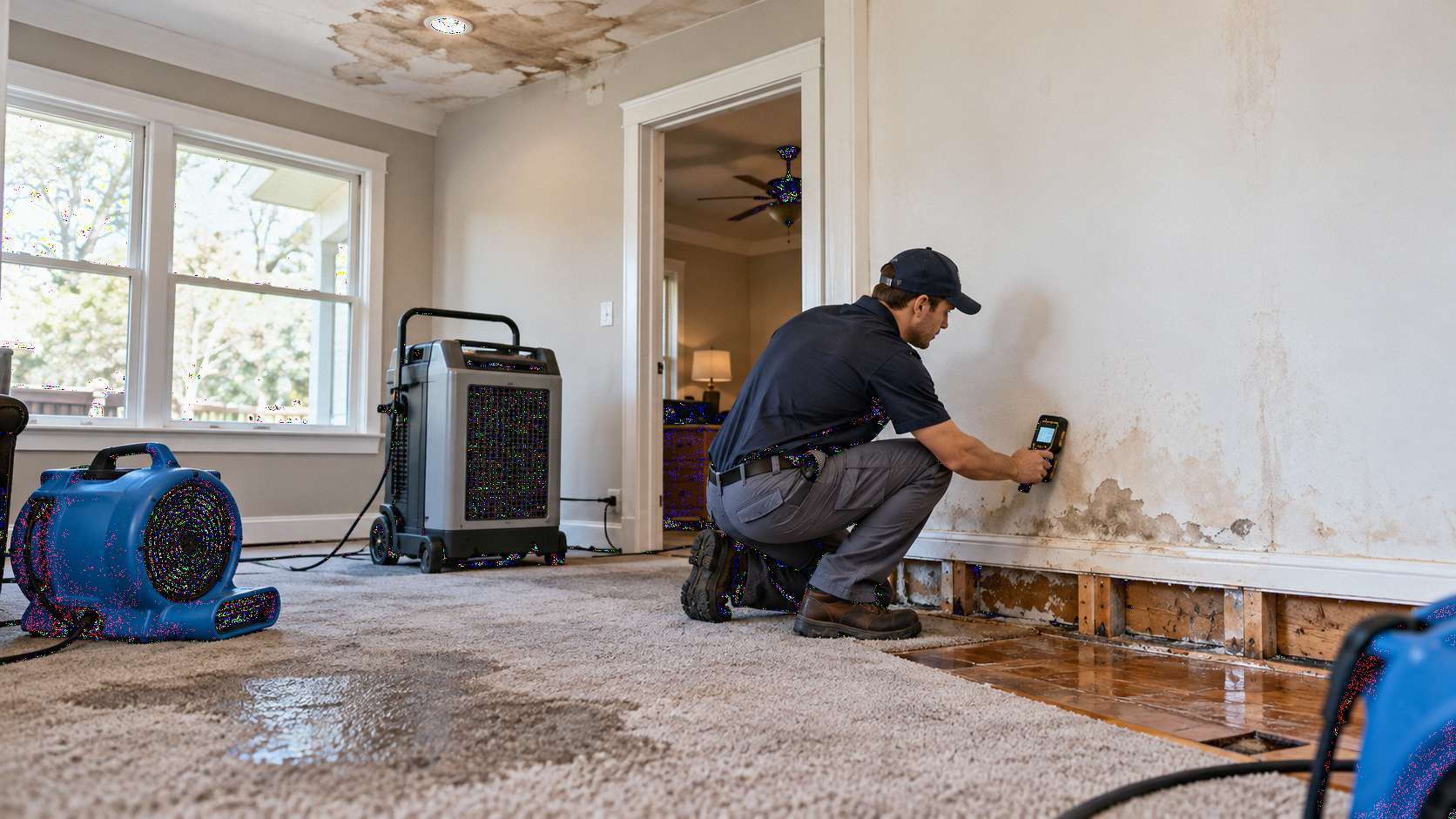
A small supply-line leak soaking one corner of a bedroom is very different from a plumbing failure that saturates carpeting, drywall, and ceiling materials. And neither is quite like moisture trapped deep inside hardwood flooring or concrete.
All three situations involve water damage, but they require different drying strategies.
That's where water damage classes come in.
Restoration professionals use four classes to describe how much moisture building materials have absorbed and how difficult that moisture may be to remove.
Under the ANSI/IICRC S500 framework, Classes 1–3 describe increasing evaporation loads from wet porous surfaces. Class 4 addresses significant moisture held in materials or assemblies that release water slowly.
These classifications help technicians develop drying plans, select equipment, and monitor progress.
One distinction matters from the beginning: water damage classes describe the drying challenge, not water contamination.
Understanding what each class means can help homeowners evaluate restoration estimates, equipment setups, and the decisions made before repairs begin.
Quick Answer: What Are Water Damage Classes 1–4?
There are four water damage classes used in professional structural drying.
- Class 1: Minimal absorption, with less than approximately 5% of the combined floor, wall, and ceiling area consisting of wet porous materials.
- Class 2: Significant absorption, with approximately 5–40% wet porous surfaces.
- Class 3: Extensive absorption, with more than approximately 40% wet porous surfaces.
- Class 4: Significant moisture absorbed into materials or assemblies with low evaporation rates, such as hardwood, plaster, concrete, or multilayer flooring.
For Classes 1–3, materials with low evaporation rates must have absorbed minimal moisture.
Class 4 is evaluated differently. It does not use the same surface-area percentage thresholds.
Water Damage Classes vs Water Damage Categories
Classes and categories are not interchangeable.
Water damage classes describe absorption and evaporation load. Water damage categories describe contamination.
A sanitary plumbing leak can produce Class 3 damage if extensive drywall, carpeting, and ceiling materials become wet.
Meanwhile, a small sewage backup may have a limited drying load but still require strict Category 3 contamination precautions.
The difference is straightforward:
- Class: How challenging is the drying process?
- Category: How contaminated is the water?
Both influence the restoration plan, but they address separate concerns.
For contamination classifications, see water damage categories 1, 2 and 3
Class 1 Water Damage: Minimal Absorption
Class 1 water damage represents the lowest evaporation load.
Less than approximately 5% of the combined floor, wall, and ceiling surface area consists of wet porous materials, with minimal absorption into low-evaporation materials.
A possible example is a small supply-line leak that wets a limited section of carpet without significantly affecting nearby walls or underlying assemblies.
Does Class 1 Require Professional Drying?
Not always, but the class alone cannot answer that question.
Moisture may travel beneath flooring or into adjacent materials even when the affected area looks small.
A professional assessment may involve targeted extraction, moisture measurements, and limited drying equipment.
The objective is to confirm that the moisture has not spread beyond the visible area.
Class 2 Water Damage: Significant Absorption
Class 2 water damage involves approximately 5–40% wet porous surfaces within the combined floor, wall, and ceiling area.
Low-evaporation materials must still have absorbed minimal moisture.
For example, a washing machine supply-line failure could soak carpeting and portions of the surrounding drywall.
Why Class 2 Creates a Greater Drying Load
Wet carpeting, gypsum board, and other porous materials release moisture into the air during drying.
As the amount of affected material increases, technicians may need greater air movement and dehumidification capacity.
The drying plan must also account for hidden moisture beneath flooring and behind trim.
A larger wet area does not automatically mean every material needs removal. Physical condition and drying feasibility still matter.
Class 3 Water Damage: Extensive Absorption
Class 3 water damage represents the greatest evaporation load among Classes 1–3.
More than approximately 40% of the combined floor, wall, and ceiling surfaces consists of wet porous materials, while low-evaporation assemblies have absorbed minimal moisture.
A major overhead plumbing failure that affects the ceiling, walls, and carpeting may produce Class 3 conditions.
What Makes Class 3 Drying More Demanding?
Several building surfaces may release moisture simultaneously.
Technicians must evaluate whether the drying environment has enough moisture-removal capacity and whether all affected materials are accessible.
The project may require additional equipment, selective material removal, and more extensive monitoring.
However, Class 3 does not automatically determine a specific machine count or drying duration.
Class 4 Water Damage: Deeply Held Moisture
Class 4 water damage involves significant absorption into materials or assemblies with low evaporation rates.
These materials can hold water internally even after visible surfaces appear dry.
Examples include:
- Hardwood flooring
- Concrete and masonry
- Plaster
- Multilayer subfloors
- Complex built-up flooring systems
Why Class 4 Is Different
In Classes 1–3, accessible porous surfaces contribute much of the evaporation load.
With Class 4, moisture may be trapped deeper within a material or between layers, making it more difficult to remove.
Specialized drying techniques or longer monitoring periods may be needed.
Hardwood Flooring and Subfloors
Water can penetrate wood boards and the layers beneath them.
Moisture Between Flooring Layers
Moisture trapped underneath a finished floor may not respond sufficiently to surface airflow alone.
When Material Removal Becomes Necessary
If an assembly cannot be adequately dried or has permanent physical damage, selective removal may be required.
Importantly, not every wet concrete slab or hardwood floor qualifies as Class 4. Significant absorption into low-evaporation materials is the key consideration.
What Is Evaporation Load in Structural Drying?
Evaporation load describes the anticipated moisture released into the air as wet building materials dry.
This matters because drying requires two related processes.
Air movement encourages moisture to evaporate from accessible surfaces. Dehumidification removes water vapor from the environment.
When evaporation exceeds the available moisture-removal capacity, indoor humidity may increase and drying can slow.
Why Material Type Matters
Carpet, drywall, wood, and concrete do not release moisture at identical rates.
Some materials present relatively accessible wet surfaces. Others hold moisture internally or restrict evaporation through their construction.
That is why water damage classes consider both the extent of wet surfaces and the characteristics of affected materials.
How Do Professionals Determine a Water Damage Class?
Restoration technicians inspect the drying environment, identify wet materials, and estimate the affected surface area.
Step 1: Define the Drying Space
The relevant space may be one room or another defined drying environment.
Step 2: Calculate Combined Surface Area
Consider a room measuring 12 × 15 feet with an 8-foot ceiling.
The combined surfaces are:
- Floor: 180 sq. ft.
- Ceiling: 180 sq. ft.
- Walls: 432 sq. ft.
- Total: 792 sq. ft.
Step 3: Identify Wet Porous Surfaces
Suppose 160 square feet of those surfaces are wet porous materials.
The percentage is approximately 20.2%.
That falls within the Class 2 range, provided low-evaporation materials have absorbed minimal moisture.
Step 4: Check for Deep Moisture
If significant moisture has penetrated hardwood, concrete, or complex assemblies, Class 4 conditions may apply regardless of the simple percentage calculation.
Step 5: Document the Assessment
Technicians use material moisture readings and physical inspection to support their findings.
A single moisture-meter reading does not independently establish the class.
For more information see how restoration companies find hidden water damage
How Water Damage Classes Affect Equipment Selection
The evaporation class influences drying equipment planning, but the exact setup depends on site conditions.
Air Movers
Air movers promote evaporation from accessible wet materials.
Positioning depends on room layout, material construction, and which surfaces need drying.
Dehumidifiers
Dehumidifiers remove moisture from the indoor air.
Greater evaporation loads may require greater moisture-removal capacity.
Specialized Drying Systems
Some Class 4 conditions may require specialized approaches for deeply held moisture in wood, concrete, or multilayer assemblies.
Monitoring Instruments
Moisture meters, thermohygrometers, and other measurement tools help technicians track material and environmental conditions.
What Happens During Professional Structural Drying?
A typical structural drying project follows several stages.
1. Stop the Water Source
The original leak must be controlled before effective drying can proceed.
2. Address Safety and Contamination
Electrical hazards and possible contamination are evaluated. Contaminated areas may need appropriate cleaning and controls before restorative air movement.
3. Extract Standing Water
Water extraction removes bulk moisture before equipment addresses what remains inside materials.
4. Evaluate Building Materials
Technicians inspect flooring, drywall, insulation, framing, cabinets, and other affected components.
5. Establish the Drying Environment
Air movers and dehumidifiers are positioned according to the remaining evaporation load and material conditions.
6. Monitor and Adjust
Material moisture readings and environmental measurements help determine whether the strategy is effective.
7. Verify Drying Completion
Remaining materials should meet suitable drying goals before permanent repairs begin.
For the complete process see structural drying after water damage
Can Water Damage Classes Change During Restoration?
The drying conditions can change as the project progresses.
Extraction removes standing water. Selective demolition changes the remaining wet surfaces. Additional inspection may reveal moisture in previously concealed assemblies.
These developments can require equipment adjustments.
However, a project does not necessarily need a new class designation every time moisture readings decrease.
The initial classification describes the assessed drying conditions; ongoing monitoring guides subsequent decisions.
How Long Does Each Water Damage Class Take to Dry?
There is no reliable fixed drying time for each class.
Duration depends on:
- Initial moisture content
- Material type and thickness
- Depth of water penetration
- Temperature and humidity
- Equipment capacity
- Drying access
- Physical damage
Class 4 conditions may require more specialized work because moisture is difficult to release.
However, Class 1 does not guarantee overnight drying, and Class 3 does not automatically require a predetermined number of days.
How Do Technicians Know When Drying Is Complete?
A wall or floor that looks dry may still contain moisture internally.
Drying verification relies on appropriate material readings, reference conditions, and the requirements of the intended repairs.
Special attention may be needed for subflooring, framing, wall cavities, and concrete substrates.
Before new flooring or finishes are installed, the affected assemblies must meet suitable drying goals and applicable manufacturer requirements.
Do Higher Water Damage Classes Mean Higher Costs?
Not automatically.
Greater drying loads may require additional equipment, labor, or monitoring. However, restoration costs also depend on material removal, contamination, accessibility, and reconstruction needs.
A small Class 4 flooring loss may require specialized work, while a larger Class 3 loss may involve extensive drying across multiple surfaces.
The classification is a technical description—not a pricing scale.
Does the Class Affect Insurance Coverage?
The class may help document the technical restoration scope, but it does not independently determine insurance coverage.
Coverage generally depends on the cause of the loss and the policy language.
A restoration report may document affected materials, moisture readings, equipment use, and drying completion.
For additional guidance see water damage insurance claim help
Common Mistakes About Water Damage Classes
Avoid assuming that:
- Class 4 means the water is contaminated
- Class 1 never requires professional help
- Every wet hardwood floor is Class 4
- More equipment always means faster drying
- Visible dryness confirms internal dryness
- Drying is complete after a fixed number of days
- Class alone determines restoration costs
Correct decisions depend on the actual moisture and material conditions.
Water Damage Restoration in Northern Virginia
Homes across Alexandria, Arlington, Fairfax, McLean, and nearby DMV communities can experience very different structural drying challenges after plumbing failures and water intrusion.
Total Home Rescue provides water damage mitigation, structural drying, and reconstruction services in Northern Virginia.
A suitable drying plan starts with identifying affected materials and measuring moisture—not simply placing the same number of machines in every room.
Final Takeaway
Water damage classes describe how affected building materials influence structural drying.
Classes 1–3 reflect increasing amounts of wet porous surface area and evaporation load. Class 4 identifies significant moisture held within materials that release water slowly.
The appropriate approach is to assess the moisture, select drying methods based on actual conditions, monitor progress, and verify drying before reconstruction.
Frequently Asked Questions About Water Damage Classes
1. What is the difference between Class 1, Class 2, Class 3, and Class 4 water damage?
The main difference is the extent and characteristics of moisture absorption.
Class 1 involves minimal wet porous surface area, generally less than approximately 5% of the combined floor, wall, and ceiling surfaces.
Class 2 involves approximately 5–40%, while Class 3 involves more than approximately 40%.
These first three classes assume minimal moisture absorption into materials with low evaporation rates.
Class 4 involves significant moisture held deeply within materials such as hardwood, plaster, concrete, or complex multilayer assemblies.
The classes describe drying conditions and do not determine the water's contamination category.
2. Is Class 4 water damage the most severe type?
Class 4 can be technically challenging, but it is not automatically the largest, most dangerous, or most expensive water loss.
Its defining feature is significant moisture held in materials that release water slowly.
For example, a relatively small hardwood flooring assembly may present Class 4 conditions, while a much larger room with saturated drywall and carpet may qualify as Class 3.
The restoration scope depends on material condition, moisture penetration, accessibility, contamination, and the ability to dry affected assemblies.
Class 4 is best understood as a specialized drying challenge rather than a universal severity ranking.
3. How do professionals calculate the water damage class?
Technicians identify wet building materials and evaluate the affected drying space.
For Classes 1–3, they estimate wet porous surface area relative to the combined floor, wall, and ceiling surface area.
The approximate thresholds are less than 5% for Class 1, 5–40% for Class 2, and more than 40% for Class 3.
They must also determine whether significant moisture has penetrated materials with low evaporation rates.
If deeply held moisture is present in such materials, Class 4 may apply.
Inspection, moisture measurements, and documentation support the assessment.
4. Does Class 3 or Class 4 require more drying equipment?
Not necessarily.
Class 3 often involves a high evaporation load from extensive wet porous surfaces, potentially requiring greater moisture-removal capacity.
Class 4 may require specialized drying approaches because the moisture is held deeply within slow-drying materials.
Equipment selection also depends on affected space, room conditions, temperature, humidity, drying access, and equipment performance.
Simply adding more air movers may not improve results, especially where moisture is trapped beneath finished surfaces.
The equipment setup should be based on the actual drying challenge and adjusted using monitoring data.
5. How long does Class 4 water damage take to dry, and when can repairs begin?
There is no universal Class 4 drying timeline.
Deeply held moisture in hardwood, concrete, plaster, or multilayer assemblies may require specialized techniques and extended monitoring.
The duration depends on moisture levels, material thickness, construction, environmental conditions, and equipment effectiveness.
Repairs should begin only when the remaining materials meet suitable drying goals and damaged components have been addressed.
Before installing replacement flooring or closing wall assemblies, technicians should verify internal material conditions and consider relevant manufacturer requirements.
A dry-looking surface is not sufficient evidence that all moisture has been removed.

