

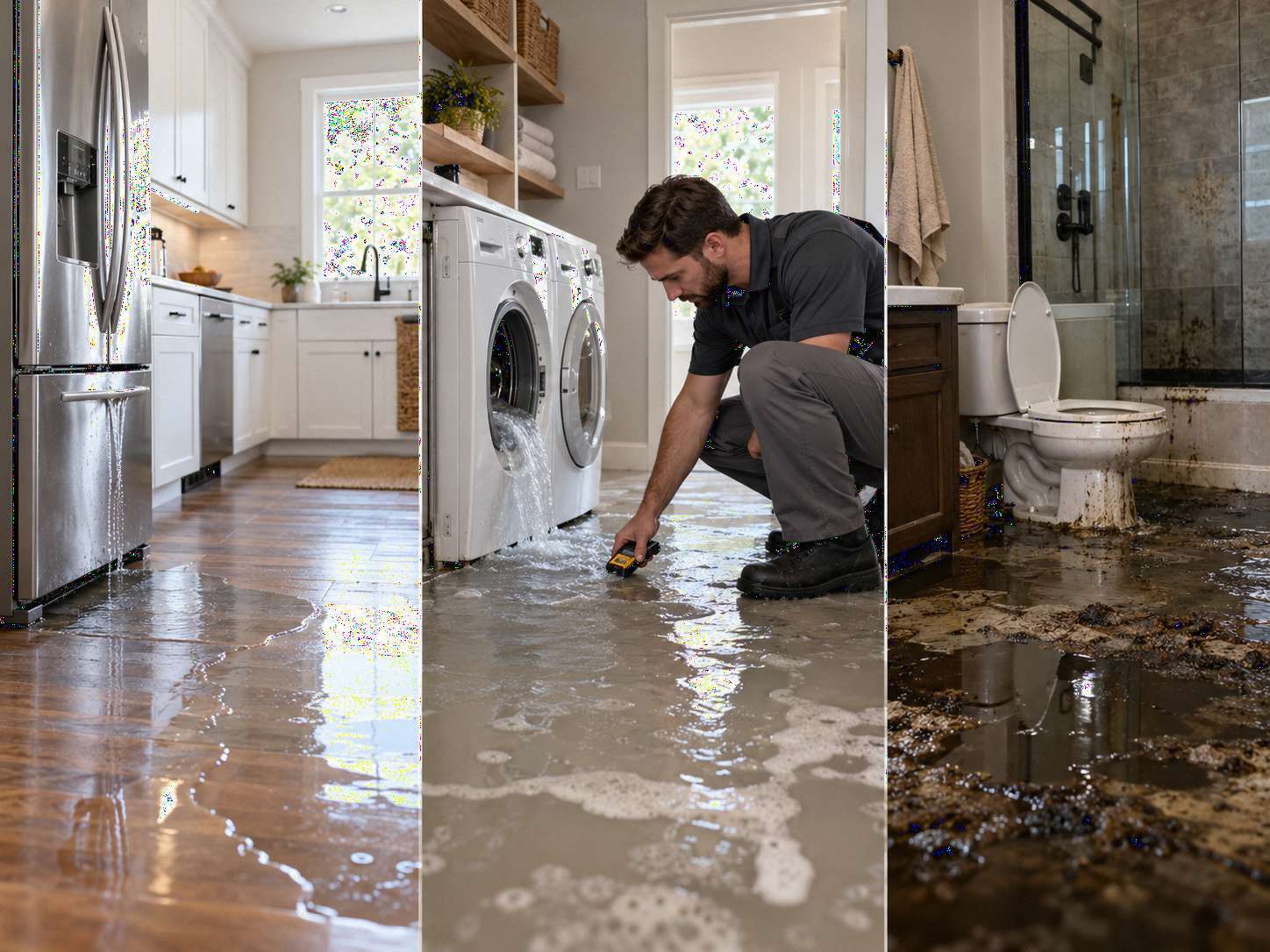
A broken water supply line, overflowing dishwasher, and sewage backup can all leave water across your floor. But they do not necessarily require the same cleanup.
The difference comes down to water damage categories.
In professional restoration, water is classified into three categories according to its contamination level: Category 1 (clean water), Category 2 (gray water), and Category 3 (black water).
These classifications help determine how technicians handle water extraction, contaminated materials, protective equipment, cleaning, and structural drying.
Water damage categories are based on contamination—not water color, depth, or the number of affected rooms.
Clear-looking water may contain harmful contaminants. Water from a sanitary source may become contaminated after entering a building. And a weather-related leak does not automatically qualify as Category 3.
Understanding the differences helps homeowners make safer decisions and avoid both incomplete cleanup and unnecessary material removal.
Quick Answer: What Are the Three Water Damage Categories?
The three water damage categories are:
- Category 1 — Clean Water: Water originating from a sanitary source without substantial contamination-related exposure risk at the source.
- Category 2 — Gray Water: Water containing significant contamination that may cause discomfort or illness through exposure.
- Category 3 — Black Water: Grossly contaminated water that may contain harmful biological or chemical agents, including sewage.
The water's originating source is important, but so is everything it contacts after entering the property.
For a broader explanation of the restoration process, read our water damage restoration homeowner guide
Why Water Damage Categories Matter
The water category can change how a restoration project is performed.
Consider two rooms with identical carpet and drywall damage. One was affected by a broken sanitary supply pipe. The other experienced a sewage backup.
Although the visible damage may look similar, the cleanup requirements can be substantially different.
Water damage categories influence:
- Personal protective equipment
- Contamination controls
- Water extraction procedures
- Material removal decisions
- Cleaning requirements
- Restoration of furniture and belongings
- The sequence of structural drying
The goal is to leave the property not only dry but appropriately cleaned and safe for normal use.
Category 1 Water Damage: Clean Water
Category 1 water damage begins with water from a sanitary source.
Typical examples include:
- Broken drinking-water supply pipes
- Leaking refrigerator water-supply lines
- Certain sanitary plumbing fixture overflows
- Broken appliance supply connections
For example, a pressurized pipe that fails beneath a kitchen sink may initially release Category 1 water.
However, that initial classification does not guarantee the water will remain sanitary throughout the loss.
Is Clean Water Damage Harmless?
No.
Even sanitary water can damage flooring, drywall, insulation, cabinets, and structural materials.
It may also create electrical hazards and slippery surfaces.
If the water remains trapped inside building assemblies, additional damage can develop.
Can Category 1 Water Damage Be Dried?
Often, provided the materials remain structurally sound and can be properly exposed to drying.
Depending on the loss, restoration may involve extraction, removing wet underlayment, opening wall cavities, and using air movers and dehumidifiers.
A clean-water origin does not automatically mean all affected materials should be saved.
Category 2 Water Damage: Gray Water
Category 2 water damage involves significant contamination.
Gray water may contain microorganisms, organic matter, cleaning residues, or other substances that create exposure concerns.
Possible sources include:
- Used dishwasher water
- Washing machine discharge
- Some toilet bowl overflows containing urine but no feces
- Other substantially contaminated household wastewater
The actual source and site conditions determine the category.
Why Gray Water Requires Additional Cleanup
Unlike an uncomplicated sanitary supply-line leak, gray water may leave contamination within absorbent building materials.
Professionals may need to:
- Restrict access to affected areas
- Use appropriate protective equipment
- Clean restorable surfaces
- Remove materials that cannot be adequately cleaned
- Control contamination before restorative drying
Can Category 2 Carpet Be Saved?
Sometimes, but not automatically.
Carpet face fibers, backing, padding, and the underlying subfloor must be considered separately.
Even if the visible carpet feels dry, the padding may retain moisture and contamination.
Drying a contaminated material does not necessarily make it sanitary.
Category 3 Water Damage: Black Water
Category 3 water damage involves grossly contaminated water.
It may contain harmful microorganisms, sewage-related contamination, chemical substances, or other agents capable of causing significant adverse reactions upon exposure.
Typical examples include:
- Sewage backups
- Waste-line backflows originating beyond a plumbing trap
- Toilet overflows containing fecal matter
- Seawater flooding
- Rising water from rivers or streams
Certain other contaminated exterior floodwater events may also qualify.
Why Black Water Damage Requires Professional Handling
Category 3 contamination can spread into drywall, insulation, flooring, and personal belongings.
Professional cleanup may require containment, protective equipment, controlled demolition, appropriate cleaning, and careful handling of contaminated debris.
Does Black Water Have to Look Black?
No.
Black water damage is a contamination classification, not a description of its appearance.
Some grossly contaminated water may look almost clear.
For sewage-specific restoration guidance, see sewage backup cleanup Virginia
What Category Is Water From Common Household Leaks?
The source provides important clues, but the final determination depends on the water's condition after entering the building.
Broken Water Supply Pipe
Water from a sanitary pressurized supply line generally begins as Category 1.
If it travels through contaminated materials, the classification may need to change.
Dishwasher or Washing Machine Leak
A leaking clean-water supply hose differs from wastewater escaping during a discharge cycle.
Used appliance water may contain detergents, food particles, soil, or other contaminants.
That distinction can affect whether the loss is Category 1 or Category 2.
Toilet Overflow
The exact source matters.
A broken toilet supply connection may initially release sanitary water.
An overflow involving urine but no feces may qualify as Category 2.
An overflow containing fecal matter or a waste-line backflow originating beyond the plumbing trap is Category 3.
Roof Leak or Wind-Driven Rain
Rainwater entering through a roof is not automatically Category 3.
In 2026, the ANSI/IICRC S500 Consensus Body clarified that wind-driven rain and other weather-related water intrusion require an assessment of actual contamination rather than automatic classification.
Exterior Flooding
Rising river or stream water and seawater are Category 3 examples under the standard.
Other forms of rainwater, groundwater, or exterior intrusion require evaluation of the water's source, pathway, and contaminants.
For basement emergencies, see flooded basement cleanup
Can Water Damage Change Categories Over Time?
Yes.
Water damage categories can change when the water becomes contaminated.
Water that begins from a sanitary source may contact wastewater, contaminated building materials, or other unsanitary conditions.
Temperature, time, environmental conditions, and materials contacted can all influence microbial activity and contamination.
There is no universal rule that Category 1 water automatically becomes Category 2 after exactly 24 or 48 hours.
Why the Water's Path Matters
The starting source is only one part of the assessment.
What Did the Water Contact?
Professionals consider the surfaces, cavities, flooring, and other materials through which the water traveled.
Was Existing Contamination Present?
Pre-existing unsanitary conditions can affect the final category.
When Should the Classification Be Reassessed?
When new information about the source, exposure conditions, or contamination becomes available, the category should be reconsidered.
The correct classification reflects the actual conditions—not a fixed assumption based on elapsed time.
Water Damage Categories vs Water Damage Classes
These terms are commonly confused, but they describe different characteristics.
Water damage categories describe contamination.
Water damage classes describe the moisture absorption and drying characteristics of the loss.
For example, a sanitary supply-line failure can affect several rooms and create extensive drying requirements while remaining Category 1.
A small sewage backup may affect only part of a bathroom while still requiring Category 3 contamination controls.
The category helps guide cleaning and safety procedures. The class and drying assessment help guide moisture removal.
Both are important, but they are not interchangeable.
How Restoration Professionals Determine the Water Category
Professional classification begins with inspection and information gathering.
A typical assessment considers:
- Original water source
- Time and circumstances of intrusion
- Status of source control
- Path of water migration
- Materials affected
- Evidence of contamination
- Existing conditions inside the property
Moisture meters and infrared cameras may help identify the affected area, but they cannot independently determine the contamination category.
For unusual contamination concerns or higher-risk environments, consultation with an indoor environmental professional may be appropriate.
How Cleanup Differs Between Categories 1, 2, and 3
The restoration process changes according to contamination and the physical condition of affected materials.
Step 1: Make the Area Safe
Avoid entering standing water where electrical hazards may exist.
Do not touch suspected sewage or unknown contaminated water.
Step 2: Stop the Source
When safe, stop the leak or arrange the appropriate plumbing or drainage repair.
Step 3: Document the Damage
Photograph water, affected materials, and belongings before significant cleanup when practical.
Step 4: Establish Contamination Controls
Category 2 and Category 3 losses require appropriate contamination controls and worker protection.
Contamination remediation should precede restorative drying.
Step 5: Remove Water and Damaged Materials
Standing water is extracted. Materials are evaluated for cleaning, drying, or removal.
Step 6: Complete Structural Drying
After appropriate cleaning and material treatment, professional equipment helps dry the remaining structure.
Moisture readings are used to verify progress.
For the complete mitigation sequence, see water mitigation process
Which Materials Can Be Saved After Water Damage?
Material salvage depends on contamination, physical damage, and the ability to clean and dry the affected assembly.
Drywall and Insulation
Some drywall exposed to sanitary water may be dryable.
Contaminated porous drywall and insulation may require removal when appropriate cleaning is not feasible.
Carpet and Padding
Carpet and padding can retain considerable moisture.
Their restoration potential depends on the water category, contamination, construction, and drying access.
Subflooring and Wood Framing
Structurally sound wood may sometimes be cleaned and dried.
Severe swelling, deterioration, hidden contamination, or limited access may change the repair decision.
Furniture and Belongings
Metal, glass, and hard plastic are generally easier to clean than upholstered furniture, books, or absorbent household items.
The decision should also consider the item's value and available restoration methods.
Why Contaminated Water Must Be Addressed Before Drying
Drying removes excess moisture.
It does not automatically remove sewage residues, microorganisms, or other contaminants.
Using high-powered air movement in an uncontrolled contaminated area may spread particles to unaffected spaces.
That is why proper contamination controls and cleaning are important before restorative drying in Category 2 and Category 3 losses.
Humidity control may still be needed during remediation, using methods appropriate to the site.
Can Mold Develop After Category 1 Water Damage?
Yes.
Mold can develop after any water damage category if materials remain damp under favorable conditions.
Even sanitary supply water can soak drywall, insulation, carpet, and wood.
EPA guidance recommends drying wet materials within 24–48 hours when possible to reduce mold risk.
This is a moisture-control recommendation, not an automatic deadline for changing water categories.
Does Insurance Coverage Depend on Water Category?
Not automatically.
Coverage generally depends on the cause of the loss and the policy's terms.
A sudden pipe failure may be treated differently from a sewer backup or exterior flood.
The water category may help document the necessary restoration scope, but it does not independently establish insurance coverage.
When Should You Call a Professional?
Professional evaluation is particularly important when:
- Sewage or other contamination is suspected
- The water source is unknown
- Electrical hazards may exist
- Multiple rooms are affected
- Water entered wall or floor cavities
- Porous materials are saturated
- Mold or hidden moisture is suspected
Common Mistakes When Classifying Water Damage
Avoid assuming that:
- Clear water is always Category 1
- Dirty-looking water is automatically Category 3
- Every toilet overflow has the same category
- All weather-related water is black water
- Category 1 water cannot become contaminated
- Drying contaminated materials makes them sanitary
- Water category automatically determines insurance coverage
Correct classification requires an assessment of actual conditions.
Water Damage Restoration in Northern Virginia
Homeowners across Alexandria, Arlington, Fairfax, McLean, and surrounding DMV communities can experience sanitary plumbing failures, appliance leaks, sewage backups, and storm-related water intrusion.
Total Home Rescue provides water damage mitigation, structural drying, and reconstruction services throughout Northern Virginia and the Washington, DC area.
The right restoration plan starts with identifying the water source, contamination concerns, and affected materials before selecting cleanup and drying procedures.
Final Takeaway
The three water damage categories describe different contamination levels:
- Category 1: Sanitary-source water
- Category 2: Significantly contaminated water
- Category 3: Grossly contaminated water
The category is not determined by water color, volume, or repair cost.
Identify the source, evaluate what the water contacted, address contamination, and then complete appropriate drying and restoration.
Frequently Asked Questions About Water Damage Categories
1. What is the difference between Category 1, Category 2, and Category 3 water damage?
The main difference is the degree of contamination.
Category 1 originates from a sanitary source, such as a broken potable-water supply pipe.
Category 2 contains significant contamination that may cause discomfort or illness through exposure. Certain appliance wastewater discharges and toilet overflows can fall into this category.
Category 3 is grossly contaminated. Sewage, waste-line backflows beyond a plumbing trap, and rising river or stream floodwater are common examples.
These categories influence protective equipment, contamination controls, cleaning, material removal, and restoration procedures.
They do not describe how much water entered the home or how extensive the structural damage is.
2. Is Category 2 gray water dangerous, and can homeowners clean it themselves?
Category 2 water presents greater contamination concerns than sanitary-source water.
It may contain microorganisms, organic material, or cleaning residues that create exposure risks.
A small incident involving an accessible nonporous surface may be simpler to address than wastewater that has saturated carpet padding, insulation, or wall cavities.
However, household fans or disinfectant sprays should not be assumed sufficient for contaminated materials.
When the water source is uncertain or contamination has spread into absorbent materials, professional assessment is advisable.
Avoid direct contact with questionable water until the hazards are understood.
3. Is Category 3 black water always sewage?
No.
Sewage is one of the most common examples, but Category 3 also includes other forms of grossly contaminated water.
Examples include seawater flooding, rising river or stream water, and certain contaminated weather-related intrusions.
However, rain entering through a damaged roof does not automatically qualify as Category 3.
The water's actual contamination and the pathway it traveled matter.
Category 3 water also does not need to look black. A relatively clear appearance cannot establish that water is sanitary.
When the origin is uncertain, the safest approach is to avoid exposure and request an appropriate assessment.
4. Can Category 1 clean water turn into Category 2 or 3 after 24 or 48 hours?
Yes, Category 1 water can become more contaminated, but there is no universal automatic category change after a fixed number of hours.
Sanitary water may contact contaminated materials or remain in conditions that encourage microbial growth.
Relevant factors include:
- Time
- Temperature
- Water source
- Contaminants already present
- Materials contacted
- Environmental conditions
EPA guidance recommends drying water-damaged materials within 24–48 hours when possible to reduce mold risk.
That recommendation is not a rule that all Category 1 water automatically becomes Category 2 or 3 at a specific time.
Classification should reflect actual site conditions.
5. Does Category 3 water damage mean all drywall, flooring, and furniture must be replaced?
No, but more extensive material removal is often necessary.
Highly absorbent materials can retain contaminants that are difficult to remove adequately.
Carpet padding, some insulation, saturated drywall, and heavily contaminated upholstery may not be practical to restore.
Certain nonporous surfaces and structurally sound building components may be cleanable using appropriate procedures.
Decisions depend on:
- Material type
- Contamination
- Physical damage
- Cleaning feasibility
- Accessibility
- Applicable restoration requirements
The goal is not to demolish everything automatically. It is to remove what cannot be appropriately restored while preserving materials that can be cleaned and dried.

