

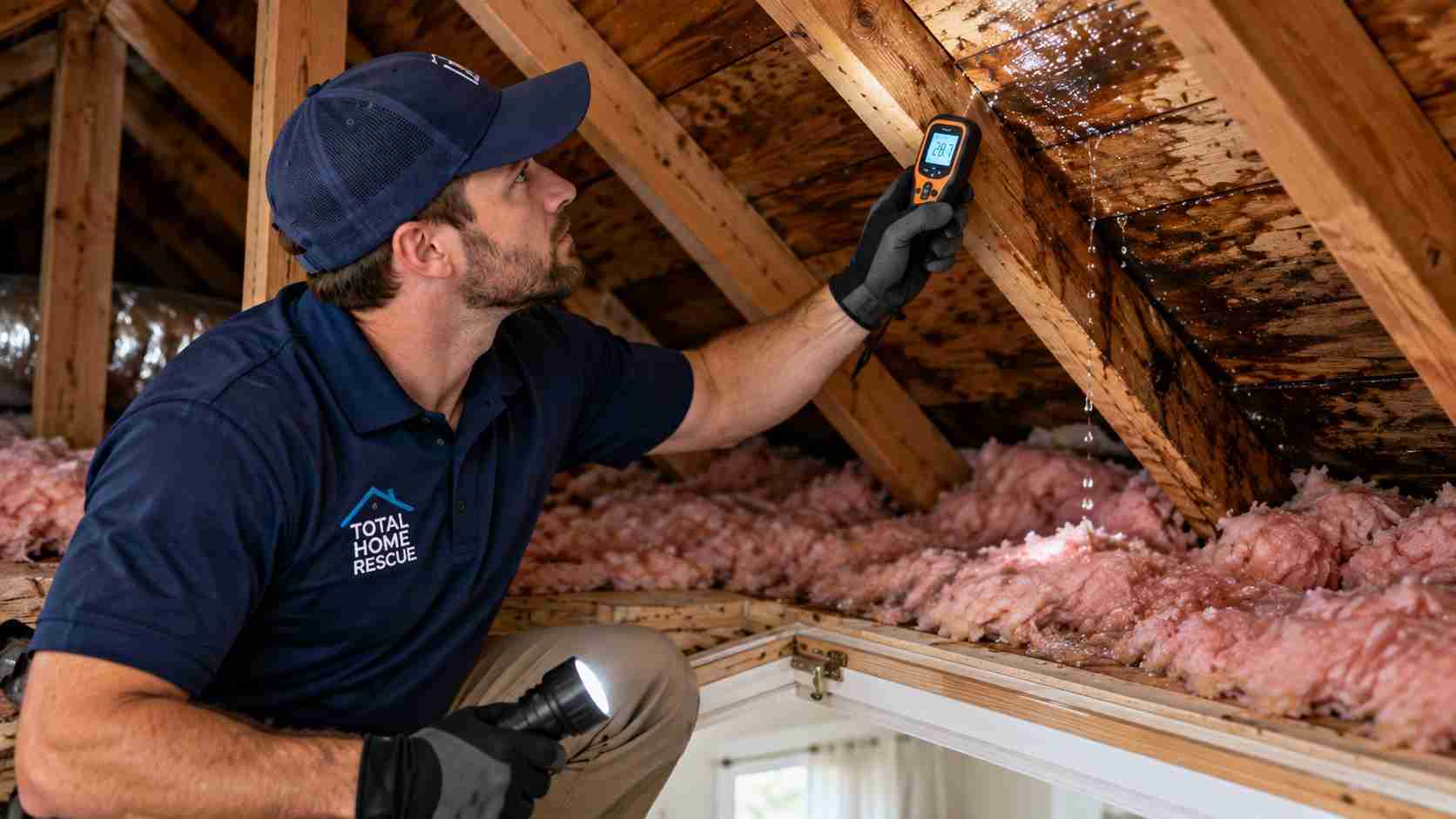
Roof Leak Water Damage: Why a Ceiling Stain May Need More Than Paint
A brown stain on the ceiling may look like a simple paint problem. But with roof leak water damage, the visible stain is often only the final sign of water traveling through the roof, attic, insulation, and drywall.
Rainwater can enter through damaged roofing, flashing, vents, valleys, skylights, or other roof penetrations. From there, it may travel several feet before appearing inside the room.
That is why painting over ceiling water damage from roof leak is rarely the first step.
The better order is:
Stop the leak → inspect hidden areas → find wet materials → dry or remove them → verify drying → repair and paint.
A small stain does not always mean major damage. But it should be investigated before being covered.
What Does a Ceiling Stain After Rain Mean?
If a ceiling stain appears, darkens, or becomes larger after rainfall, exterior water intrusion is a likely cause.
Common roof-related sources include:
- damaged shingles;
- failed flashing;
- roof valleys;
- plumbing vent penetrations;
- skylights;
- chimneys;
- roof-to-wall transitions;
- damaged sealants.
The stain may not be directly below the leak.
Water can run along roof decking, rafters, nails, pipes, or framing before reaching insulation and drywall.
This means water stains after rain should be treated as a clue, not an exact map of the problem.
If the stain appears without rainfall and is close to HVAC equipment, another source may be responsible. See AC leak water damage
How Roof Leak Water Damage Spreads
1. Water Gets Through the Roof
A defect in the roofing system allows rainwater to reach materials below the roof covering.
At this point, the problem can begin spreading beyond the roof itself.
2. Water Reaches the Attic
Once water reaches roof decking, rafters, or trusses, attic water damage can begin before anything is visible inside the home.
Water often moves sideways before moving downward.
Why the Stain May Be Far From the Leak
Sloped framing, pipes, nails, and other materials can redirect water.
The Visible Stain Is Only the End Point
The place where water appears on the ceiling may be several feet away from the actual roof opening.
Key Point
The full moisture path matters more than the size of the visible stain.
3. Insulation Gets Wet
Attic insulation can hold moisture against drywall and wood.
Even after rain stops, wet insulation may slow drying and keep nearby materials damp.
4. Water Reaches Drywall
Common signs of roof leak drywall damage include:
- yellow or brown staining;
- bubbling paint;
- peeling texture;
- soft drywall;
- damaged seams;
- sagging.
5. Moisture Can Move Into Walls
A leak near an exterior wall may travel down inside the wall cavity.
This can create hidden roof leak damage without obvious dripping.
If moisture or odor seems to be coming from inside a wall see signs of hidden mold in your home
Why Painting Over a Ceiling Stain Can Fail
Primer can hide discoloration. It cannot fix the cause.
Paint Does Not Stop the Leak
If water is still entering through the roof, the stain can return after the next storm.
Paint Does Not Dry Insulation
Wet insulation may remain above a ceiling that already feels dry from below.
Paint Does Not Repair Damaged Drywall
Drywall that has softened, sagged, or started breaking down may need repair or removal.
Paint Does Not Remove Hidden Moisture
Moisture may remain:
- behind drywall;
- under insulation;
- inside framing;
- around roof penetrations;
- inside wall cavities.
The important question is not simply whether the stain feels dry.
It is whether the entire affected area is dry.
When Roof Leak Water Damage Needs Fast Attention
Some situations should be handled quickly.
The Ceiling Is Sagging
A bulging or sagging ceiling may mean the drywall is saturated or water has collected above it.
Keep people and belongings away from the area until it is evaluated.
Water Is Near Electrical Fixtures
Leaks around recessed lights, ceiling fans, switches, or wiring require extra caution.
Avoid touching wet electrical components.
Water Is Still Entering
If rainwater continues entering the home, the source needs to be controlled before interior repairs can be completed.
Drywall Feels Soft
Soft or crumbling material may have lost enough strength that repainting alone is not appropriate.
The Stain Returns After Every Storm
Recurring water stains after rain strongly suggest that the leak has not been fully corrected.
How Roof Leak Water Damage Is Evaluated
A useful inspection should answer four questions:
- Where did the water enter?
- Where did it travel?
- What became wet?
- What can be dried and what needs repair or removal?
Step 1: Stop the Roof Leak
Structural drying will not solve a roof that continues allowing rain inside.
The roof source should be repaired first or at the same time as interior mitigation.
Step 2: Inspect the Attic
When the attic is accessible, signs of attic water damage may include:
- water tracks;
- stained roof decking;
- damp rafters;
- wet insulation;
- staining around nails;
- moisture near roof penetrations.
An old stain does not necessarily mean material is currently wet, which is why moisture conditions should still be checked.
Step 3: Check Beyond the Visible Stain
The stained portion of the ceiling should not automatically define the entire affected area.
Water may have spread into neighboring insulation, drywall, or framing.
Step 4: Measure Moisture
Moisture meters can help determine whether building materials remain wet.
Thermal imaging may help identify suspicious areas, but temperature differences alone do not confirm moisture.
Step 5: Decide What Can Be Saved
The decision depends on:
- the material;
- amount of water exposure;
- physical condition;
- duration of exposure;
- contamination;
- accessibility;
- ability to dry the material.
Does Roof Leak Drywall Damage Always Need Removal?
No.
A ceiling stain does not automatically mean the drywall must be removed.
Drywall may sometimes remain if it is structurally sound and can be dried effectively.
Removal becomes more likely when the material is:
- sagging;
- badly softened;
- crumbling;
- delaminated;
- repeatedly wetted;
- contaminated;
- difficult to dry.
Why the Backside Matters
Water usually reaches the hidden side of ceiling drywall first.
Wet insulation may sit directly on top of the drywall while the visible room-facing surface looks nearly normal.
That is why roof leak drywall damage cannot always be judged from below.
Does Wet Attic Insulation Need to Be Replaced?
Not always.
The answer depends on the insulation type, how wet it became, whether it is contaminated, and whether it can dry properly.
What should not happen is ignoring wet insulation simply because dripping stopped.
Wet insulation may:
- hold moisture against framing;
- keep drywall damp;
- slow structural drying;
- conceal the true size of the affected area.
With attic water damage, insulation should be part of the inspection.
Can a Roof Leak Cause Damage Without Dripping?
Yes.
A slow or intermittent leak may wet materials without creating obvious dripping inside the room.
Possible signs of hidden roof leak damage include:
- faint ceiling discoloration;
- paint peeling;
- visible drywall seams;
- musty odor;
- damp attic insulation;
- roof-deck staining;
- wall staining near the ceiling.
Waiting until water is dripping into the room can allow a smaller moisture problem to become more expensive to repair.
Roof Leak Water Damage and Mold
A roof leak does not automatically mean mold is present.
The concern increases when materials remain damp or the leak happens repeatedly.
Potential locations include:
- the backside of drywall;
- roof decking;
- wood framing;
- areas around wet insulation.
For more information see mold after water damage in Virginia
If the concern is inside a ceiling or wall see mold behind drywall signs and removal
For ceiling-specific problems see mold on ceiling causes and remediation
For attic problems see attic mold removal
What to Do After Finding Water Stains After Rain
1. Document the Damage
Take photos before repairs begin.
If the stain changes during future rain, photograph that too.
2. Protect the Area
Move furniture, electronics, rugs, and valuables away from active water.
3. Correct the Roof Leak
The source needs to be stopped before the interior can remain dry.
4. Inspect Hidden Areas
Check the attic, insulation, ceiling, and nearby walls where appropriate.
5. Dry or Remove Affected Materials
Materials that can be dried may remain.
Materials that have lost integrity or cannot be dried may need to be removed.
6. Verify Drying
Do not rebuild based only on appearance.
7. Repair and Paint
Drywall repair, primer, texture, and paint should come after the moisture problem is resolved.
Roofer vs. Water Damage Restoration Company
A roofer and a restoration company handle different parts of roof leak water damage.
What a Roofer Does
A roofer finds and repairs the exterior entry point.
This may involve roofing materials, flashing, penetrations, valleys, or other roof components.
What a Restoration Company Does
A water damage restoration company focuses on what happened after water entered the building.
This may include:
- moisture inspection;
- attic evaluation;
- wet insulation assessment;
- drywall removal when needed;
- structural drying;
- moisture monitoring;
- mold remediation;
- drywall and finish restoration.
Repairing the roof does not automatically dry the attic or ceiling.
Drying the ceiling does not repair the roof.
For significant damage, both parts may be necessary.
When Does a Roof Leak Become a Mold Remediation Project?
Mold remediation may be needed when visible growth or contaminated materials are discovered after water intrusion.
The moisture source should still be corrected first.
Cleaning growth without solving the leak is not a complete solution.
For an overview see what is mold remediation step by step process
For choosing a contractor see how to hire a mold remediation company in Northern Virginia
For cost information see mold remediation cost Virginia 2026
Fairfax homeowners can also review mold remediation estimate Fairfax VA 2026
Does Insurance Cover Roof Leak Water Damage?
Coverage depends on the cause of the damage and the specific insurance policy.
Sudden water damage may be treated differently from long-term leakage, deterioration, or maintenance problems.
Useful documentation can include:
- photos;
- date of discovery;
- source information;
- moisture readings;
- mitigation records;
- repair invoices.
If mold is involved, different limitations may apply.
For related guidance see does insurance cover mold remediation in Virginia
Roof Leak Water Damage Restoration in Northern Virginia
After a roof leak, repairing the roof may solve the source but not the interior moisture.
Total Home Rescue handles interior water damage mitigation, structural drying, damaged drywall and insulation, mold remediation when necessary, and restoration of affected areas.
For broader information see mold remediation Northern Virginia complete local guide 2026
Professional mold remediation services are available at mold remediation
Local service pages include mold remediation Alexandria VA
Final Takeaway
A ceiling stain after rain is evidence that water reached the inside of the home.
It does not show exactly how much material became wet.
The correct response to roof leak water damage is:
stop the leak → inspect → dry or remove affected materials → verify drying → repair the ceiling
Painting should come last.
A fresh coat of paint can hide a stain.
It cannot dry wet insulation, repair weakened drywall, or remove hidden roof leak damage.
FAQ About Roof Leak Water Damage
1. Can I Paint Over a Ceiling Stain After a Roof Leak?
Yes, but only after the leak has been repaired and the affected materials are dry.
Paint and stain-blocking primer can cover discoloration, but they cannot remove moisture from drywall, insulation, or framing.
If the ceiling is firm and drying has been verified, cosmetic repair may be appropriate.
If drywall is soft, sagging, deteriorated, or repeatedly wet, additional restoration may be needed first.
2. How Do I Know if a Ceiling Stain Is From the Roof?
The timing is an important clue.
A stain that appears or grows during or after rainfall should prompt a roof and attic inspection.
Water tracks, wet insulation, or stained roof decking may help identify the source.
Plumbing and HVAC leaks can create similar symptoms, so the source should be confirmed rather than assumed.
3. Does Wet Ceiling Drywall Always Need Replacement?
No.
Minor roof leak drywall damage may sometimes be dried if the material remains structurally sound.
Replacement becomes more likely when the drywall is sagging, soft, crumbling, contaminated, or cannot be dried effectively.
The hidden side of the drywall should also be considered because moisture may remain above the ceiling.
4. Can a Small Roof Leak Cause Mold?
It can if materials stay damp or the same area becomes wet repeatedly.
Mold may develop on drywall paper, framing, roof decking, or other materials inside the attic or ceiling assembly.
For prevention guidance see how to prevent mold growth in Northern Virginia
5. When Should I Call a Water Damage Restoration Company?
Consider professional evaluation when there are recurring water stains after rain, wet insulation, soft drywall, a sagging ceiling, bubbling paint, musty odors, visible growth, or significant attic water damage.
A roofer addresses why the water entered.
A restoration company addresses what became wet after it entered.
The goal is to find the full extent of the damage, save materials that can be dried, remove materials that cannot, and rebuild only after the structure is ready.

