

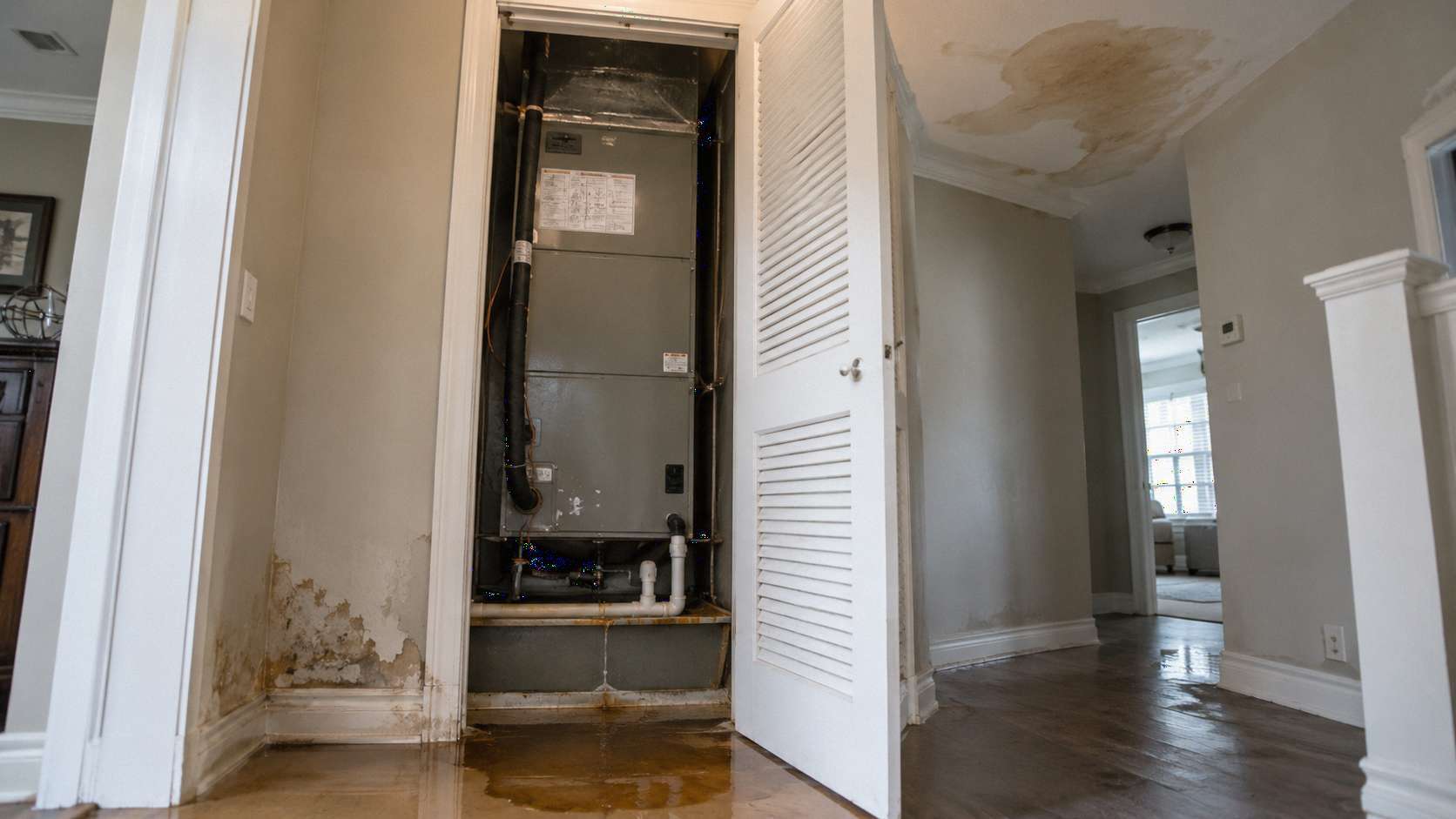
AC leak water damage can start as a small condensation problem and spread into drywall, ceilings, insulation, flooring, carpet padding, and nearby rooms before the leak becomes obvious.
An air conditioner normally removes moisture from indoor air while cooling the home. That moisture condenses on the evaporator coil, collects in a drain pan, and exits through the condensate drain system.
When the water cannot drain correctly, it may overflow around the indoor HVAC unit.
Common causes include an AC drain line clog, damaged condensate pan, frozen evaporator coil, condensate-pump problem, or disconnected drainage component. Carrier identifies clogged condensate drains, frozen evaporator coils, and damaged drain pans among common causes of indoor AC water leaks.
The correct response is:
Stop additional leaking → identify and repair the HVAC source → document the affected area → remove accessible water → locate hidden moisture → dry and monitor wet materials → repair walls, ceilings, and floors after moisture conditions are addressed.
The most important distinction is simple:
Repairing the air conditioner stops the source. It does not automatically dry the building.
For a complete restoration overview see
Quick Answer: What Should You Do After an AC Water Leak?
If you discover an active HVAC condensate leak:
- Turn the cooling system off when it can be done safely.
- Avoid standing water around energized HVAC or electrical equipment.
- Remove accessible surface water.
- Photograph the HVAC unit, drain pan, surrounding flooring, walls, and any ceiling damage below.
- Have the HVAC source diagnosed and repaired.
- Check nearby drywall, insulation, flooring, carpet padding, baseboards, and rooms below.
- Begin appropriate drying promptly.
- Do not patch stains or reinstall finishes over unresolved moisture.
If water is actively spreading through finished areas see
How Does HVAC Condensation Turn Into Water Damage?
Condensation is a normal part of air-conditioning operation.
When warm indoor air passes over the cold evaporator coil, moisture in the air condenses into liquid water.
Under normal conditions:
Condensation forms → water enters the drain pan → water reaches the condensate drain line → water drains safely away.
Problems begin when that drainage path is interrupted.
EPA specifically recommends keeping air-conditioning drip pans clean and condensate drain lines unobstructed and flowing properly as part of indoor moisture control.
If the HVAC system continues running while the drain system is restricted, new condensation can continue forming and add to the leak.
What Causes an HVAC Condensate Leak?
An HVAC condensate leak does not always have the same cause.
AC Drain Line Clog
An AC drain line clog is one of the most common problems.
Dust and airborne particles can combine with moisture and form buildup inside the condensate line. Over time, the restriction can prevent water from draining normally.
Water then backs up toward the drain pan.
If the pan fills, it may overflow into the home.
Common signs can include:
- Standing water near the indoor HVAC unit
- Water inside an HVAC closet
- Ceiling or floor staining near the equipment
- Musty odor
- Little or no expected condensate drainage
- HVAC shutdown caused by an overflow safety switch
Carrier notes that debris can accumulate inside condensate drains and that clogged lines may cause water to back up and damage nearby floors or ceilings.
Damaged Condensate Pan
A cracked, corroded, or damaged drain pan may allow water to escape even when the drain line itself is open.
Frozen Evaporator Coil
A frozen evaporator coil can create additional water when the accumulated ice melts.
Restricted airflow is one possible contributor to coil freezing.
Condensate Pump or Drainage Failure
Some HVAC systems depend on a condensate pump to move water.
If the pump, drainage connection, or drain configuration fails, condensation may accumulate around the indoor unit.
Why an AC Drain Line Clog Can Cause Hidden Damage
An AC drain line clog often creates a slow leak rather than a dramatic flood.
That can make it easy to underestimate.
A system may continue producing condensation while the homeowner sees only a small puddle near the equipment.
Repeated water exposure can gradually affect:
- Drywall
- Baseboards
- Flooring
- Carpet padding
- Insulation
- Ceiling assemblies
- Wood framing
Clearing the drain line is important, but the repair does not establish whether surrounding building materials are dry.
Water Around HVAC Closet: Where Does It Go?
Water around HVAC closet flooring may spread much farther than the visible puddle.
Possible pathways include:
- Under baseboards
- Beneath laminate
- Under LVP or vinyl
- Into carpet padding
- Beneath partition walls
- Into the lower edge of drywall
- Through openings around mechanical components
If the closet is located upstairs, water may also migrate downward.
Warning Signs Water Has Spread Beyond the Closet
Look for:
- Swollen baseboards
- Damp carpet outside the closet
- Raised flooring seams
- Soft drywall
- Paint bubbling
- Discoloration in a neighboring room
- Moisture appearing on the ceiling below
The absence of visible standing water does not prove the surrounding materials are dry.
For more information see
Air Conditioner Leak Ceiling Damage
Air conditioner leak ceiling damage commonly occurs when an air handler is located in an attic or above finished living space.
Condensate may leak into:
- Ceiling drywall
- Attic insulation
- Wood framing
- Areas around penetrations or fixtures
The first visible sign may appear downstairs rather than near the HVAC equipment.
Signs of a Ceiling Leak From AC Equipment
A ceiling leak from AC may produce:
- Yellow or brown water stains
- Bubbling paint
- Peeling finish
- Damp drywall
- Soft areas
- Sagging
- Active dripping
The stain may not appear directly underneath the leak.
Water can move along framing or other surfaces before reaching finished drywall.
Is Every Ceiling Stain an AC Problem?
No.
Similar damage can come from:
- Roof leaks
- Plumbing
- Bathrooms
- Supply lines
- Other water sources
The source should be confirmed before repairing the ceiling.
For a detailed guide see
Does Ceiling Drywall Need to Be Removed?
Not automatically.
The decision depends on actual conditions.
Important factors include:
- Amount of water
- Duration of exposure
- Physical drywall condition
- Wet insulation above the ceiling
- Accessibility
- Ability to dry the assembly
When May Ceiling Drywall Remain?
Drywall that remains firm and structurally intact may present a different situation from material that has physically deteriorated.
When Is Removal More Likely?
Removal becomes more relevant when drywall is:
- Soft
- Sagging
- Swollen
- Delaminated
- Physically damaged
What If Insulation Is Wet?
Wet insulation can retain moisture inside the ceiling assembly and may require additional access.
Can You Simply Paint Over the Stain?
No.
Paint may hide the discoloration but does not address moisture inside the ceiling.
Ceiling Restoration Rule
Confirm the source → identify affected materials → evaluate condition → create necessary access → dry and monitor → repair finishes.
AC Leak Water Damage Inside Walls
AC leak water damage can also enter finished walls, especially around HVAC closets and condensate piping.
Water may reach:
- The bottom edge of drywall
- The back side of drywall
- Insulation
- Wood framing
- Materials behind baseboards
Possible signs include:
- Damp or swollen baseboards
- Soft drywall
- Peeling paint
- Recurring stains
- Persistent dampness
- Musty odor
For more information see
How AC Leak Water Damage Affects Flooring
Flooring can conceal a significant amount of moisture after an HVAC condensate leak.
LVP and Vinyl
Water-resistant flooring does not mean water cannot move underneath it.
Water can enter through:
- Room perimeters
- Door transitions
- Seams
- Wall edges
- Mechanical penetrations
Laminate
Laminate can react to moisture with:
- Raised seams
- Swollen edges
- Warping
- Core deterioration
Permanent swelling may remain even after the material dries.
Hardwood and Engineered Wood
Wood flooring may show:
- Cupping
- Crowning
- Swelling
- Buckling
- Staining
Carpet and Padding
Carpet can begin to feel dry while the pad underneath remains damp.
For flooring-specific guidance see
For wood flooring decisions see
HVAC Repair vs. Water Damage Restoration
These are two different scopes of work.
An HVAC technician may correct:
- An AC drain line clog
- Damaged condensate pan
- Frozen coil
- Condensate pump issue
- Drain connection problem
That stops or reduces additional leaking.
It does not automatically answer whether:
- Ceiling drywall is dry
- Insulation is dry
- Water remains beneath flooring
- Wall cavities contain moisture
- Carpet padding is still wet
The HVAC repair corrects the mechanical source.
Water-damage restoration addresses what happened after water escaped into the building.
When Is Professional Drying Needed?
Professional drying becomes more relevant when an HVAC condensate leak reaches porous or concealed materials.
Examples include:
- Wet ceiling drywall
- Wet wall drywall
- Insulation
- Carpet padding
- Water beneath flooring
- Hardwood
- Several affected rooms
- Unknown leak duration
Professional restoration may involve:
- Water extraction
- Moisture measurements
- Air movement
- Dehumidification
- Targeted access
- Monitoring drying progress
For detailed drying guidance see
Why Fans Alone May Not Be Enough
A fan can increase airflow over an exposed wet surface.
It cannot verify moisture conditions beneath flooring or inside a ceiling cavity.
Drying can require a combination of:
- Air movement
- Dehumidification
- Moisture monitoring
- Access to concealed materials
The correct strategy depends on which materials became wet and whether moisture can actually escape.
Why the First 24–48 Hours Matter
Wet materials should be addressed promptly after AC leak water damage.
EPA recommends drying wet or damp materials within approximately 24–48 hours after a leak or spill when possible and states that moisture control is the key to controlling mold.
This does not mean mold automatically appears exactly 48 hours after a leak.
The practical takeaway is:
Do not wait for visible mold before dealing with wet drywall, insulation, flooring, or carpet padding.
Can an HVAC Condensate Leak Cause Mold?
Persistent moisture can create conditions that support mold growth.
Possible locations include:
- HVAC closet drywall
- Ceiling cavities
- Insulation
- Framing
- Carpet padding
- Materials beneath flooring
- Areas around condensate pans
An HVAC condensate leak does not automatically mean mold remediation will be needed.
The first priorities are controlling the leak and drying affected materials.
For additional information see
For HVAC-specific mold information see
Seven Mistakes After an AC Water Leak
Mistake 1: Clearing the Drain Line and Assuming Everything Is Finished
The repair may stop additional water but does not dry affected construction.
Mistake 2: Painting Over a Ceiling Stain
Paint does not correct air conditioner leak ceiling damage.
Mistake 3: Ignoring Water Around the HVAC Closet
Water around HVAC closet flooring can travel underneath adjacent finishes.
Mistake 4: Assuming the Floor Is Dry Because the Surface Feels Dry
Moisture may remain beneath LVP, laminate, carpet, or wood flooring.
Mistake 5: Assuming Every AC Leak Is a Drain-Line Clog
Other HVAC problems can also release water.
Mistake 6: Waiting for Mold
Wet materials should be addressed before visible growth becomes the reason to act.
Mistake 7: Reconstructing Too Early
New paint, flooring, trim, or drywall should not conceal unresolved moisture.
DIY Cleanup vs. Professional AC Leak Water Damage Restoration
A small amount of condensation discovered immediately on a hard, accessible surface can have a limited cleanup scope.
Professional help becomes more appropriate when:
- Ceiling drywall is wet
- Insulation is affected
- Wall drywall is wet
- Water moved underneath flooring
- Carpet padding is saturated
- Several rooms are affected
- Leak duration is unknown
- Moisture remains after surface cleanup
For more information see
How Much Does AC Leak Water Damage Restoration Cost?
There is no universal price for AC leak water damage.
The restoration scope depends on what became wet.
Cost factors can include:
- Leak duration
- HVAC location
- Ceiling involvement
- Wet drywall
- Wet insulation
- Flooring type
- Carpet and padding
- Number of affected areas
- Required material access
- Drying requirements
- Reconstruction
An AC drain line clog discovered quickly beside a hard utility-room floor can result in a very different scope from an attic air handler leaking through insulation and ceiling drywall.
For broader pricing factors see
For room-specific cost factors see
Does Homeowners Insurance Cover AC Leak Water Damage?
Coverage depends on the cause and the actual policy.
NAIC's consumer guide lists freezing, rupturing, or sudden and accidental overflow from an air-conditioning system among perils included in common broader homeowners policy forms.
That does not mean every AC leak is automatically covered.
A sudden accidental overflow may be treated differently from repeated leakage, deterioration, or unresolved maintenance conditions.
Helpful documentation can include:
- HVAC equipment
- Drain pan
- Condensate line
- Apparent leak source
- Ceiling damage
- Wet walls
- Flooring damage
- HVAC service documentation
- Water mitigation records
For broader insurance guidance see
For claim preparation see
How Can You Help Prevent Another AC Condensate Leak?
Prevention focuses on keeping the condensate system functioning properly.
Useful steps include:
- Routine HVAC maintenance
- Keeping the condensate drain unobstructed
- Keeping the drain pan clean
- Replacing filters as appropriate
- Investigating recurring water around the indoor unit
- Responding to unexplained AC shutdowns
- Checking ceilings below attic HVAC equipment
EPA specifically recommends keeping AC drip pans clean and drain lines unobstructed and flowing correctly.
FAQ: AC Leak Water Damage
1. How can I tell if an AC leak caused hidden water damage?
Start by checking beyond the visible puddle.
Potential warning signs include:
- Swollen baseboards
- Damp carpet padding
- Soft drywall
- Bubbling paint
- Raised flooring seams
- Recurring ceiling stains
- Moisture appearing in an adjoining room
However, hidden AC leak water damage may exist without obvious surface symptoms.
Water can travel under floating flooring, along the back of drywall, through insulation, or across ceiling framing.
If the leak duration is unknown, the HVAC unit is located in an attic, or water has crossed into more than one finished area, a broader moisture assessment may be appropriate.
The goal is not to remove everything automatically. It is to determine what actually became wet.
2. Can an AC drain line clog cause serious ceiling damage?
Yes.
An AC drain line clog can cause condensate to back up into the drain pan.
If the air handler is in an attic or another elevated location, overflowing water can enter insulation and ceiling drywall.
The seriousness of the resulting air conditioner leak ceiling damage depends on how much water escaped, how long the leak continued, and the physical condition of the ceiling.
Warning signs that deserve prompt attention include:
- Sagging drywall
- Bulging areas
- Active dripping
- Significant softness
- Expanding stains
A small visible stain does not necessarily mean only the painted surface became wet.
3. Why does water keep appearing around my HVAC closet?
Recurring water around HVAC closet flooring usually means either the HVAC source is still active or trapped moisture is continuing to emerge from surrounding materials.
Potential HVAC causes include:
- AC drain line clog
- Damaged drain pan
- Frozen evaporator coil
- Condensate pump failure
- Drain connection problem
The water should not simply be wiped up repeatedly.
Inspect the flooring outside the closet, baseboards, nearby drywall, and the opposite side of adjacent walls.
If water has moved beneath flooring, it can sometimes reappear at edges or transitions after the original puddle is gone.
4. Can AC leak water damage dry without professional equipment?
Sometimes, depending on the amount of water and the materials involved.
A small amount of water on an accessible nonporous surface may dry quickly once the source is stopped.
But drywall, insulation, wood, carpet padding, and layered flooring systems can retain moisture longer.
Whether professional drying is appropriate depends on:
- Amount of water
- Duration
- Materials affected
- Indoor humidity
- Accessibility
- Extent of concealed moisture
The decision should be based on actual conditions rather than assuming every leak needs equipment or assuming every leak will dry by itself.
5. When do I need both an HVAC contractor and a water damage restoration company?
You may need both when the HVAC problem has allowed water to enter building materials.
An HVAC professional addresses the mechanical cause, such as:
- AC drain line clog
- Damaged drain pan
- Frozen coil
- Condensate pump problem
- Drainage failure
Water-damage restoration becomes more relevant when there is:
- Air conditioner leak ceiling damage
- Wet drywall
- Wet insulation
- Water beneath flooring
- Saturated carpet padding
- Several affected areas
- Unknown leak duration
- Persistent moisture
The HVAC contractor stops the source.
The restoration process addresses what became wet.
Final Takeaway
AC leak water damage can begin as a condensate drainage problem and spread into ceilings, walls, flooring, insulation, carpet padding, and adjoining rooms.
An HVAC condensate leak should be corrected promptly.
An AC drain line clog can cause condensate to back up and overflow.
Water around HVAC closet flooring may extend underneath nearby finishes.
Air conditioner leak ceiling damage can involve drywall, insulation, and framing rather than only a visible stain.
And a ceiling leak from AC equipment should not simply be patched or painted before the moisture condition is understood.
The correct sequence is:
Stop additional leaking → repair the HVAC source → document the affected area → remove accessible water → identify concealed moisture → dry and monitor affected materials → repair finishes after moisture conditions are addressed.
That sequence helps prevent the most common mistake after an AC leak: repairing the equipment while leaving the building materials wet.

