

Mold Behind Drywall: Signs, Risks & When Removal Is Needed
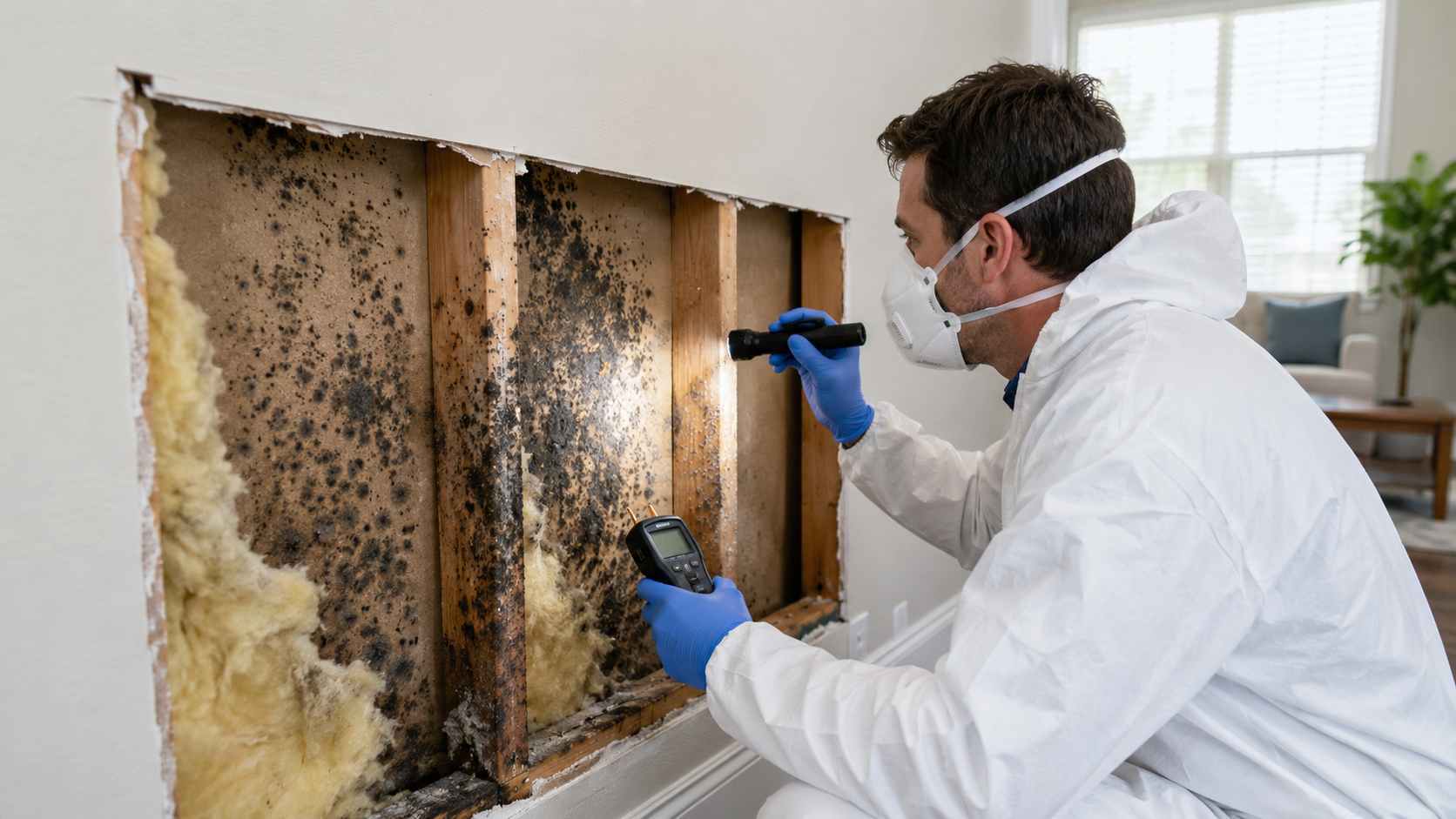
Mold behind drywall is one of the most common hidden problems after a plumbing leak, roof leak, bathroom overflow, HVAC condensation issue, basement water intrusion, or slow leak inside a wall. The front of the wall may show only a small stain, bubbling paint, or a musty smell, while the backside of the drywall, insulation, base plate, and wall cavity may already be affected.
Mold behind drywall usually forms after a wall leak, plumbing failure, roof leak, or trapped moisture inside a wall cavity. Common signs include musty odor, bubbling paint, stains, soft drywall, warped baseboards, and recurring discoloration. If drywall stayed wet for more than 24–48 hours, feels soft, or has mold on the paper backing, removal is often needed because drywall is porous. The safest approach is to stop the leak, inspect moisture levels, remove contaminated materials when needed, dry the cavity, and rebuild only after the area is clean and dry.
This is why mold behind drywall should never be treated as a simple cosmetic issue. Drywall is porous, and once moisture reaches the paper backing or stays trapped inside the wall cavity, mold can grow where homeowners cannot see it. Painting over the stain, spraying bleach, or drying only the surface may hide the problem temporarily but will not remove contaminated material inside the wall.
Total Home Rescue helps homeowners and property managers in Northern Virginia, including Alexandria, Arlington, Fairfax, McLean, Tysons, and Falls Church, evaluate mold behind drywall after leaks, water damage, and hidden wall moisture problems.
If you recently had water damage, start with this related guide: mold after water damage in Virginia.
For homeowners in Northern Virginia, Alexandria, Arlington, Fairfax, McLean, Tysons, Falls Church, and nearby DMV areas, the right response depends on three things: how long the wall stayed wet, whether moisture is still present, and whether the drywall or insulation is contaminated.
What Causes Mold Behind Drywall?
Mold behind drywall usually starts when moisture enters a wall cavity and cannot dry fast enough. Drywall is made with gypsum and paper facing. The paper layer, dust, insulation, and organic debris inside the wall cavity can support mold growth when moisture is present.
Common causes include:
- Plumbing leaks inside walls
- Toilet, sink, tub, shower, or supply line leaks
- Roof leaks that travel down framing
- Condensation on cold pipes or HVAC ducts
- Basement moisture or foundation seepage
- Water damage from an upstairs unit
- Washing machine or dishwasher leaks
- Poor drying after water damage
- Repeated bathroom humidity
- Hidden leaks behind cabinets, vanities, or appliances
The most dangerous situation is not always a major flood. A small leak inside the wall can create hidden wall mold if it continues for days or weeks. Many homeowners do not notice the problem until they smell a musty odor, see bubbling paint, or discover soft drywall near the baseboard.
For broader hidden mold warning signs, see: signs of hidden mold in your home.
Signs of Mold Behind Drywall
The signs of mold behind drywall are not always obvious. Sometimes the wall does not look black or fuzzy. Instead, the evidence appears as moisture damage, odor, surface changes, or recurring stains.
Visual Signs of Mold Behind Drywall
Watch for:
- Brown, yellow, gray, green, or black staining
- Bubbling or peeling paint
- Soft, swollen, or crumbly drywall
- Warped baseboards or trim
- Water rings on walls or ceilings
- Cracks in joint compound
- Sagging or uneven wall sections
- Stains that return after repainting
- Visible mold near baseboards, corners, or outlets
If the stain appears near a bathroom, kitchen, laundry room, HVAC closet, basement wall, or ceiling below another unit, the chance of mold after leak in wall is higher.
Odor Signs of Hidden Wall Mold
A musty odor is one of the strongest warning signs. You may notice:
- Musty smell near one wall
- Odor that gets stronger after rain
- Smell near baseboards or outlets
- Damp smell in one room only
- Odor that returns after cleaning
- Smell when the HVAC system runs
A wall can smell moldy before visible mold appears. If the odor is strongest near one section of drywall, the issue may be inside the wall cavity.
Moisture and Texture Signs
Drywall affected by water may feel different. Look for:
- Soft spots
- Swelling near the bottom of the wall
- Paint that feels loose
- Drywall that dents easily
- Baseboards pulling away from the wall
- Dampness near flooring
- Condensation or sweating near walls
If the drywall is soft, swollen, or deteriorated, it is often no longer a cleanable surface. In many cases, the affected section must be removed.
Signs of Mold Behind Drywall
How Long Can Drywall Stay Wet Before Mold Grows?
Drywall should be dried as quickly as possible after a leak. Mold risk increases when wet drywall, insulation, baseboards, and wall cavities stay damp for more than 24–48 hours. The exact timeline depends on temperature, humidity, airflow, material type, and how much water entered the wall.
A small clean-water leak caught immediately may sometimes be dried without demolition. But if the wall cavity stayed wet, the backside of the drywall became damp, or insulation absorbed moisture, wet drywall mold becomes much more likely.
Why Surface Drying Is Not Enough
A wall can feel dry on the front but remain wet inside because:
- Paint slows evaporation
- Insulation holds moisture
- Baseboards trap water at the bottom
- Cabinets block airflow
- Wall cavities have limited ventilation
- Water travels down studs and plates
- Moisture can remain behind vinyl wallpaper or heavy paint
This is why professional moisture readings are important. Guessing based only on what the wall looks like can lead to missed mold growth.
When Can Wet Drywall Be Saved?
Wet drywall may be salvageable if the water source was clean, the leak was caught quickly, the drywall is still firm, insulation is dry, moisture readings return to normal, and there is no odor or visible mold.
Drywall is more likely to be saved when:
- The wall was wet for a short time
- Water did not reach the backside of the panel
- The drywall is not soft or swollen
- There is no musty odor
- No mold is visible on either side
- The wall cavity is dry
- The leak source is fully corrected
However, even when the front looks clean, the backside may still be affected. If there is any doubt, the wall cavity should be inspected before repairs or painting.
When Is Drywall Removal Needed?
Drywall removal is often needed when mold is present on the paper facing, backside, insulation, or inside the wall cavity. Because drywall is porous, cleaning the visible surface does not reliably remove contamination from the material.
You may need to remove drywall mold when:
- Mold is visible on the drywall surface
- Mold is found on the backside of the drywall
- The drywall is soft, swollen, or crumbling
- The wall stayed wet for more than 24–48 hours
- There is a persistent musty odor
- Insulation inside the wall is wet
- The leak came from contaminated water
- Moisture readings remain elevated
- Mold returns after cleaning or painting
- The affected area is near a long-term leak
Removing drywall is not just about cutting out a stained area. The goal is to remove unsalvageable porous materials, expose the cavity, dry the structure, clean remaining surfaces, and prevent the same problem from returning.
For process details, see: what is mold remediation step-by-step
Save Drywall vs Remove Drywall
Is Mold Behind Drywall Dangerous?
Mold behind drywall can be a health concern and a property damage concern. Some people are more sensitive to mold exposure, especially those with allergies, asthma, respiratory conditions, or weakened immune systems. Mold can also create ongoing odor, indoor air quality concerns, and property damage if the moisture source is not corrected.
The risk increases when mold is disturbed. Cutting open drywall without containment can release dust, spores, and contaminated debris into the room. This is why professional remediation often includes containment, HEPA air filtration, controlled removal, HEPA vacuuming, cleaning, and drying.
For more information about health concerns, see: is black mold dangerous? health risks explained.
What Not to Do If You Suspect Mold Behind Drywall
If you suspect mold behind drywall, avoid quick cosmetic fixes. They may hide the problem and make future damage more expensive.
Do not:
- Paint over stains
- Spray bleach into the wall
- Cut open moldy drywall without containment
- Run regular fans across suspected mold
- Ignore musty odor after a leak
- Install new drywall before the cavity is dry
- Seal the wall before moisture readings are normal
- Assume the wall is safe because the surface feels dry
The correct order is: stop the water source, inspect moisture, determine affected materials, remove contaminated porous materials if needed, dry the area, clean remaining surfaces, and rebuild only after the cavity is ready.
When to Call a Professional Immediately
You should call a mold remediation company immediately if the drywall is soft, the wall smells musty, mold is visible near the baseboard, the leak affected insulation, or the water damage involves more than one wall or room. Professional help is also important when the property is a rental, condo, managed property, or insurance claim because documentation, moisture readings, photos, and a written scope may be needed.
Call a professional quickly if:
- The wall was wet for more than 24–48 hours
- The drywall is soft, swollen, or deteriorated
- The leak came from a toilet, sewer, or contaminated source
- Mold is visible or suspected inside the wall
- The room has a persistent musty odor
- More than one room or unit is affected
- A property manager, landlord, tenant, or insurance adjuster is involved
- You need a clear remediation estimate before repairs begin
For commercial and residential mold remediation service details, visit: mold remediation.
How Professionals Remove Mold Behind Drywall
Professional remediation should be controlled, documented, and based on the actual moisture and material conditions.
1. Moisture Mapping
The first step is identifying where the water traveled. Technicians may use moisture meters, thermal imaging, visual inspection, and cavity checks to determine whether the wall is dry or still wet.
Moisture mapping helps answer important questions:
- Is the drywall still wet?
- Did moisture reach the insulation?
- Did water travel under baseboards?
- Is the damage limited to one wall section?
- Is the leak still active?
- Is removal needed before drying can work?
2. Source Identification
Mold remediation is not complete if the leak is still active. The source may be a pipe, roof leak, HVAC drain, shower, toilet, exterior wall, or foundation issue.
Before rebuilding, the moisture source must be corrected. Otherwise, mold behind drywall can return even after new drywall is installed.
3. Containment
If mold is present or suspected, containment may be set up to reduce cross-contamination. This can include plastic barriers, negative air pressure, and HEPA air scrubbers.
Containment is especially important when removing drywall mold inside occupied homes, condos, rental properties, and managed properties. The goal is to control dust and debris during demolition.
4. Controlled Drywall Removal
Affected drywall is cut and removed carefully. The size of the cut depends on moisture readings, visible damage, mold growth, and access needs. Wet insulation and unsalvageable porous materials are removed.
This step may include:
- Removing baseboards
- Cutting affected drywall sections
- Bagging contaminated materials
- Removing wet insulation
- Exposing framing and wall cavities
- Checking adjacent materials
- Documenting removal with photos
5. Cleaning and HEPA Vacuuming
Remaining surfaces may be HEPA vacuumed, cleaned, and treated according to the remediation scope. Framing that is structurally sound may often be cleaned and dried rather than removed.
The purpose is to remove settled dust, reduce contamination, and prepare the cavity for drying and repair.
6. Drying
Air movers, dehumidifiers, and drying equipment may be used after contaminated materials are removed. Drying should be verified before reconstruction.
Installing drywall too early can trap moisture again and create a repeat mold problem.
7. Documentation and Rebuild
Photos, moisture readings, scope notes, and completion documentation are especially important for insurance, property managers, landlords, and homeowners. Once the area is dry and clean, drywall and finishes can be restored.
For local service information, visit: mold remediation — http://totalhomerescue.pro/mold-remediation
Mold Behind Drywall After a Leak in Northern Virginia
Northern Virginia homes often have conditions that make mold behind drywall more likely after water damage. Older homes in Alexandria and Arlington may have aging plumbing. Fairfax and Falls Church properties often deal with basement moisture. Condos and townhomes may experience water damage from neighboring units. McLean and Tysons properties may have finished basements, HVAC closets, and multi-level plumbing runs where leaks can stay hidden.
Local examples include:
- Mold behind drywall after a bathroom leak in Alexandria
- Wet drywall mold after an upstairs unit leak in Arlington
- Hidden wall mold in a finished basement in Fairfax
- Mold after leak in wall behind a kitchen cabinet in McLean
- Drywall mold near HVAC equipment in Tysons
- Wall cavity mold after roof or exterior leak in Falls Church
Helpful local service pages:
For a broader regional guide, see: mold remediation Northern Virginia complete local guide
Does Insurance Cover Mold Behind Drywall?
Insurance coverage depends on the cause of the water damage, policy language, timing, documentation, and whether the loss was sudden and accidental. Mold behind drywall after a sudden plumbing leak may be treated differently from mold caused by long-term seepage, poor maintenance, or unresolved humidity.
Documentation matters. Homeowners should keep:
- Photos of the leak source
- Photos of visible wall damage
- Moisture readings
- Contractor inspection notes
- Plumbing repair invoices
- Remediation estimate
- Drywall removal photos
- Final completion documentation
A clear written scope can help explain why drywall removal is needed, what materials were affected, and what steps are required before rebuild.
For a deeper explanation, read: does insurance cover mold remediation in Virginia.
If you need a written estimate, see: mold remediation estimate Fairfax VA.
What to Do After Finding Mold Behind Drywall
If you find or suspect mold behind drywall, the most important step is to avoid disturbing the wall before the moisture source and affected materials are understood. Cutting, sanding, or removing moldy drywall without containment can spread dust and contamination into nearby rooms.
First, stop the leak or moisture source. Mold will return if the wall cavity continues to get wet. This may require plumbing repair, roof repair, HVAC drain correction, exterior sealing, or fixing a bathroom, kitchen, or basement water issue.
Next, document the damage before cleanup begins. Take clear photos of the stained drywall, soft areas, bubbling paint, baseboards, flooring, leak source, and any visible mold. Documentation is especially important if the project may involve homeowners insurance, a landlord, a property manager, or an adjuster.
After that, check the moisture level inside and around the affected wall. The surface may feel dry while the backside of the drywall, insulation, wood framing, or bottom plate remains wet. Professional moisture readings can help determine whether drying is enough or whether drywall removal is needed.
If the drywall is soft, swollen, moldy, or wet on the backside, affected materials should usually be removed in a controlled way. Moldy drywall and wet insulation are porous materials and often cannot be cleaned completely once contaminated.
Finally, dry the exposed wall cavity before rebuilding. New drywall should not be installed until the framing and surrounding materials are dry. Rebuilding too soon can trap moisture and allow mold behind drywall to return.
First, stop the leak or moisture source. Mold will return if the wall cavity continues to get wet. This may require plumbing repair, roof repair, HVAC drain correction, exterior sealing, or fixing a bathroom, kitchen, or basement water issue.
Next, document the damage before cleanup begins. Take clear photos of the stained drywall, soft areas, bubbling paint, baseboards, flooring, leak source, and any visible mold. Documentation is especially important if the project may involve homeowners insurance, a landlord, a property manager, or an adjuster.
After that, check the moisture level inside and around the affected wall. The surface may feel dry while the backside of the drywall, insulation, wood framing, or bottom plate remains wet. Professional moisture readings can help determine whether drying is enough or whether drywall removal is needed.
If the drywall is soft, swollen, moldy, or wet on the backside, affected materials should usually be removed in a controlled way. Moldy drywall and wet insulation are porous materials and often cannot be cleaned completely once contaminated.
Finally, dry the exposed wall cavity before rebuilding. New drywall should not be installed until the framing and surrounding materials are dry. Rebuilding too soon can trap moisture and allow mold behind drywall to return.
How Much Does It Cost to Remove Mold Behind Drywall?
The cost to remove mold behind drywall depends on the size of the affected area, how much drywall must be removed, whether insulation is contaminated, whether containment is needed, and whether the project includes rebuild.
Main cost factors include:
- Number of affected rooms
- Length and height of wall openings
- Amount of wet drywall mold
- Whether insulation must be removed
- Whether flooring or baseboards are affected
- Type of water source
- Need for HEPA air scrubbers
- Need for drying equipment
- Documentation for insurance
- Rebuild and painting scope
A small isolated wall opening may be less expensive than a multi-room water damage project. However, hidden wall mold can become more costly when the leak affected insulation, flooring, adjacent rooms, cabinets, or shared wall cavities.
For pricing details, see: mold remediation cost Virginia 2026 — http://totalhomerescue.pro/guides/mold-remediation-cost-virginia-2026
Cost Factors for Mold Behind Drywall
How to Prevent Mold Behind Drywall
Prevention is mostly about moisture control and fast response. Mold behind drywall is easier to prevent than to remediate.
Prevention tips:
- Repair plumbing leaks immediately
- Dry wet drywall quickly
- Check under sinks and around toilets
- Use bathroom exhaust fans
- Keep basement humidity under control
- Inspect ceilings after storms
- Do not ignore small stains
- Keep HVAC drain lines clear
- Check for condensation around ducts and pipes
- Avoid painting over damp walls
- Call for inspection after hidden leaks
The biggest mistake is waiting until a stain becomes a visible mold problem. If a wall was wet, smells musty, or feels soft, it should be evaluated before cosmetic repairs are completed.
For more prevention tips, see: how to prevent mold growth in Northern Virginia
Related resources:
FAQ: Mold Behind Drywall
1. How do I know if I have mold behind drywall?
You may have mold behind drywall if you notice a musty odor, bubbling paint, wall stains, soft drywall, warped baseboards, or recurring discoloration after cleaning. Mold behind drywall is also common after plumbing leaks, roof leaks, bathroom overflows, basement water intrusion, and leaks from an upstairs unit.
The wall may look only slightly damaged on the front while the backside of the drywall is wet or contaminated. If there is odor, moisture, or a known leak history, the wall cavity should be checked before painting or repair.
2. Can mold grow behind drywall after one leak?
Yes. Mold can grow behind drywall after one leak if moisture remains trapped long enough. The risk is higher when the wall cavity contains wet insulation, when the drywall paper backing stays damp, or when the leak is not discovered quickly.
A one-time leak does not always mean drywall must be removed. However, if the wall was wet for more than 24–48 hours, smells musty, feels soft, or shows visible mold, removal may be needed.
3. Does mold behind drywall always require removal?
Not always, but removal is common when mold is growing on porous drywall material. If the drywall is firm, dry, and not contaminated, it may sometimes be saved. If the drywall paper is moldy, the backside is affected, the wall is soft, or insulation is wet, removal is usually the correct solution.
The decision should be based on moisture readings, visual inspection, leak source, material condition, and whether mold growth is present inside the wall cavity.
4. Can I remove drywall mold myself?
Small surface mold on non-porous materials may sometimes be handled by homeowners, but mold behind drywall is different. Cutting into moldy drywall without containment can spread spores and contaminated dust into the room. This is especially risky if the affected area is large, the wall cavity is involved, or occupants have allergies, asthma, or respiratory sensitivity.
For hidden wall mold, a professional remediation company can set containment, remove affected materials safely, clean remaining surfaces, dry the area, and document the work.
5. Should I test for mold before removing drywall?
Testing is not always required when there is visible mold or clear water damage. If mold is visible on drywall, the priority is usually correcting the water source and removing contaminated porous material. Testing may be useful when there is a musty odor but no visible mold, when occupants are experiencing symptoms, when documentation is needed, or when the scope is disputed.
In many leak-related cases, moisture inspection and controlled exploratory opening provide more practical information than air testing alone.
6. Can mold behind drywall spread to other rooms?
Yes, mold-related contamination can spread if affected materials are disturbed without containment or if moisture continues traveling through connected wall cavities. Air movement, HVAC systems, demolition dust, and open wall cavities can all contribute to cross-contamination.
This is why moldy drywall should not be aggressively cut, sanded, or demolished without a plan. Containment and HEPA air filtration help reduce the risk of spreading contamination during removal.
7. Is a musty smell enough to suspect mold behind drywall?
Yes. A musty smell is a valid warning sign, especially after a leak. Odor does not prove the size or severity of the problem, but it often means moisture or microbial growth may be present somewhere nearby.
If the odor is strongest near one wall, baseboard, cabinet, bathroom, HVAC closet, or basement corner, the wall cavity should be inspected for hidden moisture and mold.
8. Will painting over mold behind drywall fix the problem?
No. Painting over mold or water stains does not fix mold behind drywall. Paint may temporarily hide discoloration, but it does not remove mold from the drywall paper, backside, insulation, or wall cavity. If moisture is still present, the stain and odor can return.
Before painting, the source of moisture must be corrected, affected materials must be removed or cleaned properly, and the area must be fully dry.
9. Does homeowners insurance cover mold behind drywall?
It depends on the cause of the damage and the policy. If mold behind drywall resulted from a sudden and accidental water event, some coverage may apply depending on policy limits and exclusions. If the mold resulted from long-term leaks, maintenance problems, or humidity, coverage may be denied or limited.
Documentation is important. Photos, moisture readings, leak repair invoices, remediation estimates, and completion records can help support the claim.
10. When should I call Total Home Rescue?
Call Total Home Rescue if you suspect mold behind drywall after a leak, smell a musty odor, see bubbling paint or soft drywall, or need a written remediation scope in Northern Virginia. This is especially important if the property is in Alexandria, Arlington, Fairfax, McLean, Tysons, Falls Church, or nearby DMV areas.
Total Home Rescue can help evaluate moisture, identify affected materials, determine whether drywall removal is needed, provide documentation, and complete mold remediation before rebuild.
Final Takeaway
Mold behind drywall is a hidden moisture problem, not just a wall stain. If drywall stayed wet, smells musty, feels soft, or shows recurring discoloration, the issue may be inside the wall cavity. In many cases, affected drywall and insulation must be removed because porous materials cannot always be cleaned completely once mold growth is present.
The safest approach is to stop the leak, document the damage, check moisture levels, remove contaminated materials when needed, dry the cavity, and rebuild only after the area is clean and dry.
For professional help in Northern Virginia, start here: mold remediation

