

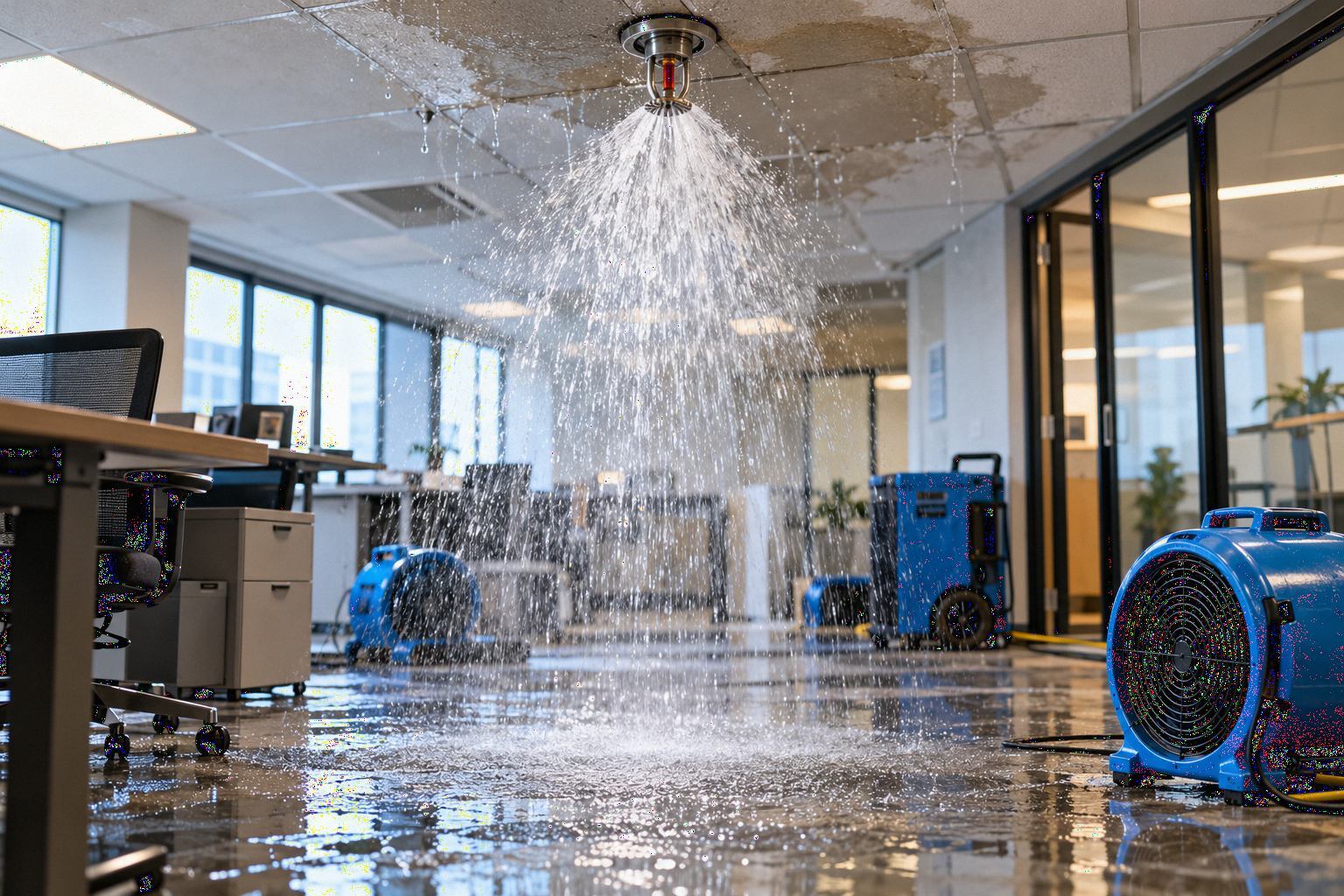
The alarm sounds. Water pours from a ceiling sprinkler onto desks, carpet, and electrical equipment. Someone reaches for the main shutoff. Someone else wants to rescue the computers.
Neither should happen before everyone is safe and the fire-protection response is under control.
Fire sprinkler water damage creates two separate jobs: managing the sprinkler system safely and restoring the building after the discharge. Water can remain hidden in walls and floors after puddles disappear.
Here is how to handle a fire, damaged head, or sprinkler pipe leak safely.
Quick Answer: What Should Happen After a Fire Sprinkler Discharge?
First, treat the discharge as a possible fire emergency. Follow the alarm and evacuation procedures, contact emergency responders as appropriate, and do not personally close sprinkler valves. Authorized personnel must determine when water can be isolated and how the building's fire protection will be maintained.
After the area is declared safe:
- Confirm the system's status and required impairment precautions.
- Have qualified personnel assess electrical hazards and unstable ceilings.
- Map the water pathway, including adjoining and lower-level spaces.
- Evaluate water contamination, extract standing water, and protect contents.
- Dry or remove affected materials and document moisture conditions.
- Coordinate fire protection reinstatement, rebuilding, and occupancy decisions separately.
Why Did the Fire Sprinkler Release Water?
In most conventional automatic systems, an individual sprinkler operates when heat at its head reaches its activation threshold. Smoke alarms do not normally open all sprinkler heads. In NFPA's 2020–2024 analysis, only one sprinkler operated in 76% of reported structure fires in which sprinklers activated.
Not every discharge is caused by fire. Physical impact to a sprinkler head, damaged piping, freezing, corrosion, defective components, or work on the system can also release water.
Wet-pipe, dry-pipe, preaction, and deluge systems do not all operate the same way. Fire protection contractors diagnose the system; restorers investigate property damage.
The First 15 Minutes: Safety Comes Before Cleanup
Follow the Building's Emergency Procedures
Keep occupants away from the affected zone. Water dripping through light fixtures, sagging ceiling tiles, and spreading puddles can create electrical and falling-material hazards.
Leave Sprinkler Shutdown to Authorized Personnel
Closing a control valve may stop the water, but it may also leave the building without critical fire suppression. Authorized fire protection personnel should manage isolation.
What If There Is No Visible Fire?
No visible flames does not establish that a shutdown is safe. Emergency responders or authorized personnel should assess the situation first.
What Is a Fire Protection Impairment?
An impairment occurs when part or all of a fire protection system cannot provide its intended protection. Notifications, fire watch, or occupancy restrictions may be required.
Who Decides When the Space Can Reopen?
Authorities determine applicable occupancy restrictions; restorers cannot clear a disabled sprinkler system.
Treat Wet Electrical Equipment as Unsafe
Do not turn on affected outlets, computers, panels, or machinery. Arrange evaluation by qualified electrical personnel before any equipment is energized.
Read the first 24 hours water damage checklist http://totalhomerescue.pro/guides/first-24-hours-water-damage-checklist for related property-protection steps.
Where Does Sprinkler Water Go After It Hits the Floor?
The puddle beneath the sprinkler is only the visible part of the loss. Water can flow across suspended ceiling grids, enter wall cavities, travel along framing, or pass through openings to the floor below.
Likely inspection areas include ceiling tiles and insulation, wallboard and baseboards, carpet backing, subflooring, built-in cabinets, stockrooms, and equipment closets.
Ceiling water damage from a sprinkler deserves particular care because saturated panels can sag or fall.
See ceiling water damage http://totalhomerescue.pro/guides/ceiling-water-damage for more on the risks of soaked ceiling assemblies.
Is Fire Sprinkler Discharge Water Clean?
Not necessarily. Water held in sprinkler piping can contain sediment or corrosion products. It may then contact soot, debris, chemicals, dusty ceiling cavities, and other building materials.
Restoration professionals evaluate actual contamination conditions using principles in ANSI/IICRC S500. Water from a sprinkler should not automatically be labeled either clean or sewage-contaminated. It depends on actual conditions.
Do not use powerful fans to distribute air across suspect contaminated materials before an appropriate assessment.
See water damage categories 1 2 and 3 for the distinction between contamination categories.
How Professional Fire Sprinkler Discharge Cleanup Works
1. Document the Loss and Map Moisture
After emergency clearance, technicians record the affected spaces, visible conditions, material types, and possible concealed moisture. Suitable moisture meters and comparison readings help locate areas that merit further inspection.
2. Extract Standing Water
Appropriate extraction equipment removes accessible water. Safety and contamination concerns may restrict extraction. Extraction reduces the bulk water load, but it cannot dry moisture held inside building materials.
3. Decide Which Materials Can Be Saved
Treatment depends on material condition and contamination. Ceiling tiles are often replaced; sound drywall may be dried, while insulation, padding, and floor layers need separate assessment.
4. Dry the Structure and Monitor Progress
Controlled airflow, dehumidification, and material-specific methods can help dry suitable materials. Measurements document progress.
Read structural drying after water damage for an explanation of why drying goes beyond running fans.
5. Clean, Verify, and Rebuild
The team addresses necessary cleaning or removal, documents appropriate final moisture conditions, and identifies work required to restore ceilings, walls, flooring, and finishes.
Rebuilding may follow. See reconstruction after water damage
How Is Commercial Water Damage Different?
In a business, a sprinkler loss may affect inventory, customer access, data systems, leased suites, and the ability to operate. Management should coordinate specialist roles.
The fire protection contractor handles sprinkler equipment. Electricians evaluate electrical systems. Restoration technicians assess materials and moisture. Contents specialists may evaluate damaged records or equipment. Authorities address occupancy restrictions.
Do not reopen an affected area simply because the floor looks dry. Safety and operational requirements must also be satisfied.
See commercial water damage restoration in Virginia for related recovery considerations.
Can Wet Ceiling Tiles, Carpet, and Drywall Be Saved?
Sometimes, but not all materials respond the same way. EPA's guidance for clean-water damage generally calls for discarding wet acoustic ceiling tiles and certain absorbent insulation. It notes that drywall may be dried in place when it remains sound and seams are intact, while flooring assemblies require evaluation of the layers underneath.
These guidelines do not guarantee salvageability; contamination, duration, and access matter.
How Long Does Sprinkler Water Damage Restoration Take?
A small, promptly contained discharge differs greatly from a release that affects several floors, electrical rooms, and concealed spaces.
EPA recommends addressing and drying wet materials within 24–48 hours when possible to reduce mold risk. That is an early response target, not a guaranteed drying or project completion time.
Timing depends on access, moisture, and required repairs. Fire protection reinstatement and reconstruction may finish at different times.
What Determines the Cost of Fire Sprinkler Water Damage Cleanup?
A site inspection is necessary for reliable pricing. Costs depend on discharge, affected floors, contamination, materials, drying, contents, and rebuilding.
Keep the sprinkler contractor's invoice separate from sprinkler water damage cleanup, contents handling, and building repairs.
Does Insurance Cover a Sprinkler Leak or Accidental Discharge?
Many property policies include some form of sprinkler leakage coverage, but the actual wording, exclusions, conditions, and deductibles govern. Losses following a covered fire may be evaluated differently from long-term deterioration or maintenance-related leakage.
Document the incident time, fire department reference if applicable, sprinkler contractor findings, damaged areas, restoration records, and invoices. Track inventory and interruption losses separately.
Insurers determine coverage; restorers cannot guarantee payment.
For claim documentation, see water damage insurance claim help
When Can the Sprinkler System and Building Return to Service?
A qualified sprinkler contractor should identify and repair the problem, replace components as necessary, complete applicable testing, and coordinate any impairment closeout. A discharged sprinkler head is not simply reset by an occupant.
Evaluate affected electrical equipment and building materials separately. Property management must follow applicable fire authority and occupancy requirements.
These are separate milestones. Restoration of one does not automatically clear the other.
Can Mold Grow After Sprinkler Water Damage?
Yes, when absorbent materials remain damp. Wet carpet padding, drywall, insulation, and ceiling cavities may support microbial growth if moisture is not addressed appropriately. But a sprinkler discharge alone does not prove mold is present or that remediation is necessary.
The priority is to identify affected materials, correct the source, and clean or dry them promptly.
Preventing Future Water Losses Without Sacrificing Fire Safety
Use qualified fire protection professionals for required inspection, testing, and maintenance. Prevent impacts and freezing; maintain emergency contacts.
Never obstruct, paint, modify, or disable sprinklers to avoid water damage. Their life-safety purpose comes first.
Fire Sprinkler Water Damage Restoration in Northern Virginia
Sprinkler leaks and discharges can affect offices, retail properties, warehouses, apartment buildings, and mixed-use spaces in Alexandria, Arlington, Fairfax, McLean, Tysons, Falls Church, and surrounding DMV communities.
Total Home Rescue provides water damage mitigation, structural drying, and reconstruction services. Qualified fire protection contractors handle sprinkler repairs and testing.
Final Takeaway
The safest recovery plan treats fire protection, property drying, and reopening as related but distinct responsibilities. Follow emergency procedures, involve authorized sprinkler personnel, assess contamination and hidden moisture, document the work, and restore occupancy only when applicable requirements are satisfied.
Frequently Asked Questions About Fire Sprinkler Water Damage
1. What should I do if a sprinkler goes off but there is no visible fire?
Treat it as a potential fire emergency. Follow the alarm and evacuation procedures until responders or authorized personnel establish that the situation is safe. Do not close sprinkler valves or silence alarms merely because water is damaging the property.
Keep people away from wet light fixtures, electrical rooms, and sagging ceilings. Notify building management and the designated fire protection contact. Qualified sprinkler personnel should identify whether a head was damaged, a pipe failed, or the system operated as intended.
Once entry is safe, arrange a prompt water damage inspection. Photograph affected areas from safe locations and record where water reached. Do not restart wet equipment to see whether it works.
Sprinkler repairs, electrical assessment, and property cleanup are separate responsibilities. Coordinating them early reduces confusion without bypassing life-safety requirements.
2. Can a single sprinkler head cause water damage on several floors?
Yes. A single operating head can soak ceiling tiles, carpet, and furniture, and water may travel into adjacent rooms or through openings to lower floors. The extent depends on the discharge duration, building layout, drainage, and construction details.
That doesn't mean every sprinkler in the building opened. In conventional automatic systems, heat typically activates individual heads. NFPA reports that only one sprinkler operated in 76% of structure fires in which sprinklers activated during 2020–2024.
The restoration assessment should follow the actual water pathway rather than simply measuring the room beneath the head. Inspecting ceiling cavities, wall bases, flooring layers, and rooms below can reveal additional affected materials.
This matters because surfaces may look dry while water remains in carpet padding, insulation, or a subfloor. Good documentation helps establish a justified cleanup and drying scope.
3. Is water from a fire sprinkler safe to clean up myself?
Do not assume it is clean or safe. Water may carry pipe sediment or corrosion products and can collect soot, dust, chemicals, or other contaminants after discharge. The water category depends on the actual conditions, not on the name of the system.
A small amount on a safe, accessible hard surface might be manageable under the building's procedures after appropriate safety checks. A substantial release, soaked ceiling, water near electricity, contaminated materials, or moisture beneath flooring warrants professional evaluation.
Avoid directing fans over suspect contamination before conditions are assessed. Employees should not enter unstable areas or energize wet electronics.
Professional sprinkler water damage cleanup can include water extraction, moisture mapping, cleaning, selective removal, and structural drying. Fire protection work still belongs to the qualified sprinkler contractor.
4. Does property insurance cover sprinkler water damage and business interruption?
Some property insurance policies cover accidental sprinkler leakage or discharge, subject to specific terms and exclusions. The cause matters, including whether the system activated during a covered fire or leaked because of another condition. Coverage for equipment, inventory, tenant improvements, and business interruption may be addressed by different provisions.
Notify the insurer according to its requirements and preserve photographs, emergency reports, sprinkler contractor findings, moisture records, and itemized restoration estimates. Businesses should separately document affected inventory and operational disruption, including records that might support a business interruption claim.
Request separate scopes for sprinkler equipment repairs, water mitigation, contents recovery, and reconstruction. This makes the claimed work easier to understand and helps avoid mixing unrelated costs.
Only the insurance carrier can determine coverage, deductibles, limits, and payment. Neither a sprinkler contractor nor a restoration provider can guarantee reimbursement.
5. When can employees return to a building after a sprinkler discharge?
There is no universal reopening time. The decision depends on fire protection status, electrical safety, affected materials, occupancy requirements, and any restrictions imposed by the appropriate authority.
A qualified sprinkler contractor may need to replace an operated head or repair piping, perform required tests, and document restoration of protection. An electrician may need to evaluate circuits and equipment exposed to water. Restoration personnel should confirm that affected materials have been treated and appropriate moisture conditions documented before rebuilding.
In some circumstances, unaffected areas may be usable under a plan accepted by responsible authorities; never presume that is permitted. A dry floor alone does not establish that it is safe to resume business.
Keep a separate checklist for emergency clearance, sprinkler system restoration, electrical assessment, moisture verification, reconstruction, and occupancy authorization. This avoids confusing cosmetic repairs with essential safety milestones.

