

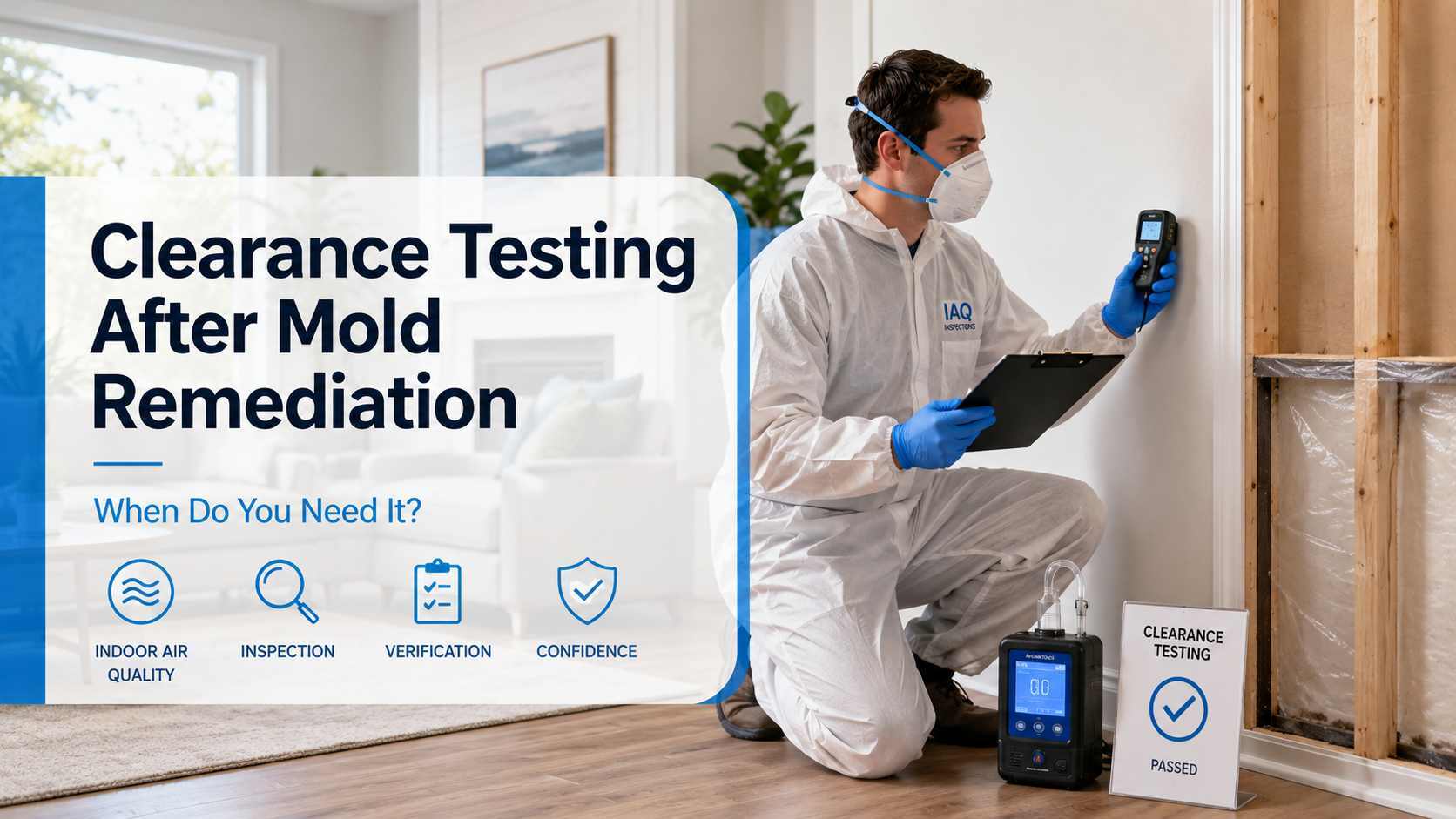
Do You Need Clearance Testing After Mold Remediation?
Mold remediation clearance testing is the final verification step after mold remediation. It helps determine whether the affected area was properly cleaned, whether moisture conditions are under control, and whether the space is ready for rebuild or normal use. This process is also called post remediation verification, a mold clearance test, third party mold testing, post-remediation testing, or an air quality test after mold remediation.
Quick Answer for Homeowners
Clearance testing after mold remediation is not always required, but it is strongly recommended when mold affected porous materials, hidden wall cavities, basements, attics, HVAC areas, or when documentation is needed for insurance, real estate, property management, or tenant concerns.
A mold remediation project may be visually complete after demolition, HEPA vacuuming, antimicrobial treatment, and cleaning. However, mold remediation complete does not always mean the area has passed independent testing. A clearance inspection provides a more objective way to confirm that the area is ready before repairs are covered up.
For homeowners still learning the full process, start with what is mold remediation step by step process to understand where clearance testing fits into the project.
What Is Mold Remediation Clearance Testing?
Mold remediation clearance testing is a final inspection and testing process performed after mold cleanup or removal is completed. The purpose is to confirm that the remediation work was effective and that the affected area meets reasonable post-cleaning conditions.
A mold clearance test may include:
- Visual inspection of the remediated area.
- Moisture readings of affected building materials.
- Air sampling inside and outside the home.
- Surface sampling from cleaned materials.
- Review of containment and work area cleanliness.
- Written findings from an independent inspector or lab.
The exact scope depends on the project. A small bathroom surface mold issue may not need full lab testing. A basement with drywall removal, water damage, and hidden mold behind walls may need a more detailed post remediation verification process.
If the mold issue started after a leak, plumbing failure, or flood, mold after water damage Virginia explains why moisture history matters before deciding if testing is needed.
Mold Remediation Complete vs Clearance Passed
One of the biggest misunderstandings is the difference between “mold remediation complete” and “clearance passed.”
Mold remediation complete means the remediation contractor completed the approved scope of work. This may include containment, controlled demolition, disposal, HEPA vacuuming, antimicrobial treatment, cleaning, and equipment removal.
Clearance passed means the area was reviewed by an inspector or testing company and met the clearance criteria used for that project. A project can be mold remediation complete without third party mold testing. A project can also be completed by the contractor but fail clearance if the inspector finds remaining dust, moisture, visible contamination, or elevated air samples.
Why the Difference Matters
This difference matters because restoration often happens immediately after remediation. Drywall, trim, flooring, insulation, cabinets, and paint may cover the same areas that were previously affected. If post remediation verification is skipped, hidden contamination or moisture may not be discovered until after repairs are complete.
For this reason, homeowners should understand the scope, exclusions, and documentation before approving work. If you are comparing prices, review mold remediation cost Virginia 2026 and mold remediation estimate Fairfax VA 2026 before assuming every estimate includes testing.
Is Clearance Testing Legally Required?
In many residential situations, final mold testing is not automatically required by law. Requirements can vary depending on the property, project type, insurance involvement, lease terms, real estate transaction, or local expectations.
Even when it is not legally required, clearance testing may still be the best professional choice. It creates documentation showing that the area was inspected after remediation. This can be useful if there are future questions about the work, air quality, remaining odor, rebuild timing, or whether the affected area was properly cleaned.
Clearance testing is especially valuable when someone other than the homeowner needs proof that the area was addressed, such as:
- Insurance adjuster.
- Property manager.
- Landlord.
- Tenant.
- Homebuyer.
- Realtor.
- Condo association.
- Commercial property representative.
If insurance may be involved, does insurance cover mold remediation Virginia explains why documentation can affect the claim process.
When Clearance Testing Is Recommended
Clearance testing is not necessary for every small mold issue, but it is often recommended when the mold problem was more than a minor surface condition.
Mold Behind Drywall
Mold behind drywall is one of the clearest reasons to consider a mold clearance test. Once the wall is closed, the cleaned framing, sheathing, or wall cavity becomes difficult to inspect. A clearance inspection before rebuild can help confirm that the area is ready.
For more detail, see mold behind drywall signs removal.
Basement Mold
Basements often have humidity, sump pump issues, foundation moisture, poor ventilation, stored contents, and finished wall systems. Because basement mold can involve hidden cavities and porous materials, post remediation verification is often a smart choice.
For local basement guidance, see basement mold remediation Northern Virginia.
Attic Mold
Attic mold can be caused by roof leaks, poor ventilation, bathroom fan discharge, insulation problems, or condensation. A clearance inspection may include visual inspection and surface sampling of roof sheathing or framing.
For service information, see attic mold removal.
Bathroom Mold
Bathroom mold may be simple surface growth, but it can also be connected to exhaust fan issues, shower leaks, ceiling moisture, or mold inside wall cavities. If drywall, subfloor, ceiling material, or vanity cabinetry was affected, post-remediation testing may be useful.
For more on this type of project, see bathroom mold remediation Virginia.
HVAC Closets and Vents
Mold near HVAC equipment can affect air movement and distribution. If the mold was around an air handler closet, vents, or nearby ceiling areas, an air quality test after mold remediation may be recommended.
When Clearance Testing May Not Be Necessary
Post-remediation testing may not be necessary for every small cleanup. If the mold was limited to a small hard surface, fully visible, not connected to a leak, and there is no need for insurance or third-party documentation, visual inspection and moisture correction may be enough.
Examples may include:
- Minor surface mold around a window due to condensation.
- Small washable bathroom surface mold.
- Limited spotting on non-porous material.
- A small area where the moisture source was obvious and corrected.
- A project where no rebuild, insurance, tenant, or real estate documentation is needed.
Even in these cases, moisture still matters. If the material remains damp, mold can return even after cleaning.
For prevention guidance, see how to prevent mold growth Northern Virginia.
What Does a Mold Clearance Test Include?
A mold clearance test can be simple or detailed depending on the project. A professional inspector should explain what will be checked, what samples will be taken, and what the results mean.
Visual Inspection
The inspector looks for remaining visible mold, dust, debris, staining, damaged materials, and incomplete cleaning. Visual inspection may include exposed framing, wall cavities, ceilings, subflooring, base plates, HVAC closets, attic sheathing, or other accessible surfaces.
Visual inspection is important because a clean lab result does not automatically mean every surface was properly cleaned.
Moisture Readings
Moisture readings help determine whether the conditions that caused mold are still present. If wood, drywall, subfloor, or framing is still wet, remediation may not be ready for closure.
Moisture readings are especially important after water damage, ceiling leaks, bathroom leaks, and basement flooding.
Air Sampling
An air quality test after mold remediation measures airborne mold spores. Indoor samples are usually compared with outdoor or control samples. The goal is to determine whether indoor spore levels are elevated or unusual compared with the reference sample.
Air testing is commonly used after larger projects, containment work, or when homeowners report odor or sensitivity.
Surface Sampling
Surface samples may be taken from cleaned framing, sheathing, subfloor, or other materials. This can help verify that a specific area was cleaned properly.
Surface sampling is not always needed, but it can be useful when there was visible growth on structural materials.
Written Report
If samples are taken, the inspector or lab provides a report. The report may include sample locations, findings, spore counts, mold types detected, and whether the area passed or requires additional work.
Why Third Party Mold Testing Is Preferred
Third party mold testing means the person or company performing the clearance inspection is independent from the remediation contractor.
This is important because the remediation company should not be the only party deciding whether its own work passed. A separate inspector creates a cleaner process and reduces conflict of interest.
Third party mold testing is especially useful when:
- The project involves insurance.
- The home is being sold.
- A landlord or tenant needs documentation.
- A property manager requires a report.
- Mold was found in hidden areas.
- Multiple rooms were affected.
- Rebuild will cover the remediated area.
- A prior remediation attempt failed.
- The homeowner wants independent confirmation.
A good remediation company should not be offended by third party mold testing. In many cases, independent verification protects both the homeowner and the contractor.
If you are choosing a contractor, how to hire mold remediation company Northern Virginia explains what to ask before approving work.
What Happens If Clearance Testing Fails?
A failed mold clearance test does not always mean the entire project was done incorrectly. It means the area did not meet the clearance criteria at the time of inspection.
Common reasons for failing post remediation verification include:
- Remaining dust or debris.
- Missed contaminated material.
- Elevated moisture readings.
- Incomplete HEPA cleaning.
- Containment opened too early.
- Air filtration not run long enough.
- HVAC or adjacent spaces contributing spores.
- Hidden mold still present.
- Rebuild started too soon.
- Mold source not fully corrected.
The next step is usually additional cleaning, drying, removal, or investigation. After corrective work is completed, another clearance inspection may be performed.
Important Point Before Rebuild
If clearance testing is required or recommended, it should usually happen before drywall, insulation, flooring, trim, or cabinets are replaced. Once the area is closed, it becomes harder and more expensive to correct missed contamination.
Clearance Testing and Black Mold Concerns
Many homeowners ask about testing because they are worried about “black mold.” Color alone does not confirm the mold species, and not every dark-colored mold is the same. However, if a homeowner is concerned about potential health risks, third party mold testing can provide more information than visual inspection alone.
Testing may help identify the type of mold present, whether airborne spores are elevated, and whether additional cleaning is needed. It should not replace medical advice, but it can help document the condition of the home.
For a deeper explanation, see is black mold dangerous health risks
Local Mold Remediation Clearance Testing in Northern Virginia
In Northern Virginia, mold problems are often connected to humid basements, roof leaks, older bathrooms, HVAC closets, finished lower levels, and water damage. Homes in Alexandria, Arlington, Fairfax, McLean, Tysons, and Falls Church often have hidden cavities, older ventilation systems, or finished basement areas where mold can spread beyond what is immediately visible.
Total Home Rescue provides local mold remediation services and can help homeowners understand when clearance testing may be appropriate before rebuild.
For a broader local overview, see mold remediation Northern Virginia complete local guide 2026 and mold remediation.
Homeowners can also review service pages for mold remediation Alexandria VA,
mold remediation Arlington VA, mold remediation Fairfax VA, mold remediation McLean VA, mold remediation Tysons VA, and mold remediation Falls Church VA.
mold remediation Arlington VA, mold remediation Fairfax VA, mold remediation McLean VA, mold remediation Tysons VA, and mold remediation Falls Church VA.
For city-specific reading, see mold remediation Alexandria VA guide and mold remediation Arlington VA guide.
How to Know If Mold Remediation Is Complete
A homeowner should not rely only on appearance or smell. A room can look better after cleaning while moisture or hidden contamination remains. Mold remediation complete should mean the approved scope was finished and the area is ready for the next step.
A properly completed remediation project should generally include:
- Moisture source identified or corrected.
- Contaminated porous materials removed when required.
- Affected hard surfaces cleaned.
- HEPA vacuuming completed where appropriate.
- Antimicrobial treatment completed when included in the scope.
- Work area cleaned of dust and debris.
- Containment maintained until cleaning is complete.
- Moisture readings reviewed.
- Rebuild delayed until the area is ready.
- Clearance testing completed when required or requested.
Homeowner Checklist
Before approving rebuild, ask whether the area was visually inspected, whether moisture readings were taken, whether clearance testing is needed, and whether any hidden areas remain inaccessible.
Final Practical Note
The best time to ask about clearance testing is before remediation starts, not after the crew leaves. If the project involves insurance, tenants, buyers, or hidden mold, include the testing plan in the conversation early.
Final Recommendation
You do not need mold remediation clearance testing for every small mold cleanup. But if the mold affected drywall, framing, basement areas, attic sheathing, HVAC closets, ceilings, bathrooms, or any hidden building materials, a mold clearance test is often worth it.
Post remediation verification helps confirm that the area is cleaner, drier, and ready for the next step. Third party mold testing can also provide documentation for insurance, real estate, property management, or peace of mind.
The safest rule is simple: if the mold problem was serious enough to require professional remediation, it is reasonable to ask whether clearance testing should be performed before the project is considered fully complete.
Need help confirming whether your mold remediation project is ready for rebuild? Contact Total Home Rescue for mold remediation guidance in Northern Virginia.
FAQ: Mold Remediation Clearance Testing
1. What is mold remediation clearance testing?
Mold remediation clearance testing is the final inspection or testing process performed after mold remediation work is complete. The goal is to verify that the affected area was properly cleaned and is ready for normal use, rebuild, or further restoration.
Depending on the project, clearance testing may include visual inspection, moisture readings, surface sampling, air sampling, and a written report. A small surface mold issue may only need a visual inspection and moisture check. A larger project involving demolition, hidden mold, basement areas, attic sheathing, or HVAC closets may need more detailed post remediation verification.
The most important point is that testing gives the homeowner documentation after the work is finished. It helps answer the question: is the mold remediation complete, or is additional cleaning, drying, or removal still needed?
2. Is a mold clearance test required after every mold remediation project?
No. A mold clearance test is not required after every mold remediation project. For a very small, visible, surface-level mold issue on a washable material, clearance testing may not be necessary if the moisture source was corrected and the affected area was cleaned properly.
However, clearance testing is recommended when the project involved porous materials, demolition, hidden mold, water damage, basements, attics, HVAC areas, rental properties, insurance documentation, or real estate concerns. In these cases, a visual “looks clean” result may not be enough.
A mold clearance test is especially useful before rebuild. If drywall, insulation, cabinets, flooring, or trim will cover the remediated area, testing before repairs can help avoid expensive problems later.
3. What is the difference between post remediation verification and an air quality test after mold remediation?
Post remediation verification is the overall process of checking whether mold remediation was successful. It may include visual inspection, moisture readings, review of the cleaned area, surface sampling, air sampling, and a written conclusion.
An air quality test after mold remediation is only one part of that process. It checks airborne mold spores and usually compares indoor samples with outdoor or control samples. Air testing can be helpful, but it does not replace visual inspection or moisture evaluation.
For example, an air sample may look acceptable while a hidden wet material remains behind a wall. On the other hand, a surface may look clean while airborne spores remain elevated because dust was disturbed. A complete post remediation verification process looks at the project from more than one angle.
4. Who should perform third party mold testing?
Third party mold testing should be performed by an independent mold inspector, indoor environmental professional, or testing company that did not perform the remediation work. This helps reduce conflict of interest and gives the homeowner a more objective result.
The remediation contractor performs the cleaning, demolition, containment, HEPA vacuuming, and treatment work. The third-party inspector verifies whether the area meets the clearance criteria. This separation is especially important for insurance claims, rental properties, real estate sales, property management files, or larger remediation projects.
A remediation company may help coordinate access or scheduling, but the testing company should remain independent. That way, the report is easier to rely on if there are questions later.
5. Can mold remediation be complete without clearance testing?
Yes. Mold remediation can be complete without clearance testing if the contractor completed the approved scope of work and clearance testing was not required or requested. However, mold remediation complete and clearance passed are not the same thing.
Mold remediation complete means the contractor finished the agreed work. Clearance passed means the area was inspected or tested and met the criteria used by the third-party inspector or testing company.
For small projects, contractor completion may be enough. For larger projects, especially where hidden materials, water damage, or insurance documentation are involved, clearance testing provides stronger confirmation. It helps determine whether the area is ready for rebuild and whether additional cleaning, drying, or investigation is needed before the project is closed.

