

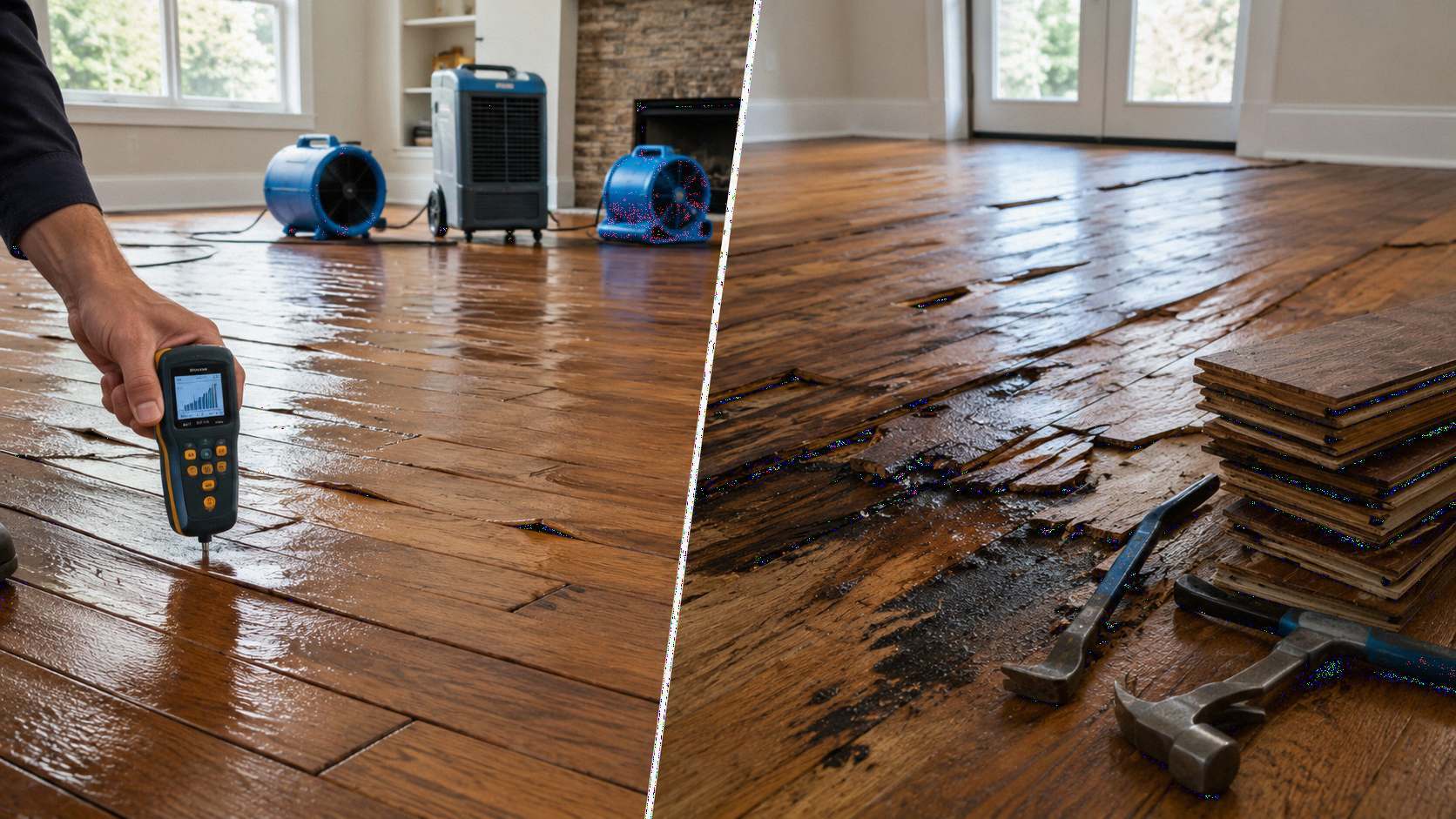
Quick Answer: Hardwood Floor Water Damage Repair or Replace
Hardwood floor water damage repair or replace decisions should be based on moisture readings, flooring type, board movement, subfloor condition, water source, contamination risk, and drying results. Some water-damaged hardwood floors can be saved with fast extraction, controlled drying, monitoring, and later water damage refinishing. Other floors need partial or full replacement when boards are buckled, loose, split, deeply stained, contaminated, delaminated, or when subfloor damage hardwood problems remain.
The key is not to decide too early. A cupping warped hardwood floor can look alarming right after a leak, but cupping is not always a final replacement decision. The National Wood Flooring Association describes cupping as raised board edges with lower centers across the width of the floorboard.
EPA guidance says water-damaged areas and items should be dried within 24–48 hours to help prevent mold growth. For hardwood floors, that means the first priority is moisture control and drying, not sanding, staining, or installing new boards before the floor and subfloor are evaluated.
For a full water damage response plan, see water damage restoration homeowner guide
Hardwood floor water damage repair or replace decisions depend on the source of water, how long the floor stayed wet, moisture readings, board movement, flooring type, finish condition, subfloor condition, contamination risk, and whether the flooring stabilizes after drying. A cupping warped hardwood floor may improve after moisture correction, but sanding should wait until the floor is dry and stable. Water damage refinishing may work when the hardwood is dry, structurally sound, and mainly cosmetically damaged. Replacement is more likely when boards buckle, detach, split, delaminate, rot, stain deeply, smell musty, or when subfloor damage hardwood problems remain.
Why Hardwood Floors Change After Water Damage
Hardwood is sensitive to moisture because wood expands and contracts as moisture conditions change. When water enters board seams, board ends, underlayment, adhesives, fasteners, or subfloor materials, the floor can move unevenly. That movement may show up as cupping, crowning, buckling, gaps, finish damage, dark staining, loose boards, squeaks, or soft areas.
Common causes of hardwood floor water damage include:
- Dishwasher leaks
- Refrigerator ice maker line leaks
- Washing machine leaks
- Water heater leaks
- Burst pipes
- Toilet overflows
- Tub or shower leaks
- Roof leaks that travel to lower floors
- HVAC condensation drain backups
- Basement flooding
- Sump pump failures
- Water trapped under rugs or furniture
- Repeated wet mopping
- Slow leaks near cabinets or walls
The question hardwood floor water damage repair or replace should not be answered from the surface only. A floor can look only slightly affected while moisture remains underneath. Another floor can look badly cupped at first but improve after drying. LSU AgCenter notes that cupped planks can flatten as they dry unless they have splits, and refinishing should wait until the floor stabilizes.
For appliance-related leaks, see appliance leak water damage
For pipe-related damage, see burst pipe water damage
First Steps After Hardwood Floor Water Damage
The first response should focus on stopping the source, removing water, and reducing moisture. Sanding, staining, refinishing, and board replacement are repair decisions. They come after drying and inspection.
Start here:
- Stop the water source if it is safe.
- Remove standing water quickly.
- Move rugs, boxes, and furniture off the wet floor.
- Take photos and videos before cleanup.
- Check baseboards, cabinets, walls, and thresholds.
- Do not cover wet hardwood with rugs or plastic.
- Do not sand cupped boards while moisture is active.
- Check whether water reached the subfloor.
- Begin drying if water entered seams or spread widely.
- Monitor moisture before choosing repair or replacement.
EPA states that the key to mold control is moisture control. That matters for hardwood flooring because moisture can remain under finished surfaces even after the top looks dry.
For first-day water damage steps, see first 24 hours water damage checklist
Can Water-Damaged Hardwood Floors Be Saved?
Some water-damaged hardwood floors can be saved. The best candidates are floors where the source was stopped quickly, standing water was removed fast, the boards stayed attached, the subfloor dried properly, and the remaining issue is mainly cosmetic.
A hardwood floor may be repairable when:
- The water source was clean and stopped quickly.
- Moisture did not sit for an extended period.
- Boards are still secure.
- Cupping is minor or improving.
- There is no buckling.
- There is no strong musty odor.
- Staining is limited.
- The subfloor is drying normally.
- Moisture readings return to stable conditions.
- The wood is thick enough for sanding if refinishing is needed.
A floor is less likely to be saved when boards are lifting, splitting, separating, delaminating, or staying wet underneath. The hardwood floor water damage repair or replace decision should happen after drying, not while the floor is still moving.
For structural drying basics, see structural drying after water damage
Cupping Warped Hardwood Floor: What It Means
A cupping warped hardwood floor usually means moisture is uneven through the board. The board edges rise higher than the center, often because the underside of the board or the subfloor has more moisture than the top surface. NWFA describes cupping as raised edges and lower centers across the board width.
Cupping may happen when:
- Water gets under the hardwood.
- The subfloor is wet.
- Humidity stays high.
- The floor dries unevenly.
- A leak continues near the floor.
- Water enters through seams.
- A wet area is covered too soon.
- Moisture comes from below the flooring system.
Cupping is a warning sign, not an automatic replacement decision. LSU AgCenter notes that cupped planks can flatten as they dry unless they have splits, and refinishing should wait until the flooring has stabilized.
This is why sanding too early can create a worse result. If raised edges are sanded while the boards are still swollen, the boards may continue changing after drying and leave an uneven floor.
For hidden moisture inspection, see how restoration companies detect hidden water damage
When Water Damage Refinishing May Work
Water damage refinishing may work when the hardwood is dry, stable, structurally sound, and the remaining damage is mostly cosmetic. Refinishing can help with surface staining, finish damage, light unevenness, or minor sanding correction after the floor has stabilized.
Refinishing may be appropriate when:
- Moisture readings are stable.
- Cupping has stopped changing.
- Boards are not loose.
- There is no buckling.
- The subfloor is dry.
- Stains are not too deep.
- The wood has enough thickness to sand.
- The affected area can blend with nearby flooring.
- There is no sewage or contamination concern.
Refinishing is not a drying method. It should not be used to hide active moisture, ongoing cupping, wet subflooring, odor, or contamination. If the floor is still wet, water damage refinishing may fail or trap moisture below a new finish.
For water under flooring, see water damage under flooring
When Hardwood Floors Need Replacing
Replacement is more likely when the flooring has structural damage, contamination, severe movement, deep staining, or damage below the visible boards. Drying may still be necessary, but drying alone may not restore the floor.
Hardwood replacement may be needed when:
- Boards are buckled or lifted.
- Boards are loose from the subfloor.
- The floor feels soft or spongy.
- Deep staining remains after drying.
- The wood is split or cracked.
- Engineered flooring is delaminating.
- There is a strong musty odor.
- Water came from sewage or contaminated water.
- Mold concern is present under the floor.
- The subfloor remains wet or damaged.
- Repeated leaks affected the same area.
- The floor cannot be sanded again because the wear layer is too thin.
A severe flooring issue is often not just a board issue. It may involve underlayment, subflooring, trim, cabinets, drywall, or humidity. EPA guidance notes that professional assistance may be needed depending on the size of the affected area and available resources, especially when an area must be dried quickly and thoroughly.
For sewage-related water damage, see sewage backup cleanup Virginia
Subfloor Damage Hardwood: Why It Changes the Decision
Subfloor damage hardwood situations are more serious because the visible hardwood is only the top layer. If moisture reached plywood, OSB, concrete, sleepers, underlayment, or floor framing, the repair plan may change.
Possible subfloor warning signs include:
- Elevated moisture readings
- Soft or spongy areas
- Swelling
- Delamination
- Persistent cupping
- Musty odor
- Loose boards
- Fastener failure
- Squeaking or movement
- Repeated cupping after drying
- Moisture migrating from below
If the subfloor remains wet and new hardwood is installed too early, the replacement flooring may cup, shift, smell, or fail. A safer sequence is to dry the flooring system, verify moisture, and only then decide whether repair, refinishing, partial replacement, or full replacement makes sense.
For mold after water damage, see mold after water damage Virginia
Solid Hardwood vs Engineered Hardwood After Water Damage
The type of hardwood affects the repair decision. Solid hardwood and engineered hardwood do not always respond the same way after water exposure.
Solid hardwood may have more refinishing potential if it is thick enough, not split, not rotten, and still securely attached. It may cup after moisture exposure, but some solid hardwood floors can be dried, monitored, sanded, and refinished after stabilization.
Engineered hardwood can be more limited. Some engineered floors have a thin wear layer, which limits sanding. If layers swell, separate, or delaminate, replacement is more likely.
Important differences include:
- Solid hardwood may allow more sanding.
- Engineered hardwood may have limited refinishing depth.
- Floating floors can trap moisture underneath.
- Glue-down floors may release or debond.
- Nail-down floors may loosen if the subfloor swells.
- Wide boards may show movement more visibly.
- Dark stains may remain after drying.
- Matching older flooring can be difficult.
This is why hardwood floor water damage repair or replace decisions should be made after inspection, not from a quick visual opinion.
Hardwood Floor Water Damage Repair or Replace: Decision Process
A good repair decision follows the correct order. The wrong order creates avoidable problems.
The correct sequence is:
- Identify the water source.
- Stop the source.
- Remove standing water.
- Inspect affected flooring and nearby materials.
- Check moisture in hardwood and subfloor.
- Dry the flooring system.
- Monitor moisture readings.
- Reassess cupping, staining, gaps, and movement.
- Decide repair, refinish, partial replacement, or full replacement.
- Complete repairs only after drying is verified.
Step 1: Stop the Source
The floor cannot be evaluated correctly while water is still entering the system. A continuing leak can make the floor look worse even if fans are running.
Step 2: Dry the Flooring System
Drying should include the hardwood, nearby trim, underlayment, subfloor, and surrounding materials when affected. The goal is not just a dry-looking surface. The goal is a stable flooring system.
Step 3: Verify Moisture
Moisture readings help determine whether the floor is ready for repair decisions. Without readings, it is easier to mistake a surface-dry floor for a fully dry floor.
Step 4: Decide Repair, Refinish, or Replace
Only after the floor stabilizes should the final repair plan be selected. This protects the homeowner from sanding too soon, replacing too early, or installing new flooring over a wet subfloor.
For the drying and mitigation process, see water mitigation process
Insurance Documentation for Hardwood Floor Water Damage
Insurance coverage depends on the water source, policy language, exclusions, endorsements, deductible, maintenance history, documentation, and carrier review. A contractor should not promise that a hardwood floor claim will be covered.
Useful documentation may include:
- Photos of standing water
- Photos of cupping or buckling
- Photos of affected rooms
- Source of water
- Plumber report if applicable
- Moisture readings
- Drying logs
- Equipment dates
- Flooring type
- Subfloor observations
- Repair estimate
- Replacement estimate
- Receipts and invoices
- Communication notes
The cause of loss matters. A sudden pipe burst may be reviewed differently than floodwater, seepage, long-term leaks, or sewer backup. Clear documentation helps explain what happened, what was affected, and what mitigation steps were taken.
For claim organization, see water damage insurance claim help
For denied claim issues, see water damage claim denied reasons
Mold Concern Under Water-Damaged Hardwood
Hardwood floor water damage can involve more than the boards. Moisture can remain under flooring, underlayment, baseboards, cabinets, thresholds, and subfloor materials. If moisture stays trapped, mold concern can increase. EPA states that the key to mold control is moisture control.
Mold concern may increase when:
- The floor stayed wet for an extended period.
- Water entered seams and stayed below the boards.
- The subfloor stayed damp.
- The area smells musty.
- There is visible growth near baseboards.
- Cabinets or trim trap moisture.
- The water source was contaminated.
- A prior leak happened in the same area.
- The floor was covered before drying.
Not every wet hardwood floor requires mold remediation. But if odor, visible growth, repeated moisture, or contaminated water is present, the area should be evaluated before repair or replacement.
For mold remediation steps, see what is mold remediation step by step process
For hidden mold signs, see signs of hidden mold in your home
Common Mistakes Homeowners Should Avoid
Many hardwood floor problems become worse because the repair decision is rushed.
Avoid these mistakes:
- Sanding before the floor is dry.
- Replacing boards before the subfloor dries.
- Covering wet flooring with rugs.
- Running heat too aggressively.
- Ignoring baseboards and cabinets.
- Assuming cupping always means replacement.
- Assuming refinishing always fixes water damage.
- Ignoring musty odor.
- Waiting too long to remove water.
- Cleaning contaminated water without precautions.
- Painting or caulking over wet trim.
- Accepting a repair plan without moisture readings.
The best plan starts with moisture control. Cosmetic work should come later.
For DIY vs professional decisions, see DIY vs professional water damage cleanup
Local Water Damage and Mold Resources
Hardwood floor water damage often connects to larger water damage issues such as wet drywall, ceiling leaks, appliance leaks, burst pipes, hidden moisture, mold concern, and insurance documentation.
FAQ: Hardwood Floor Water Damage Repair or Replace
1. Can water-damaged hardwood floors be saved?
Yes, some water-damaged hardwood floors can be saved, but only after the floor and subfloor are dried and inspected. A floor is more likely to be saved when the water source is stopped quickly, standing water is removed fast, boards remain attached, the subfloor dries properly, and the remaining damage is mostly cosmetic.
A floor is less likely to be saved when boards buckle, lift, split, rot, delaminate, smell musty, show deep staining, or remain warped after drying. The decision hardwood floor water damage repair or replace should be based on moisture readings, flooring type, subfloor condition, contamination risk, and whether the boards stabilize.
2. Will a cupping warped hardwood floor go back to normal?
A cupping warped hardwood floor may improve after the moisture source is corrected and the flooring system dries. Cupping means the board edges are higher than the center, usually because moisture is uneven through the board. NWFA defines cupping as raised edges and lower centers across the board width.
The floor should be allowed to dry and stabilize before sanding or refinishing. LSU AgCenter notes that cupped planks can flatten as they dry unless they have splits, and refinishing should wait until the floor stabilizes. If cupping remains after stabilization, refinishing or replacement may be considered depending on the board and subfloor condition.
3. Is water damage refinishing enough to fix hardwood floors?
Water damage refinishing may be enough when the floor is dry, stable, structurally sound, and the remaining problem is cosmetic. Refinishing may help with surface staining, finish damage, or minor unevenness after drying.
Refinishing is not enough when boards are still wet, actively cupping, buckled, loose, delaminated, contaminated, or affected by subfloor damage hardwood issues. Refinishing too early can hide the problem temporarily while moisture continues to affect the flooring system.
4. How do I know if there is subfloor damage under hardwood?
Signs of subfloor damage hardwood issues may include soft spots, persistent cupping, loose boards, squeaking, musty odor, staining near seams, elevated moisture readings, or repeated flooring movement after drying. In some cases, the top hardwood may look manageable while the subfloor remains wet.
A moisture inspection is important because subfloor problems cannot always be confirmed visually. If the subfloor remains wet and new boards are installed too soon, the replacement floor may cup, shift, or fail.
5. Should I repair, refinish, or replace water-damaged hardwood floors?
Repair may be possible when the affected area is small and the boards are stable. Refinishing may work when the floor is dry, structurally sound, and the damage is mainly cosmetic. Replacement is more likely when boards are buckled, loose, split, rotten, delaminated, contaminated, deeply stained, or when subfloor damage remains.
The safest sequence is drying first, inspection second, repair decision third. For hardwood floor water damage repair or replace decisions, do not rely only on appearance. Moisture readings, drying results, flooring type, subfloor condition, and contamination risk should guide the final recommendation.
Final Takeaway
Hardwood floor water damage repair or replace decisions should not be rushed. Some floors can be saved with quick water removal, controlled drying, moisture monitoring, and later water damage refinishing. Other floors need partial or full replacement when there is severe board movement, contamination, deep staining, buckling, delamination, or subfloor damage hardwood concerns.
A cupping warped hardwood floor is a warning sign, not an automatic replacement decision. The right approach is to stop the water source, dry the flooring system, verify moisture conditions, and then decide whether repair, refinishing, partial replacement, or full replacement makes sense.

