

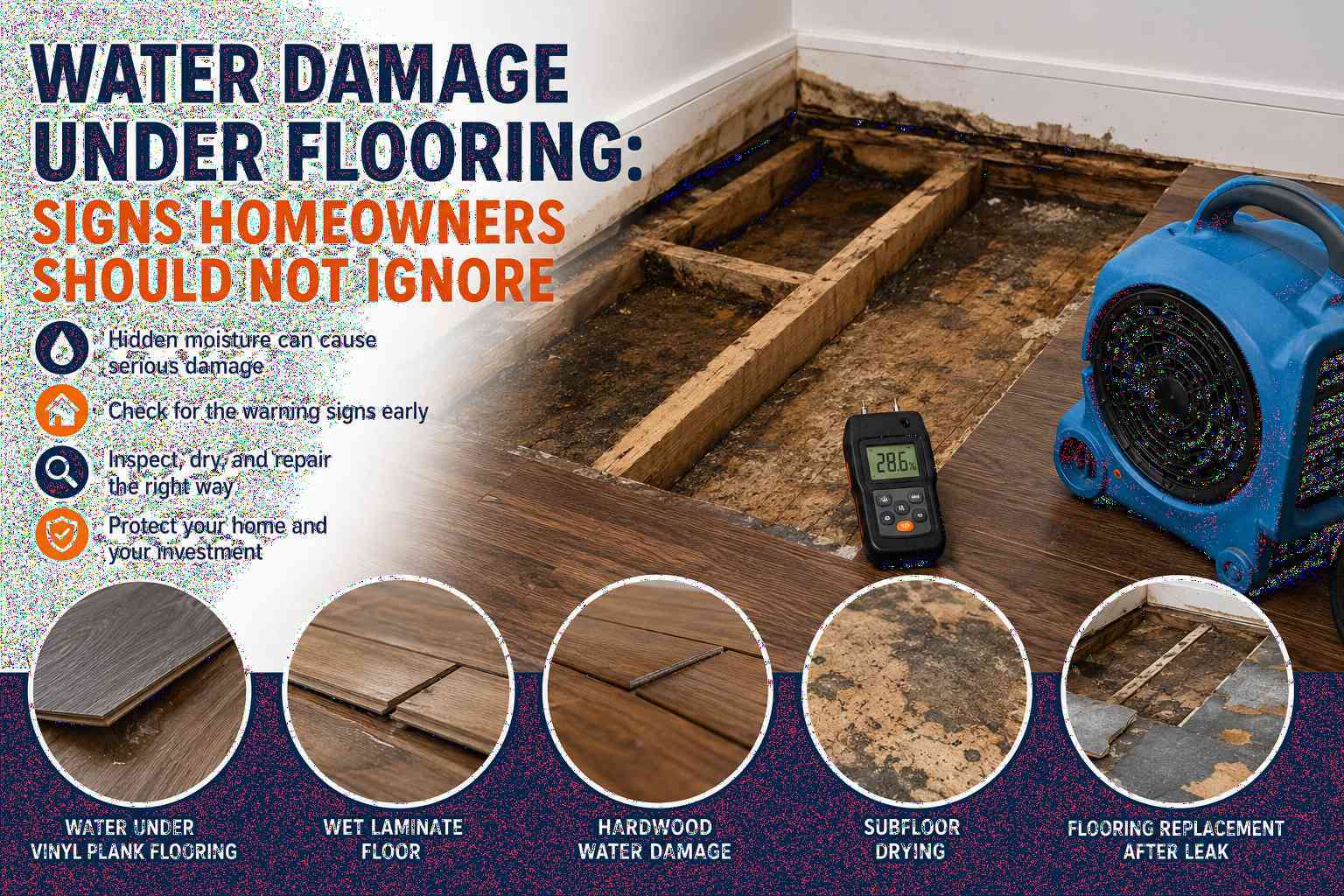
Quick Answer: What Are the Signs of Water Damage Under Flooring?
Water damage under flooring can be hidden even when the top surface looks dry. Homeowners should watch for musty odor, soft spots, raised seams, loose planks, bubbling, cupping hardwood, swollen laminate, dark edges, damp carpet pad, water coming up between boards, or moisture near baseboards.
The biggest problem is moisture trapped below the visible floor. Water under vinyl plank flooring, a wet laminate floor, or hardwood water damage can affect underlayment, plywood, OSB, concrete, nearby drywall, trim, cabinets, and wall cavities. When water reaches the lower layers, subfloor drying may be needed before repairs. If the flooring is swollen, warped, delaminated, contaminated, moldy, or unable to dry properly, flooring replacement after leak damage may be necessary.
The safe rule is simple: do not judge the floor by appearance alone. Stop the water source, document the damage, check moisture below the surface, dry the affected materials, and do not install replacement flooring until the subfloor is confirmed dry.
For the full drying process, see structural drying after water damage
Why Water Damage Under Flooring Is Easy to Miss
Water does not always stay where the leak started. A dishwasher leak, refrigerator supply line leak, washing machine overflow, toilet overflow, water heater leak, pipe leak, basement water event, or stormwater intrusion can spread under flooring before visible damage appears.
Moisture can move under:
- Vinyl plank flooring
- Laminate flooring
- Hardwood flooring
- Carpet and carpet pad
- Tile edges
- Baseboards and quarter round
- Underlayment
- Plywood subfloor
- OSB subfloor
- Concrete slab surfaces
- Floor cavities
- Nearby drywall
- Cabinets and toe kicks
The finished floor is only the visible layer. A surface can feel dry while water remains below the planks, pad, underlayment, or subfloor. That is why water damage under flooring should be evaluated by water source, material condition, moisture readings, and drying progress — not by sight alone.
For a full homeowner overview, see water damage restoration homeowner guide
Signs of Water Damage Under Flooring
The first signs are often small. They may show up before major warping, visible mold concern, or full flooring failure.
Common signs include:
- Musty odor near the floor
- Soft or spongy walking areas
- Raised seams
- Loose vinyl planks
- Dark lines between boards
- Water squeezing through seams
- Swollen laminate edges
- Cupped hardwood boards
- Buckling or lifting flooring
- Bubbling surface layer
- Damp carpet pad
- Staining near baseboards
- Peeling quarter round
- Cracking near tile edges
- Elevated moisture readings
A small leak can still create hidden damage if water travels underneath the finished floor. The sooner the issue is inspected, the better the chance of limiting demolition, replacement, and mold-related concerns.
Water Under Vinyl Plank Flooring
Water under vinyl plank flooring is one of the most common hidden moisture problems. Vinyl plank may resist water on the top surface, but that does not mean the full floor system is protected. Water can still move through seams, edges, transitions, gaps, and baseboards.
Signs of water under vinyl plank flooring may include:
- Loose planks
- Clicking sounds
- Planks lifting at edges
- Water appearing through seams
- Musty odor
- Darkened seams
- Damp underlayment
- Moisture near baseboards
- Soft areas below the plank layer
The top of the vinyl plank may look clean while moisture remains trapped underneath. If water reaches underlayment or subflooring, drying may require lifting affected planks, removing wet underlayment, using drying equipment, and confirming moisture levels before reinstalling or replacing flooring.
For the cleanup process, see water mitigation process
Wet Laminate Floor Problems
A wet laminate floor usually shows problems at the seams and edges first. Laminate often includes a wood-based core, which can swell when water enters through joints, cuts, edges, or damaged areas.
Signs of a wet laminate floor include:
- Raised seams
- Swollen edges
- Peaking planks
- Bubbling surface
- Soft spots
- Planks that no longer lock tightly
- Discoloration near seams
- Musty odor
- Damp underlayment
Once laminate swells, it often does not return to its original shape. Even if the damaged laminate is removed, the subfloor still needs to be checked. Installing new laminate over a damp subfloor can trap moisture and cause new damage later.
Why Laminate Swells
Laminate can handle small surface spills better than trapped water below the floor. When water reaches seams or the core material, swelling can appear quickly.
Why the Subfloor Matters
The damaged laminate is not always the only issue. Water may remain below the plank layer after the surface looks dry.
Why Timing Matters
The longer water stays under laminate, the more likely swelling, odor, subfloor moisture, and replacement become.
Simple Rule
Do not install new laminate until the subfloor and underlayment area are dry.
Hardwood Water Damage
Hardwood water damage can appear as cupping, crowning, staining, cloudy finish, buckling, movement, or gaps. Wood reacts to moisture. When water affects hardwood from below, the boards can absorb moisture unevenly and change shape.
Common hardwood water damage signs include:
- Cupped boards
- Crowned boards
- Dark stains
- Cloudy finish
- Gapping after drying
- Squeaks or movement
- Buckling
- Boards lifting from the subfloor
- Moisture readings above nearby unaffected areas
Hardwood should not be sanded, refinished, or repaired before moisture conditions are stable. If repairs happen too early, the wood may continue moving as it dries. The subfloor below hardwood should also be checked before final repair decisions are made.
For cost planning after a leak, see water damage restoration cost guide
Subfloor Drying: Why the Surface Is Not Enough
Subfloor drying is one of the most important parts of handling water damage under flooring. The subfloor may be plywood, OSB, concrete, or another structural layer. If the subfloor remains wet, replacement flooring may fail even if the new surface looks perfect.
Subfloor drying may involve:
- Moisture readings
- Removing wet flooring
- Removing wet underlayment
- Extracting standing water
- Air movement
- Dehumidification
- Exposing the subfloor to air
- Monitoring drying progress
- Confirming dryness before repair
Drying only the visible floor surface may leave moisture in the layer that supports the finished flooring. Before replacement flooring is installed, the subfloor should be dry enough for the selected material and installation method.
When Flooring Replacement After a Leak May Be Needed
Flooring replacement after leak damage may be needed when flooring cannot be dried, cleaned, reset, or safely reused. Replacement is more likely when materials are swollen, warped, delaminated, contaminated, moldy, or permanently damaged.
Replacement may be needed when:
- Laminate is swollen
- Vinyl plank is warped or loose
- Hardwood is severely cupped or buckled
- Carpet pad is saturated
- Underlayment is wet
- Subfloor is damaged
- Water came from sewage or floodwater
- Mold is visible or suspected
- Moisture readings stay high
- Flooring traps water underneath
Replacement should not happen before moisture is controlled. Installing new flooring over wet underlayment or a damp subfloor can trap moisture and create a second round of damage.
For insurance-related questions, see does insurance cover water damage restoration
Clean Water Leak vs Contaminated Water
The water source changes the drying and replacement decision. Clean water from a supply line may be handled differently than sewage, stormwater, floodwater, or water that passed through contaminated materials.
Drying may be more realistic when:
- The source is clean
- The leak is caught quickly
- Water did not spread far
- Materials are stable
- Moisture readings improve
- The subfloor can be exposed and dried
Removal or replacement may be more likely when:
- Water is contaminated
- Water sat too long
- Flooring is swollen or warped
- Carpet pad is saturated
- Underlayment is wet
- Subfloor is damaged
- Mold concern is present
- The floor cannot be dried from above
Even clean water can create a bigger issue if it stays trapped below flooring. The decision should be based on source, material condition, contamination concerns, and moisture readings.
Professional Inspection for Water Damage Under Flooring
A professional inspection should look below the surface. The goal is to determine what got wet, how far water traveled, and whether the flooring system can dry without removal.
A contractor may inspect:
- Flooring seams
- Loose planks
- Baseboards
- Quarter round
- Underlayment
- Subfloor
- Adjacent drywall
- Cabinets
- Carpet pad
- Concrete slab conditions
- Crawlspace or basement below
- Indoor humidity
- Moisture readings
For documentation and claim preparation, see water damage insurance claim help
Drying Equipment Used for Flooring Water Damage
Water damage under flooring often needs more than towels and household fans. Depending on the material and moisture readings, drying may require extraction tools, air movers, dehumidifiers, moisture meters, floor drying systems, or selective removal.
Drying equipment may include:
- Water extraction tools
- Air movers
- Dehumidifiers
- Moisture meters
- Floor drying mats when appropriate
- Selective removal tools
- Containment when needed
- HEPA filtration when needed
Fans may dry the top surface while moisture remains below the floor. Professional drying focuses on flooring layers, underlayment, subfloor, humidity control, and drying progress.
For more detail, see structural drying after water damage
Mold Concerns Under Flooring
Mold concerns increase when moisture stays trapped under flooring. Flooring, underlayment, carpet pad, subflooring, trim, and nearby walls should not stay damp after a water event.
Mold concerns may be higher when:
- Flooring stays wet
- Carpet pad is saturated
- Underlayment remains damp
- Subfloor remains damp
- Humidity stays high
- Water sat too long
- Musty odor appears
- Moisture is trapped under vinyl plank
- Laminate is swollen
- Water damage happened repeatedly
For mold after leaks, see mold after water damage Virginia
For prevention guidance, see how to prevent mold growth Northern Virginia
For hidden mold signs, see signs of hidden mold in your home
Common Mistakes Homeowners Make
Many flooring problems get worse because the surface looks dry. Hidden water can still affect subflooring, underlayment, carpet pad, baseboards, cabinets, and nearby walls.
Common mistakes include:
- Using only household fans
- Ignoring musty odor
- Not checking the subfloor
- Not removing wet underlayment
- Assuming waterproof vinyl means no hidden moisture
- Installing new flooring too soon
- Sanding hardwood before moisture stabilizes
- Ignoring swollen laminate seams
- Leaving wet carpet pad in place
- Waiting too long to document damage
Local Water Damage and Mold Resources
Water damage under flooring often connects with water mitigation, structural drying, mold prevention, drywall water damage, insurance documentation, and replacement planning.
FAQ: Water Damage Under Flooring
1. What are the first signs of water damage under flooring?
The first signs of water damage under flooring may include musty odor, soft spots, raised seams, loose planks, staining near baseboards, water coming up between boards, or a floor that feels spongy. Hardwood may cup, laminate may swell, and vinyl plank may loosen or trap moisture underneath.
The surface alone does not tell the full story. A floor can look dry while water remains under the flooring, underlayment, carpet pad, or subfloor. Moisture readings help determine whether the full floor assembly is actually dry.
2. Is water under vinyl plank flooring a problem?
Yes. Water under vinyl plank flooring can be a problem even if the plank surface is water-resistant. Water can travel under the planks, reach underlayment, move under baseboards, or affect the subfloor.
If water is trapped underneath, affected flooring may need to be lifted or partially removed so the area below can dry. The decision depends on the water source, installation type, moisture readings, and whether the subfloor or underlayment is wet.
3. Can a wet laminate floor be saved?
A wet laminate floor may sometimes be dried if the leak is small, clean, and handled quickly. However, laminate often swells at seams or edges when moisture gets into the core. Once swelling, bubbling, or plank deformation occurs, replacement may be needed.
Even if damaged laminate is removed, the subfloor should be checked first. Installing new flooring over a damp subfloor can trap moisture and create future problems.
4. What happens to hardwood water damage?
Hardwood water damage may cause cupping, crowning, staining, cloudy finish, gapping, buckling, or movement. Hardwood reacts to moisture, so the drying process should be monitored before repair decisions are made.
In some cases, hardwood can be dried. In other cases, replacement or refinishing may be needed. Sanding or refinishing should not happen before moisture conditions are stable, because the floor can continue moving as it dries.
5. When is flooring replacement after a leak necessary?
Flooring replacement after leak damage may be necessary when flooring is swollen, warped, contaminated, delaminated, moldy, or unable to dry. Replacement may also be needed when water is trapped underneath and the flooring cannot be removed and reinstalled without damage.
Subfloor drying should happen before replacement flooring is installed. The safest process is to stop the leak, document the damage, remove water, inspect the flooring layers, dry the subfloor, confirm moisture levels, and then repair or replace the floor.
Final Takeaway
Water damage under flooring should not be ignored just because the surface looks dry. Moisture can stay trapped below vinyl plank, laminate, hardwood, carpet pad, underlayment, or subflooring.
Homeowners should watch for water under vinyl plank flooring, a wet laminate floor, hardwood water damage, soft spots, musty odor, raised seams, and moisture near baseboards. Subfloor drying may be needed before repairs, and flooring replacement after leak damage may be necessary when materials are swollen, contaminated, warped, or unable to dry.
The safest rule is simple: stop the water source, document the damage, inspect below the flooring, dry the subfloor, verify moisture levels, and do not install replacement flooring until the structure is dry.

