

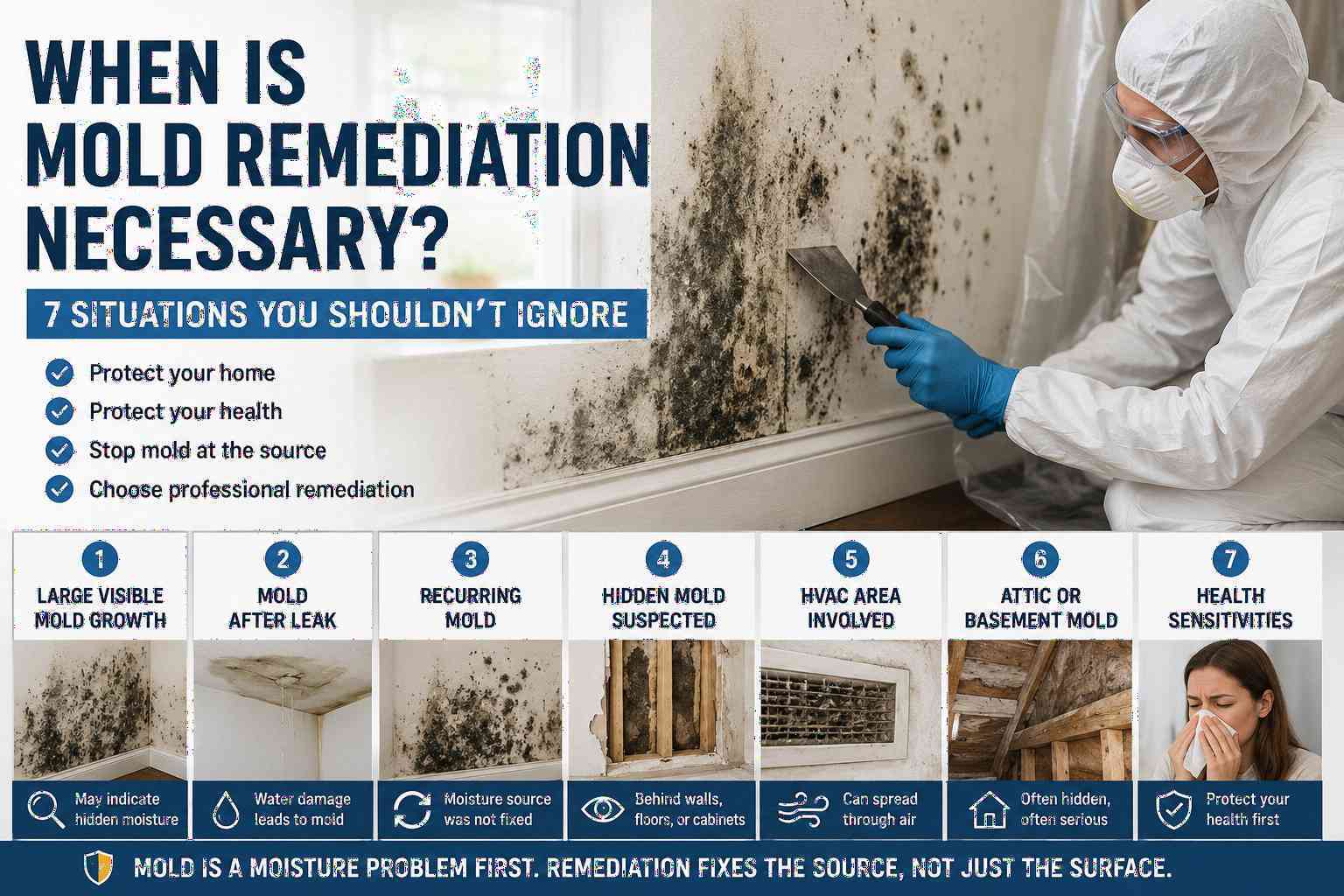
Quick Answer: When Is Mold Remediation Necessary?
When is mold remediation necessary? Mold remediation is usually necessary when visible mold growth is larger than a small surface spot, mold appears after a leak or water damage, mold keeps returning, porous materials are affected, HVAC systems may be involved, occupants have health sensitivities, or the moisture source is hidden.
A small mold spot on a hard, non-porous surface may sometimes be cleaned by a homeowner if the source of moisture is known and corrected. But when mold affects drywall, insulation, wood framing, flooring, cabinets, ceilings, HVAC areas, attics, basements, or hidden wall cavities, professional mold removal is usually the safer and more complete option.
The better question is not only “Do I see mold?” The better question is “Why is this material wet, how far did moisture travel, and what materials are affected?” Mold is a moisture problem first and a cleaning problem second. If the water source is not corrected, visible mold growth can return after surface cleaning.
For a complete process breakdown, read mold remediation step by step process
Mold Remediation vs Mold Cleaning
Mold cleaning and mold remediation are not the same service. Mold cleaning usually means removing a small amount of visible surface growth from an accessible surface. Mold remediation means identifying the moisture source, controlling the work area, removing or cleaning affected materials, reducing spread, and documenting the work.
Professional mold removal may include:
- Visual inspection
- Moisture readings
- Source identification
- Containment setup
- HEPA filtration when needed
- Removal of non-salvageable porous materials
- Cleaning of salvageable surfaces
- Antimicrobial treatment where appropriate
- Disposal of affected debris
- Post-remediation photos
- Optional clearance testing
For local service information, visit mold remediation
Situation 1: Visible Mold Growth Is Larger Than a Small Spot
Visible mold growth is one of the clearest signs that remediation may be needed. A small spot on bathroom grout is different from mold spreading across drywall, ceilings, baseboards, cabinets, insulation, flooring, or wood framing.
When is mold remediation necessary in this situation? It becomes necessary when the affected area is larger than a small isolated spot, the material is porous, the growth is spreading, or the moisture source is unknown. Mold on porous materials can be difficult to clean completely because contamination may extend into the material, not just sit on the surface.
Do not paint over mold. Do not spray bleach and assume the problem is solved. Do not disturb a larger contaminated area without containment. If visible mold growth is expanding or appears on drywall, ceilings, carpet, wood framing, or insulation, professional mold removal should be considered.
For hidden warning signs, read signs of hidden mold in your home
Table 1: 7 Situations When Mold Remediation Is Necessary
Situation 2: Mold Appears After a Leak or Water Damage
Mold after leak problems should not be ignored. A plumbing leak, roof leak, appliance leak, toilet overflow, water heater failure, HVAC drain backup, or storm intrusion can wet materials beyond the visible stain. Drywall, baseboards, cabinets, insulation, subflooring, and ceiling cavities can hold moisture.
When materials stay wet, mold can develop behind finished surfaces. This is why mold after leak situations often need more than surface cleaning. If a homeowner wipes the visible stain but leaves wet drywall, insulation, flooring, or cabinets in place, the problem can return.
Call a professional when:
- The leak was active for more than a short period
- Water reached drywall, flooring, cabinets, or insulation
- A musty odor remains after drying
- Staining keeps spreading
- Mold appears near the leak path
- The leak affected more than one room or level
- The source was roof, plumbing, or HVAC related
For water-related mold guidance, read mold after water damage Virginia
For ceiling leaks, see mold on ceiling causes remediation
Situation 3: Mold Keeps Coming Back
Recurring mold is a strong sign that the moisture source was not fixed. If the same spot returns after cleaning, the problem is usually humidity, condensation, a hidden leak, poor ventilation, or damp materials behind the surface.
This is one of the clearest answers to when is mold remediation necessary. If mold keeps returning, you need a moisture investigation, not another layer of paint. A recurring issue may involve window condensation, bathroom fans, HVAC condensation, basement moisture, attic ventilation, or a slow plumbing leak.
For prevention strategies, read how to prevent mold growth Northern Virginia
Situation 4: Mold Is Behind Drywall, Under Flooring, or Inside Cabinets
Hidden mold is harder to evaluate because the surface may show only a stain, bubbling paint, soft drywall, swelling trim, loose flooring, or a musty smell. Mold behind drywall or under flooring should not be disturbed without planning because cutting into contaminated material can spread dust and debris.
When to call mold remediation company professionals? Call when you suspect mold inside wall cavities, under flooring, behind cabinets, around a vanity, behind baseboards, or inside a ceiling assembly. A professional scope can identify what needs removal, what can be cleaned, and how the work area should be controlled.
For drywall-specific guidance, read mold behind drywall signs removal
For estimate structure, see mold remediation estimate Fairfax VA 2026
Situation 5: Mold Is Near HVAC Systems, Vents, or Air Handlers
Mold near HVAC equipment should be handled carefully because air systems can move particles through the home. Mold around vents, inside an HVAC closet, near a condensate line, or around an air handler may involve condensation, clogged drains, dirty filters, duct leakage, or poor airflow.
DIY mold removal risks are higher around HVAC areas because the issue may not be limited to the visible surface. Cleaning a wall near a vent does not correct an overflowing condensate pan or duct condensation problem. In many cases, HVAC service and mold remediation need to be coordinated.
For HVAC-related mold problems, read mold HVAC closet vents Virginia
Situation 6: Mold Is in an Attic or Basement
Attics and basements often hide mold until the problem becomes more advanced. These areas may have poor airflow, exposed framing, insulation, roof leaks, foundation moisture, condensation, or long-term humidity. Professional mold removal is often necessary because affected materials may include wood framing, roof sheathing, insulation, drywall, and stored contents.
Attic mold may appear on roof sheathing, rafters, or insulation. Basement mold may appear on drywall, framing, baseboards, flooring, storage items, or finished walls. In both cases, the moisture source matters more than the visible stain.
For attic issues, visit attic mold removal
For attic pricing, read attic mold removal cost Virginia guide
For basement problems, see basement mold remediation Northern Virginia
Situation 7: Someone in the Home Has Health Sensitivities
Mold can be a concern for people with allergies, asthma, respiratory sensitivity, immune concerns, or other medical conditions. A remediation contractor should not diagnose symptoms or make medical claims. However, visible mold and moisture conditions should still be taken seriously.
When is mold remediation necessary for health-related concerns? It is especially important when visible mold growth is present, the area is larger than a small surface spot, mold is recurring, the home has a musty odor, or occupants report sensitivity concerns. People with health questions should speak with a qualified medical professional.
For health context, see is black mold dangerous health risks
DIY Mold Removal Risks
DIY mold removal risks increase when homeowners disturb mold without understanding the source, affected materials, or containment needs. Small surface cleaning may be reasonable in limited situations, but DIY work can make the problem worse when mold is inside porous materials, behind walls, near HVAC systems, or caused by a larger water event.
Common DIY mold removal risks include:
- Spreading dust and debris
- Missing hidden moisture
- Cleaning only the visible surface
- Leaving wet materials in place
- Using bleach as a substitute for remediation
- Painting over mold
- Disturbing contaminated insulation
- Cutting drywall without containment
- Delaying professional drying after water damage
Table 2: DIY Mold Removal vs Professional Mold Removal
When to Call Mold Remediation Company Professionals
You should call a mold remediation company when visible mold growth is larger than a small area, mold appears after a leak, mold keeps returning, the source is hidden, porous materials are affected, HVAC systems may be involved, or documentation is needed for insurance, real estate, rental property, or property management.
A professional mold removal company should explain:
- What area is affected
- What caused the moisture
- What materials need removal
- What materials can be cleaned
- Whether containment is needed
- Whether HEPA filtration is needed
- Whether drying is complete
- Whether clearance testing is recommended
- What repairs are excluded
- What documentation will be provided
For contractor selection, read how to hire mold remediation company Northern Virginia
What a Professional Mold Remediation Scope Should Include
A professional scope should be clear enough that a homeowner understands exactly what is included. A vague one-line estimate is not enough for mold work. The scope should separate remediation from repairs, painting, plumbing, HVAC, roofing, drywall finishing, flooring, and reconstruction.
A complete mold remediation estimate may include inspection notes, affected area description, moisture source notes, containment details, HEPA filtration if included, demolition or material removal, cleaning method, disposal process, antimicrobial treatment if included, post-remediation photos, optional clearance testing, and exclusions.
For cost planning, read mold remediation cost Virginia 2026 guide
For insurance questions, see does insurance cover mold remediation Virginia
Documentation Matters
Documentation matters when mold follows a leak, insurance claim, property sale, tenant complaint, or recurring moisture problem. Photos, moisture readings, estimates, invoices, and completion notes help show what was found and what work was performed.
Clearance Testing
Clearance testing is not always required, but it can be useful after larger projects, real estate-related remediation, rental property disputes, or insurance-related work. Testing is often performed by an independent third party.
For more detail, read mold remediation clearance testing
Important Safety Note
If the mold was caused by sewage, contaminated water, major flooding, or significant structural damage, do not treat it as a simple cleaning project. These conditions may require specialized cleanup, drying, removal, and safety controls.
Quick Decision Guide
If you are asking when is mold remediation necessary, the safest rule is simple: if the mold is large, recurring, hidden, caused by water damage, near HVAC, affecting porous materials, or tied to health-sensitive occupants, do not treat it as a basic cleaning job.
Table 3: Mold Remediation Decision Guide
Professional Mold Removal in Northern Virginia
Homes in Northern Virginia often face mold issues from humid summers, storms, older plumbing, finished basements, attic ventilation problems, roof leaks, and HVAC condensation. The right response depends on the affected area and moisture source.
For regional guidance, read mold remediation Northern Virginia complete local guide 2026
For local service pages, see mold remediation Alexandria VA
For city-specific guides, read mold remediation Alexandria VA guide and mold remediation Arlington VA guide
Mold in Rental Properties
Mold remediation may also be necessary in rental homes, apartments, and managed properties. In these cases, documentation is especially important because owners, tenants, and property managers may need a clear record of the moisture source, inspection findings, remediation scope, and repairs.
For rental property guidance, see mold in rental property Virginia guide
For the dedicated version of this guide, see when is mold remediation necessary
FAQ: When Is Mold Remediation Necessary?
1. When is mold remediation necessary instead of basic cleaning?
Mold remediation is necessary when the problem is larger than a small surface spot, when visible mold growth is spreading, when mold is on porous materials, when mold follows a leak, or when the moisture source is hidden. Basic cleaning may be enough for a very small isolated area on a hard, non-porous surface if the source is known and fixed. However, remediation is usually the better option when drywall, insulation, wood framing, flooring, cabinets, HVAC areas, ceilings, attics, or basements are involved. The goal is not only to remove what is visible. The goal is to correct moisture and prevent the issue from returning.
2. When should I call a mold remediation company?
You should call a mold remediation company when visible mold growth is widespread, mold appears after a leak, mold keeps returning, or you smell a musty odor but cannot find the source. You should also call when mold may be behind drywall, under flooring, inside cabinets, in an attic, in a basement, or near HVAC equipment. Professional mold removal is also recommended when you need documentation for insurance, real estate, rental property management, or clearance testing. A qualified contractor should inspect the affected area, identify the moisture source, explain the scope, list exclusions, and document the work.
3. Is mold after a leak always serious?
Mold after leak situations should always be taken seriously because water can travel farther than the visible stain. A small plumbing leak can wet drywall, cabinets, baseboards, subflooring, and insulation. A roof leak can affect ceilings, attic materials, wall cavities, and framing. If materials are dried quickly and no mold develops, remediation may not be needed. But if visible mold growth appears, a musty odor remains, or materials stayed wet, professional inspection is recommended. The faster the moisture source is corrected, the lower the chance of a larger mold remediation project.
4. What are the biggest DIY mold removal risks?
The biggest DIY mold removal risks are spreading contamination, missing hidden moisture, disturbing porous materials, and cleaning only the visible surface. Homeowners often wipe mold, spray bleach, or paint over staining without checking why the area became wet. That can allow mold to return. DIY cleanup is especially risky when mold is behind drywall, under flooring, in insulation, near HVAC systems, or caused by sewage, flooding, or major water damage. If the affected area is large or the source is unclear, professional remediation is safer than trial-and-error cleaning.
5. Does professional mold removal include repairs?
Professional mold removal does not always include repairs. Mold remediation usually includes containment, removal of affected materials, cleaning, disposal, and documentation. Repairs may include plumbing work, roof repair, HVAC repair, drywall replacement, painting, flooring, insulation replacement, or reconstruction. These should be listed separately in the estimate. A clear scope should explain what is included and what is excluded. Before approving work, homeowners should ask whether the estimate includes drying, demolition, cleaning, antimicrobial treatment, clearance testing, repairs, and post-remediation photos.
6. Is mold remediation necessary if I only smell mold but cannot see it?
It may be necessary, but inspection should come first. A musty odor can indicate hidden moisture or mold behind drywall, under flooring, in cabinets, in HVAC closets, in basements, or in attic areas. Odor alone does not show the size or exact source of the problem. A professional inspection can help identify moisture patterns and determine whether remediation is needed. If the odor follows a leak, water damage, basement moisture, or HVAC issue, it should not be ignored. The longer the source remains active, the more likely materials may become affected.
7. Is mold remediation necessary before selling a house?
Mold remediation may be necessary before selling a house if visible mold growth, musty odors, water damage, attic mold, basement mold, or inspection concerns are present. Buyers may ask for professional remediation, documentation, clearance testing, or repair credits. Addressing mold before listing can reduce surprises during inspection and negotiation. The scope should include the moisture source, affected materials, remediation method, exclusions, and completion documentation. If the issue is small and cosmetic, basic cleaning may be enough, but recurring or hidden mold should be handled professionally.
8. How do I know if a mold remediation estimate is complete?
A complete mold remediation estimate should identify the affected area, moisture source, materials involved, containment plan, cleaning method, removal scope, disposal process, drying needs, documentation, and exclusions. It should also clarify whether clearance testing is included or optional. Be cautious with estimates that only say “remove mold” without explaining how. A low price may exclude containment, HEPA filtration, demolition, disposal, drying, or repairs. The best estimate is not always the cheapest. It is the one that clearly explains what problem is being solved and what work is not included.
Final Takeaway
When is mold remediation necessary? It is necessary when mold is more than a small surface issue, when visible mold growth is spreading, when mold appears after a leak, when mold keeps returning, when porous materials are affected, when HVAC systems may be involved, or when the source of moisture is hidden.
The safest path is to identify the moisture source, stop the water, avoid disturbing affected materials, and call a professional when the scope is unclear. Professional mold removal is not just about cleaning what you see. It is about correcting the conditions that allowed mold to grow and documenting the work so the problem does not keep coming back.

