

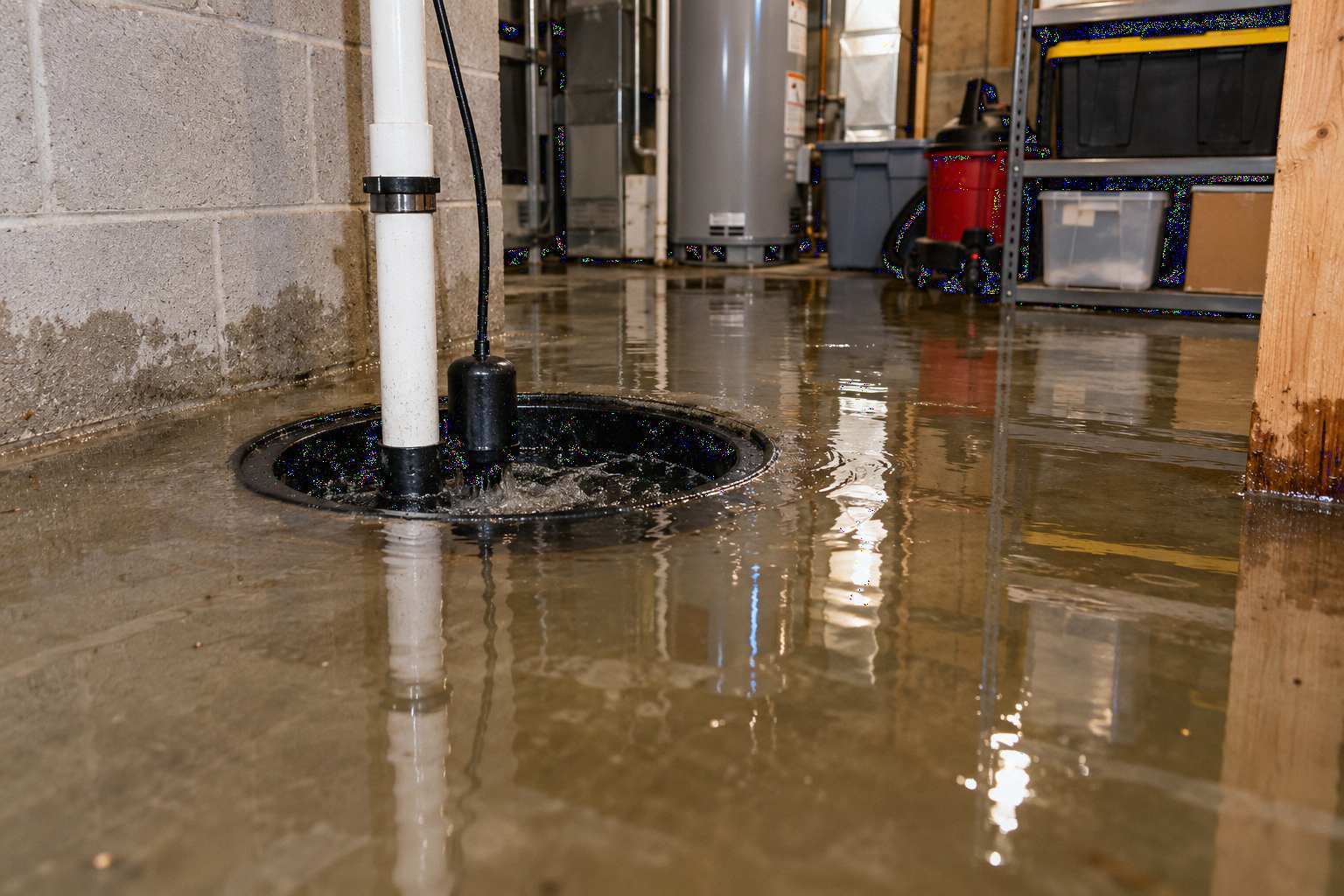
Sump pump failure water damage can turn a drainage problem into a finished-basement water loss very quickly.
When a sump pump loses power, stops working, becomes overwhelmed, or cannot discharge water effectively, the sump pit may overflow. Water can then spread across the basement floor, beneath carpet or finished flooring, behind baseboards, into drywall and insulation, and through openings between rooms.
The most important point is that restoring the sump pump and restoring the basement are two different jobs.
A repaired pump may stop additional water from entering. It does not remove moisture already trapped in building materials.
The correct response is:
Make the basement safe → restore effective water removal → document the flooding → extract standing water → identify hidden moisture → dry and monitor affected materials → reconstruct after moisture conditions are addressed.
For a complete overview of the water-damage restoration process see
Quick Answer: What Should You Do After a Sump Pump Fails?
If water is rising in the basement after a sump pump failure:
- Do not enter standing water if electrical equipment may be energized.
- Avoid touching wet outlets, appliances, cords, pumps, or electrical equipment while standing in water.
- Restore safe pumping through the primary pump or available sump pump backup when possible.
- Document the sump pit, water level, flooring, walls, and contents.
- Remove standing water when the basement can be entered safely.
- Check drywall, flooring, carpet padding, insulation, baseboards, framing, and adjacent rooms.
- Begin drying wet porous materials promptly.
- Do not begin cosmetic repairs simply because the visible water is gone.
The visible puddle is only one part of sump pump failure water damage. Water may already be beneath flooring or inside finished walls.
For active water emergencies see
Why Do Sump Pumps Fail?
There is no single cause of sump pump failure water damage.
Possible problems include:
- Electrical power loss
- Mechanical pump failure
- Float-switch problems
- Restricted discharge
- Failed discharge components
- Pump capacity being exceeded
- Failure of a sump pump backup
- Unusually high groundwater during prolonged rainfall
The sump system should be evaluated to determine why water removal failed rather than assuming that every overflow requires the same repair.
From the restoration perspective, however, another question is just as important:
How far did water travel before the system regained control?
Sump Pump Overflow During Heavy Rain
A sump pump overflow commonly appears during heavy or prolonged rainfall because groundwater around the home can increase rapidly.
Water around the foundation may enter perimeter drainage and move toward the sump pit. The pump must then remove that water fast enough to prevent the pit from overflowing.
If the system cannot keep up, water can enter the basement.
Why Heavy Rain Basement Water Can Return After Extraction
Heavy rain basement water does not always behave like a broken interior pipe.
When a plumbing line inside the home is shut off, the source may stop immediately.
Groundwater can continue moving toward the foundation while surrounding soil remains saturated.
This means a basement may be extracted and then begin collecting water again if effective pumping has not been restored.
For seasonal flooding information see
Can the Sump Pump Be Running and Still Overflow?
Yes.
A pump making noise does not prove the system is successfully controlling water.
The more useful question is whether the sump level is:
- Falling
- Staying controlled
- Continuing to rise
If water continues rising, the system is not keeping up with incoming water.
Basement Flooding From Sump Pump Failure: Safety Comes Before Cleanup
Basement flooding from sump pump failure should not be treated like an ordinary spill.
Basements often contain electrical and mechanical equipment such as:
- Outlets
- Electrical panels
- Furnaces
- Water heaters
- Laundry appliances
- Extension cords
- Pumps
Standing water can create electrical and physical hazards.
Do not walk through water simply to reach the sump pump, electrical panel, or another piece of equipment if the electrical condition is uncertain.
For severe flooding, professional assistance may be safer than trying to troubleshoot equipment from inside the wet area.
What Does a Sump Pump Backup Actually Do?
A sump pump backup provides a secondary method of water removal when the primary system cannot operate normally.
Depending on the installed system, backup protection may help during certain power failures or primary pump problems.
However, a backup does not guarantee that the basement cannot flood.
What Can Homeowners Check Safely?
Useful questions include:
- Is electrical power available?
- Is the primary pump operating?
- Is water actually leaving through the discharge?
- Did the backup activate?
- Is water in the sump pit rising or falling?
What If Both Pumps Are Running but Water Is Still Rising?
Incoming water may be exceeding the effective pumping capacity, or another drainage or discharge problem may exist.
Should You Keep Resetting the Pump?
Repeatedly resetting equipment does not repair a failed motor, restricted discharge, electrical problem, or capacity issue.
The Practical Rule
Restore safe water removal first. Then treat the wet basement as a separate restoration project.
Flooded Basement Cleanup: What to Do After the Water Stops Rising
Once the sump system or another pumping method is controlling incoming water, flooded basement cleanup can focus on the building.
Step 1: Document the Loss
Before major cleanup, photograph or record:
- The sump pit
- Water depth
- Finished flooring
- Carpet
- Walls
- Baseboards
- Furniture
- Stored belongings
- Mechanical equipment
Documentation can also help establish what the basement looked like before damaged materials are removed.
Step 2: Extract Standing Water
Once conditions are safe, remove standing water.
This limits continued absorption into porous materials.
Step 3: Separate Wet Contents
Cardboard boxes, paper, textiles, upholstered furniture, and wood contents can absorb and retain water.
Moving wet contents may also make it easier to inspect floors and walls.
Step 4: Find the Full Moisture Footprint
Do not assume that the edge of the original puddle marks the edge of the damage.
Water may have moved under walls, transitions, carpet padding, and flooring.
For a detailed immediate-response guide see
For the mitigation process see
Hidden Sump Pump Failure Water Damage
One of the biggest risks after extraction is hidden moisture.
The basement can look substantially better while water remains inside:
- Carpet padding
- Flooring underlayment
- Drywall
- Insulation
- Wall cavities
- Wood framing
- Areas behind baseboards
A dry-looking exposed surface does not prove the layers behind or beneath it are dry.
This is especially important with finished basements because water can pass beneath partition walls and continue into an adjacent room.
For more information see
Wet Drywall After a Sump Pump Overflow
Finished basement drywall is vulnerable during a sump pump overflow because its lower edge is close to the floor.
Water can wick into drywall or reach its back side through the wall cavity.
Warning signs may include:
- Dark staining
- Soft drywall
- Swelling
- Bubbling paint
- Damaged baseboards
- Persistent dampness
Does Wet Basement Drywall Always Need to Be Removed?
No.
The decision should depend on actual conditions, including:
- Water source
- Possible contamination
- Length of exposure
- Physical condition
- Height of moisture
- Insulation behind the wall
- Ability to access and dry the assembly
Is a Flood Cut Always Required?
No.
An automatic cut at a predetermined height should not replace assessment of the actual wet area.
When Is Removal More Likely?
Removal becomes more relevant when drywall is physically damaged, contamination is involved, insulation remains wet behind it, or access is necessary to address concealed materials.
Wet Wall Decision Rule
Locate moisture → evaluate the materials → create only necessary access → dry and monitor → reconstruct after moisture conditions are addressed.
For detailed drywall guidance see
Water Under Basement Flooring After Sump Pump Failure
Flooring can hide a significant portion of sump pump failure water damage.
Carpet and Padding
Carpet fibers may begin drying while padding underneath remains wet.
Water can also travel laterally through padding beyond the obvious flood line.
Laminate Flooring
Possible signs of water exposure include:
- Swollen edges
- Raised seams
- Warping
- Core deformation
Drying cannot necessarily reverse permanent physical swelling.
LVP and Vinyl Flooring
A water-resistant finished surface does not mean the floor assembly underneath remained dry.
Water may move through:
- Perimeters
- Transitions
- Seams
- Floor penetrations
Hardwood and Engineered Wood
Wood flooring may react to moisture through:
- Cupping
- Crowning
- Swelling
- Buckling
- Staining
For flooring-specific guidance see
For wood-floor restoration decisions see
When Is Professional Basement Drying Needed?
Professional drying becomes more relevant when basement flooding from sump pump failure affects porous, layered, or concealed materials.
Examples include:
- Wet finished drywall
- Wet insulation
- Saturated carpet and padding
- Water beneath flooring
- Wet framing
- Multiple affected basement rooms
- Unknown flood duration
- Persistent moisture after extraction
Professional structural drying may include:
- Water extraction
- Air movers
- Dehumidification
- Moisture measurements
- Targeted material access
- Ongoing monitoring
For more information see
Why Fans Alone May Not Be Enough
Fans and air movers increase airflow.
They do not perform the same job as dehumidification.
As wet materials release moisture, that moisture moves into the indoor air. If humidity remains elevated, drying conditions may become less effective.
A few household fans also cannot establish whether moisture remains:
- Under flooring
- Inside carpet padding
- Behind drywall
- Inside insulation
- In enclosed wall cavities
Professional drying is therefore based on the actual affected materials and moisture conditions rather than simply placing fans in the room.
Why Prompt Flooded Basement Cleanup Matters
Water-damaged porous materials should be addressed quickly.
A practical target is to begin drying as soon as the basement can be safely accessed rather than waiting for odors, staining, or visible mold.
Drying does not necessarily mean every material will reach appropriate conditions in one or two days.
The time required depends on:
- Amount of water
- Material type
- Humidity
- Temperature
- Air movement
- Accessibility
- Flood duration
The important point is to control moisture early and monitor drying progress.
Can Sump Pump Failure Cause Mold?
Persistent moisture following sump pump failure water damage can create conditions that support mold growth.
Potential locations include:
- Drywall
- Carpet padding
- Insulation
- Wood framing
- Areas behind baseboards
- Cardboard
- Stored porous materials
A basement flood does not automatically mean mold remediation is required.
The priority is to stop the water problem and dry affected materials.
For additional information see
For basement-specific mold guidance see
Heavy Rain Basement Water Is Not the Same as Sewage Backup
The source of basement water matters.
Heavy rain basement water associated with groundwater and sump failure is different from sewage or wastewater backing up through a sanitary drain.
Floodwater can also collect contaminants before or after it enters a building.
If sewage, drain backup, or visibly contaminated water is involved, material handling and cleanup decisions may need to change.
For sewage-specific information see
Seven Mistakes After Sump Pump Failure
Mistake 1: Fixing the Pump and Assuming the Basement Is Restored
A functioning pump controls new water. It does not dry wet walls, flooring, or contents.
Mistake 2: Entering Standing Water Without Considering Electrical Hazards
Basement water may be in contact with energized equipment.
Mistake 3: Removing Only the Visible Puddle
Water may remain beneath flooring and behind finished walls.
Mistake 4: Running Fans Without Controlling Humidity
Moving air alone does not prove materials are drying properly.
Mistake 5: Rebuilding Immediately
New flooring or drywall should not conceal unresolved moisture.
Mistake 6: Assuming All Basement Water Has the Same Contamination Risk
The actual source and conditions matter.
Mistake 7: Waiting for Mold Before Acting
Proper flooded basement cleanup starts with moisture control, not visible mold.
DIY vs. Professional Flooded Basement Cleanup
Not every sump-pump incident requires extensive restoration.
A small, immediately controlled amount of water on unfinished concrete may have a limited scope.
Professional help becomes more relevant when:
- A significant area is flooded
- Electrical hazards exist
- Finished drywall becomes wet
- Insulation is affected
- Carpet or padding is saturated
- Water moves under flooring
- Several rooms are involved
- Water may be contaminated
- Flood duration is unknown
- Moisture remains after extraction
For a broader comparison see
How Much Does Sump Pump Failure Water Damage Restoration Cost?
There is no accurate universal price for sump pump failure water damage.
The restoration scope depends on factors such as:
- Depth and spread of water
- Duration of flooding
- Finished or unfinished basement
- Drywall involvement
- Insulation
- Flooring type
- Carpet and padding
- Contents
- Required material access or removal
- Structural drying
- Reconstruction
A minor sump pump overflow across unfinished concrete is very different from flooding throughout a finished basement with drywall, carpet, flooring, and multiple affected rooms.
For broader cost factors see
For room-specific cost information see
Does Homeowners Insurance Cover Sump Pump Failure Water Damage?
Coverage depends on the policy and the cause of the loss.
Homeowners should not assume that sump pump failure water damage is handled the same way as water from a burst interior plumbing line.
Some policies may exclude sump pump overflow or water backup unless additional coverage has been added through an endorsement.
Relevant policy terms can include:
- Sump pump overflow
- Water backup
- Sewer or drain backup
- Groundwater
- Flood
- Endorsement limits
- Deductibles
Flood insurance also has its own definitions and basement-coverage restrictions.
Document the loss and ask the insurer which specific coverage applies to the actual event.
For broader insurance guidance see
For claim documentation see
How Can You Reduce the Risk of Another Sump Pump Overflow?
After the basement has been dried and restored, address the reason the system failed.
Possible preventive steps include:
- Periodically testing the primary pump
- Checking that the float moves freely
- Inspecting the discharge route
- Evaluating pump condition and capacity
- Reviewing sump pump backup options
- Considering suitable backup power
- Monitoring the sump pit during major storms
- Correcting exterior drainage issues when present
A sump pump backup can reduce certain risks, particularly when the primary pump cannot operate, but it does not make the system maintenance-free or guarantee protection against every storm.
FAQ: Sump Pump Failure Water Damage
1. What should I do immediately when my sump pump fails and my basement starts flooding?
First, determine whether the basement is safe to enter.
Do not step into standing water when electrical equipment, outlets, cords, appliances, pumps, a furnace, water heater, or electrical service equipment may be affected.
If water removal can be restored safely through the primary pump or a sump pump backup, reducing additional water accumulation becomes the next priority.
Document the basement before significant cleanup whenever possible.
Once the water is controlled and conditions are safe, begin extraction.
Then check much more than the exposed floor. Basement flooding from sump pump failure can affect drywall, insulation, carpet padding, flooring, wall cavities, framing, baseboards, and stored belongings.
The sump pump repair and the basement restoration should be treated as separate parts of the same loss.
2. Why does my sump pump overflow during heavy rain if it still seems to be running?
A sump pump overflow does not necessarily mean the pump has completely stopped.
During prolonged rainfall, groundwater may reach the sump pit faster than the system can effectively remove it.
A pump may also run while a discharge restriction, system-capacity issue, or another mechanical problem limits actual performance.
The most useful indicator is the water level.
If the pump runs but the sump level continues rising, water is entering faster than it is successfully leaving.
Heavy rain basement water can also continue returning after initial extraction while surrounding soil remains saturated, which is why restoring effective pumping is important before assuming the flooding is over.
3. How can I tell whether water is trapped behind basement walls or under the floor?
Visible appearance alone is not always reliable.
Warning signs can include:
- Damp or swollen baseboards
- Soft drywall
- Bubbling paint
- Raised flooring seams
- Wet carpet padding
- Persistent dampness
- Moisture appearing in an adjacent room
However, hidden moisture may exist even when these signs are absent.
Water can pass beneath partition walls, under floating flooring, into insulation, and around floor transitions.
Professional moisture assessment can help determine the extent of the affected area before materials are closed or covered.
The goal is not to remove everything automatically. It is to determine which assemblies became wet and which can be appropriately dried or need access.
4. Does homeowners insurance cover sump pump overflow or sump pump backup failure?
Coverage depends on the actual policy.
Many homeowners should specifically check whether their policy includes an endorsement for water backup or sump pump overflow because this type of loss may not be covered under the base policy.
The cause also matters.
Water associated with a failed sump pump, groundwater, sewer backup, and a qualifying external flood can be treated differently under insurance contracts.
Review terms relating to:
- Water backup
- Sump pump discharge or overflow
- Sewer and drain backup
- Groundwater
- Flood
- Coverage limits
- Deductibles
Do not assume that a basement flood is automatically covered or automatically excluded.
Photograph the loss and obtain the carrier's interpretation based on the policy actually in force.
5. How soon should flooded basement cleanup and structural drying begin?
Flooded basement cleanup should begin as soon as the space can be entered safely and incoming water is controlled.
Standing water should be extracted first.
Wet porous materials should then be evaluated and drying should begin promptly.
The actual drying period can vary considerably depending on:
- Water depth
- Flood duration
- Drywall and insulation involvement
- Flooring type
- Carpet and padding
- Indoor humidity
- Temperature
- Accessibility
- Drying equipment
- Measured moisture progress
A common moisture-control target is to address wet materials within approximately the first 24–48 hours when conditions allow.
That does not mean every flooded basement must be completely dry within 48 hours.
The important distinction is between starting drying promptly and promising a fixed drying completion time.
Final Takeaway
Sump pump failure water damage is not finished when the pump starts working again.
A failed pump creates the first problem.
Water spreading into the basement creates the second.
A sump pump overflow can move beneath flooring and through finished wall assemblies.
Basement flooding from sump pump failure may affect drywall, insulation, carpet, flooring, framing, and stored contents.
Heavy rain basement water may continue entering while groundwater remains elevated.
Proper flooded basement cleanup involves extraction, moisture assessment, drying, and monitoring—not simply removing the visible puddle.
And a sump pump backup can reduce some future risk, but it does not replace regular system checks or proper post-loss drying.
The correct order is:
Make the basement safe → restore effective water removal → document the flooding → extract standing water → locate concealed moisture → dry and monitor affected materials → reconstruct only after moisture conditions are addressed.
That sequence helps prevent the most common mistake after sump pump failure: fixing the pump while leaving the basement wet.

