

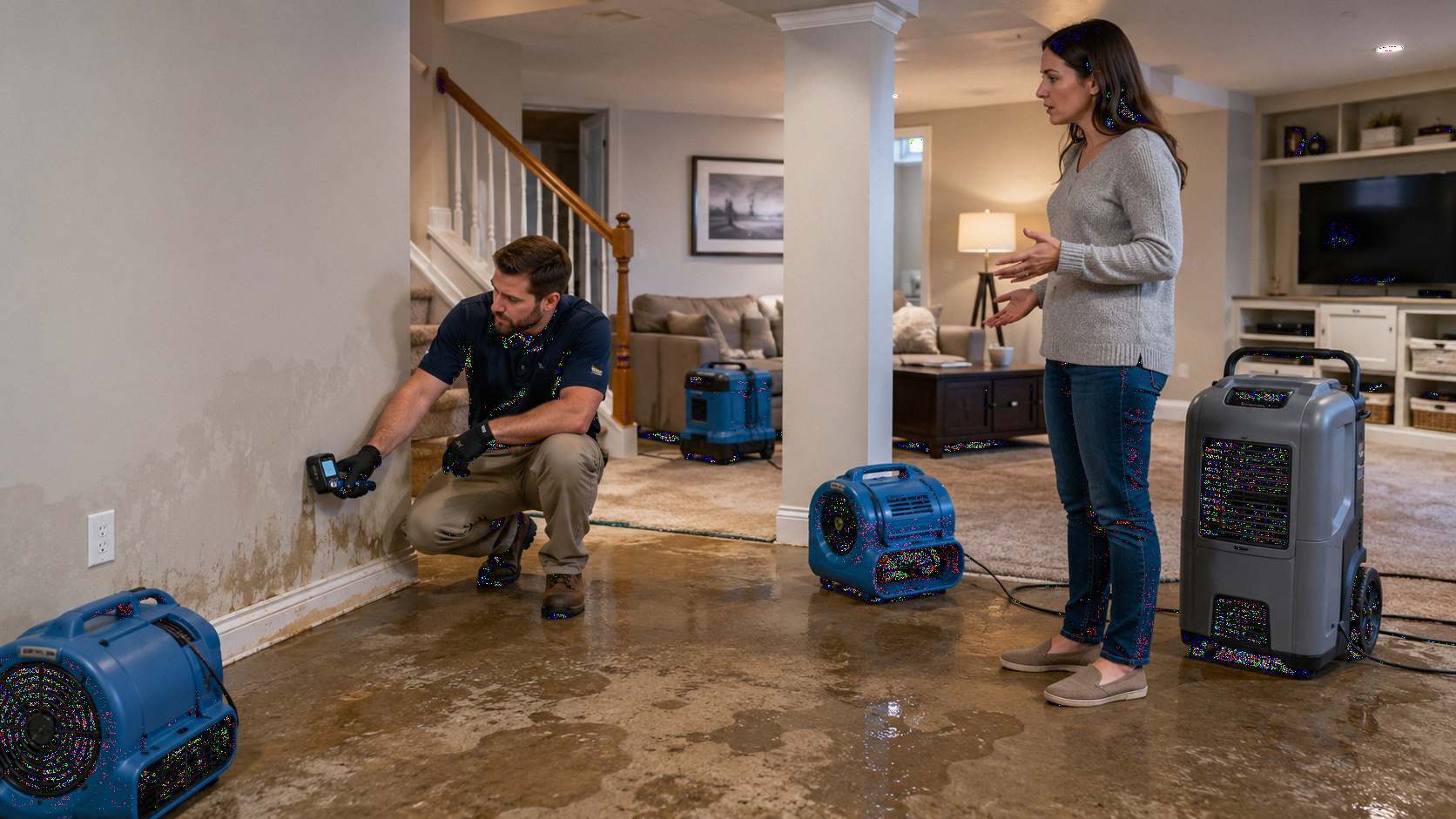
Quick Answer: Water Damage Restoration Fairfax VA
Water damage restoration Fairfax VA is the process of stabilizing a home after a leak, flood, pipe burst, appliance failure, roof leak, sewer backup, or basement water intrusion. The work usually includes stopping the water source, removing standing water, checking hidden moisture, drying affected materials, documenting the damage, and planning repairs after the structure is dry.
For Fairfax homeowners, the most important step is not repainting, replacing flooring, or patching drywall. The first step is mitigation. A professional Fairfax water mitigation company should inspect whether water reached drywall, flooring, carpet pad, baseboards, cabinets, insulation, subflooring, or ceiling cavities. EPA guidance says water-damaged areas and items should be dried within 24–48 hours to help prevent mold growth.
This matters because Fairfax basement flooding, pipe bursts, appliance leaks, roof leaks, and Tysons water damage can spread farther than the visible wet area. A floor may look dry while moisture remains under the finished surface. A ceiling stain may look small while the wet area above it is larger. A finished basement may appear cleaned up while drywall, trim, carpet pad, or insulation still holds moisture.
For immediate first steps, see first 24 hours water damage checklist
Water damage restoration Fairfax VA helps homeowners recover after burst pipes, appliance leaks, ceiling stains, roof leaks, sump pump failures, sewer backups, stormwater intrusion, and basement flooding. The process usually includes safety review, source control, water extraction, moisture inspection, structural drying, selective material removal when needed, drying verification, documentation, and repair planning. Fairfax homeowners should act quickly, document damage, avoid covering wet materials, check hidden moisture, contact insurance when appropriate, and work with a Fairfax water mitigation company that verifies drying before repairs begin.
Why Fairfax Homes Need Fast Water Mitigation
Fairfax homes can experience water damage from interior plumbing failures and exterior water intrusion. Interior losses may involve supply lines, water heaters, toilets, tubs, showers, washing machines, dishwashers, refrigerators, or HVAC drain lines. Exterior water intrusion may involve heavy rain, sump pump failure, foundation seepage, basement window wells, poor grading, roof leaks, or stormwater entry.
Common reasons homeowners need water damage restoration Fairfax VA include:
- Burst pipes
- Water heater leaks
- Dishwasher leaks
- Washing machine supply line leaks
- Refrigerator ice maker line leaks
- Toilet overflows
- Tub or shower leaks
- Roof leaks
- Ceiling water stains
- HVAC condensation drain backups
- Sump pump failures
- Basement seepage
- Stormwater intrusion
- Sewer or drain backups
- Water from an upstairs room or unit
The water source matters because cleanup, drying, material removal, and insurance documentation can change depending on whether the loss came from a sudden plumbing failure, long-term seepage, floodwater, surface water, sewage, or a roof leak. Virginia SCC states that homeowners insurance policies issued in Virginia generally do not provide coverage for damage to a home and belongings caused by floods, surface water, or surges.
For insurance basics, see does insurance cover water damage restoration
What Fairfax Homeowners Should Do First
After water damage, start with safety and documentation. Do not begin with paint, flooring replacement, or drywall patching. Start by stopping the source, documenting the visible damage, removing water, and checking whether hidden moisture spread into nearby materials.
Start here:
- Stop the water source if it is safe.
- Shut off the local valve or main water supply if needed.
- Stay away from wet electrical areas.
- Keep children and pets out of affected rooms.
- Move furniture and belongings when safe.
- Take photos and videos before cleanup.
- Document the visible source if possible.
- Contact your insurance carrier or agent when appropriate.
- Begin extraction and drying quickly.
- Check nearby rooms, lower levels, closets, and wall bases.
Do not assume the home is dry because the visible puddle is gone. Water can remain under flooring, behind baseboards, inside wall cavities, behind cabinets, in carpet pad, and above ceiling drywall. A reliable Fairfax water mitigation company should inspect moisture before repairs cover the affected area.
For pipe-related damage, see burst pipe water damage
For appliance leaks, see appliance leak water damage
Fairfax Basement Flooding: Why Basements Need Extra Attention
Fairfax basement flooding can be more complicated than a small surface leak because finished basements contain materials that absorb and trap moisture. A finished basement may include carpet, carpet pad, laminate, vinyl plank, drywall, insulation, baseboards, built-ins, storage, furniture, and utility systems.
Basement water damage can affect:
- Carpet and carpet pad
- Luxury vinyl plank
- Laminate flooring
- Hardwood flooring
- Baseboards and trim
- Drywall
- Insulation
- Framing
- Stored boxes
- Furniture
- Utility rooms
- Mechanical equipment
- Electrical components
- Built-in shelving
- Finished basement walls
Fairfax County states that most homeowner insurance policies do not cover damage caused by flooding. The county also notes that flood insurance may be available through the National Flood Insurance Program in participating communities, including Fairfax County.
This is why source documentation matters. Water from a failed supply line inside the home may be reviewed differently than stormwater, surface water, seepage, or floodwater. A contractor can document the damage and drying process, but the insurance carrier decides coverage based on the policy, cause of loss, exclusions, endorsements, and claim review.
For basement mold concerns, see basement mold remediation Northern Virginia
What a Fairfax Water Mitigation Company Should Do
A Fairfax water mitigation company should focus first on stabilizing the property. Mitigation is the emergency phase. Restoration is the larger recovery process that may include drying, cleaning, documentation, repair planning, drywall, flooring, trim, painting, cabinets, and rebuild.
Mitigation may include:
- Safety review
- Water source identification
- Water extraction
- Moisture meter readings
- Thermal imaging when useful
- Moisture mapping
- Removal of unsalvageable wet materials when needed
- Air movers and dehumidifiers
- Humidity control
- Drying monitoring
- Photos and documentation
- Repair planning after drying
A small clean-water spill on a hard floor is different from a finished basement flood, soaked carpet pad, ceiling leak, sewer backup, or moisture inside a wall cavity. The goal is to understand what materials were affected, how far the water traveled, and what must be dried before repairs begin.
For the step-by-step mitigation process, see water mitigation process
Water Damage Restoration Fairfax VA Process
A complete water damage restoration Fairfax VA project usually follows a sequence. The exact scope depends on the source, affected rooms, wet materials, contamination concerns, and how long materials stayed wet.
Emergency Inspection
A technician checks the source, affected rooms, visible damage, safety concerns, and hidden moisture risk. The inspection should identify what is wet, what appears dry, and what needs additional monitoring.
Water Extraction
Standing water is removed from floors, carpet, basements, and affected areas when possible. Extraction helps reduce water spread and prepares the area for drying.
Structural Drying
Air movers and dehumidifiers are used to dry affected materials and control humidity. Drying should be guided by moisture readings, not only by appearance.
Drying Verification
Moisture readings should be checked before drywall, flooring, trim, paint, or cabinet repairs cover the affected area.
A reliable process does not jump from “water removed” to “new drywall.” Flooring, drywall, baseboards, cabinets, insulation, and subflooring can hold moisture after visible water is gone. Repairs should be planned after drying is verified.
For structural drying details, see structural drying after water damage
Tysons Water Damage: Condos, Townhomes, and Mixed-Use Buildings
Tysons water damage can involve condos, townhomes, apartments, offices, and mixed-use properties. In multi-unit buildings, water can start in one unit and affect another. A washing machine leak, toilet overflow, sprinkler discharge, HVAC drain backup, roof leak, or pipe burst can move through ceilings, walls, floors, and shared spaces.
For Tysons and nearby multi-unit water damage, document:
- Where the water first appeared
- Which rooms were affected
- Whether another unit may be involved
- Building management communication
- Photos and videos
- Moisture readings
- Contractor invoices
- Drying equipment dates
- Repair estimates
- Insurance correspondence
Multi-unit water damage can involve homeowners, tenants, condo associations, landlords, property managers, and insurance carriers. A restoration contractor can document damage and perform mitigation, but coverage and responsibility depend on policy language, association documents, lease terms, and carrier review.
For commercial or mixed-use water damage, see commercial water damage restoration Virginia
Hidden Moisture: The Damage Homeowners Often Miss
One of the biggest risks in water damage restoration Fairfax VA is hidden moisture. Water follows seams, gravity, flooring layers, wall cavities, and porous materials. It may spread farther than the visible stain or puddle.
Hidden moisture may be found in:
- Drywall behind paint
- Carpet pad under carpet
- Subfloor under vinyl plank
- Cabinet toe kicks
- Ceiling insulation
- Wall cavities
- Baseboards and trim
- Stairwell walls
- Closets behind affected rooms
- Finished basement walls
- Under thresholds and transition strips
A moisture meter helps check whether materials are actually wet. A thermal imaging camera can help locate suspicious temperature patterns, but thermal findings should be verified with moisture readings. Restoration decisions should be based on inspection, readings, drying progress, and documentation.
For hidden moisture detection, see how restoration companies detect hidden water damage
For wet drywall decisions, see wet drywall after water leak
Water Damage and Mold Concern in Fairfax Homes
Mold concern increases when moisture remains in building materials. The risk depends on material type, humidity, temperature, airflow, contamination, and how quickly drying begins. EPA states that the key to mold control is moisture control.
Mold concern may increase when:
- Water sat for an extended period
- Drywall stayed wet
- Carpet pad absorbed water
- Humidity remained high
- Cabinets trapped moisture
- The leak happened behind a wall
- The basement was affected
- The water source was contaminated
- The same area had prior leaks
- Repairs covered wet materials too quickly
Not every water damage job becomes mold remediation. But if materials stayed wet, there is odor, visible growth, or repeated water intrusion, the area should be evaluated before rebuild. For Fairfax homeowners, the practical rule is simple: dry first, verify moisture, then repair.
For mold after water damage, see mold after water damage Virginia
For local mold services, see mold remediation Fairfax VA
Insurance Documentation for Water Damage in Fairfax
Insurance coverage depends on the source of water, policy language, exclusions, endorsements, deductibles, maintenance history, documentation, and carrier review. A contractor should not promise that a claim will be covered. The contractor’s role is to document the loss, perform mitigation, and provide records that help explain the damage and work performed.
Helpful documentation may include:
- Photos before cleanup
- Videos of standing water
- Source information
- Plumber report if applicable
- Moisture readings
- Drying logs
- Equipment dates
- Damaged material photos
- Contents list
- Repair estimate
- Communication notes
- Receipts and invoices
Virginia SCC explains that standard homeowners, renters, and commercial insurance policies issued in Virginia typically do not cover damage caused by floods, surface water, or storm surge. Fairfax County also states that most homeowner insurance policies do not cover flooding, which makes it important to understand whether the loss is from interior plumbing, floodwater, seepage, sewer backup, or another source.
For claim organization, see water damage insurance claim help
For denied claim issues, see water damage claim denied reasons
Repair Planning After Drying
Repairs should come after mitigation, drying, and moisture verification. A Fairfax home may need drywall repair, insulation replacement, flooring replacement, trim repair, painting, cabinet work, or ceiling repair. But repairs should match the actual affected area, not only the visible surface damage.
Repair planning may include:
- Removing damaged drywall
- Replacing insulation when needed
- Repairing subfloor damage
- Replacing baseboards
- Reinstalling flooring
- Repairing ceiling drywall
- Painting affected areas
- Rebuilding damaged finishes
- Checking for remaining odor
- Confirming the water source is fixed
If repairs begin too early, moisture can become trapped behind new materials. That may lead to odor, staining, swelling, paint failure, flooring movement, and mold concern. A clean repair starts with a dry structure.
For water under flooring, see water damage under flooring
For ceiling damage, see ceiling water damage
How to Choose a Water Damage Restoration Company in Fairfax
Choosing the right Fairfax water mitigation company can affect drying results, documentation, and repair planning. The company should explain the process clearly and avoid scare tactics, unsupported guarantees, or promises about insurance approval.
Ask these questions:
- What areas are affected?
- How will hidden moisture be checked?
- What equipment is needed?
- Will moisture readings be documented?
- How will drying be monitored?
- What materials may need removal?
- What can potentially be dried in place?
- When can repairs begin?
- What documentation will I receive?
- Do you help organize information for insurance review?
A good company should explain the difference between mitigation and restoration. It should also avoid claiming materials are dry without checking them or giving exact timelines before inspection is complete.
For contractor selection guidance, see how to choose water damage restoration company
Local Water Damage and Mold Resources
Fairfax homeowners often need more than one guide because water damage can involve drying, flooring, drywall, insurance, mold concern, and repairs.
FAQ: Water Damage Restoration Fairfax VA
1. What should I do first after water damage in Fairfax, VA?
First, protect people and stop the source if it is safe. If water is coming from a plumbing line, shut off the local valve or main water supply. If the leak involves electrical outlets, ceiling fixtures, standing water near cords, or a sagging ceiling, stay away from the affected area and get professional help.
Next, document the damage before cleanup when safe. Take photos and videos of standing water, wet flooring, ceiling stains, damaged belongings, baseboards, and the source if visible. Then begin water extraction and drying. Do not wait for the area to dry naturally, especially if water reached drywall, flooring, carpet pad, cabinets, or a finished basement.
2. How long does water damage restoration in Fairfax take?
The timeline depends on the source, size of the affected area, materials involved, humidity, airflow, contamination level, and how quickly mitigation begins. A small clean-water leak may require less drying than a large basement flood, multi-room pipe burst, roof leak, or sewer backup.
The drying phase often requires equipment and moisture monitoring. Repairs should begin only after affected materials are evaluated and drying is verified. If drywall, flooring, insulation, cabinets, or subflooring are damaged, the project may include both mitigation and repair phases.
3. Is Fairfax basement flooding covered by homeowners insurance?
It depends on the source of water and your policy. A sudden interior plumbing leak may be reviewed differently from floodwater, stormwater, surface water, seepage, or sewer backup. Virginia SCC states that homeowners insurance policies issued in Virginia generally do not provide coverage for damage caused by floods, surface water, or surges.
Fairfax County also states that most homeowner insurance policies do not cover damage caused by flooding. A restoration contractor can document the damage, but the insurance carrier decides coverage based on policy language, cause of loss, exclusions, endorsements, and claim review.
4. When should I call a Fairfax water mitigation company?
Call a Fairfax water mitigation company when water reaches drywall, flooring, carpet, cabinets, ceilings, insulation, subflooring, or a finished basement. You should also call when the source is unclear, water may be trapped under flooring, there is a ceiling leak, or the affected area smells damp or musty.
Professional mitigation is especially important when water has spread beyond the visible area. Moisture meters and thermal imaging can help identify hidden moisture, and drying equipment can help reduce humidity and dry affected materials. Fast action can reduce secondary damage and support better documentation.
5. What is the difference between water mitigation and water damage restoration?
Water mitigation is the emergency phase. It focuses on stopping the spread of damage through water extraction, moisture inspection, drying equipment, selective material removal when needed, and monitoring. Restoration is the broader recovery process that may include mitigation plus repairs, reconstruction, flooring, drywall, trim, painting, and final cleanup.
For water damage restoration Fairfax VA, both steps matter. Mitigation helps stabilize the home. Restoration helps return the affected area to usable condition. Skipping mitigation and jumping straight to repairs can trap moisture and create future problems.
Final Takeaway
Water damage restoration Fairfax VA should not be treated as simple surface cleanup. Water can move behind walls, under flooring, into finished basements, above ceilings, and inside cabinets. The best response is to stop the source, document the damage, remove water, inspect hidden moisture, dry affected materials, and verify conditions before repairs begin.
Whether the problem is Fairfax basement flooding, a pipe burst, a roof leak, appliance leak, sewer backup, or Tysons water damage, the same principle applies: act quickly, avoid guessing, and do not cover wet materials with cosmetic repairs.

